Global Industrial Boiler Procurement Trends in 2026: Efisiensi, Emissions and Automation
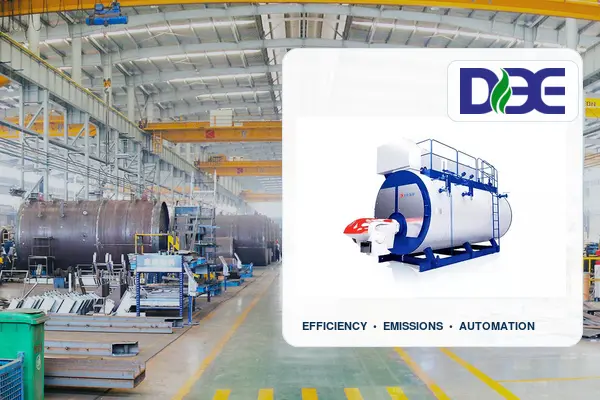
Industrial boiler procurement in 2026 is increasingly influenced by lifecycle efficiency, emissions compliance, fuel flexibility, automation and operating cost—not simply the initial equipment price.
For industrial buyers, this changes the questions that need to be asked before a boiler is ordered.
A quoted efficiency figure is no longer enough without knowing the operating conditions behind it. An emissions promise has limited value unless it corresponds to the regulations at the installation site. A PLC-controlled boiler is not necessarily a “smart boiler” unless its sensors, data, alarms and remote-access functions support the plant’s actual operating strategy.
The wider industrial energy market is changing as well. The International Energy Agency (IEA) reports that industries relying heavily on low-temperature heat and steam account for a significant share of global industrial energy consumption. It also identifies energy efficiency and increasing electrification of industrial heat as important parts of the transition now taking place across multiple markets. IEA – Renewables for Industry
For buyers planning a new steam or hot-water project, five industrial boiler procurement trends deserve particular attention in 2026:
- Real operating efficiency matters more than a single rated-efficiency number.
- Emissions requirements are moving earlier into the boiler selection process.
- Listrik, biomassa, gas and multi-fuel options are being evaluated against local energy conditions.
- Boiler automation is expanding from basic PLC control to monitoring, analytics and predictive maintenance.
- Total cost of ownership is becoming more useful than purchase price alone.
The result is a more engineering-driven procurement process.
1. What Is Changing in Industrial Boiler Procurement in 2026?
Traditional boiler purchasing often started with three questions:
- How many tons of steam per hour are required?
- What fuel will be used?
- How much does the boiler cost?
Those questions remain important, but they are no longer sufficient.
A better industrial boiler procurement process begins with the plant’s operating profile and ends with lifecycle performance.
Modern buyers increasingly need to evaluate:
- average and peak steam demand;
- required pressure and temperature;
- load fluctuations;
- fuel availability and future fuel risks;
- real operating efficiency;
- persyaratan emisi;
- kondisi air umpan;
- automation requirements;
- Peralatan tambahan;
- installation and commissioning;
- certification;
- suku cadang;
- maintenance capability;
- supplier technical support;
- and total lifetime cost.
This creates an important distinction.
A boiler should not be selected simply because it can produce the required maximum steam capacity. It should be selected because the complete boiler system can meet the plant’s real load profile efficiently, safely and reliably.
| Procurement Factor |
Traditional Focus |
2026 Procurement Focus |
| Harga |
Initial equipment price |
Total lifecycle cost |
| Kapasitas |
Maximum t/h |
Rata-rata, peak and minimum load |
| Efisiensi |
Rated efficiency |
Efficiency under actual conditions |
| Emisi |
General compliance |
Installation-market requirements |
| Kontrol |
Basic PLC |
Plc + monitoring + data + diagnostics |
| Bahan bakar |
Single available fuel |
Biaya, availability and flexibility |
| Pemeliharaan |
Repair after failure |
Preventive and predictive maintenance |
| Supplier |
Equipment delivery |
Engineering and lifecycle support |
This shift from equipment purchasing to performance purchasing is one of the most important industrial boiler procurement trends in 2026.
2. Trend #1: Boiler Efficiency Is Becoming a Procurement Priority
Industrial boiler efficiency has always mattered. What is changing is how sophisticated buyers evaluate it.
The first question should not be:
“What is the efficiency of this boiler?”
A more useful question is:
“Under what load, bahan bakar, suhu air umpan, excess-air level and test method was this efficiency measured?”
Two boilers with apparently similar efficiency ratings may perform very differently once installed.
Rated Efficiency vs. Real Operating Efficiency
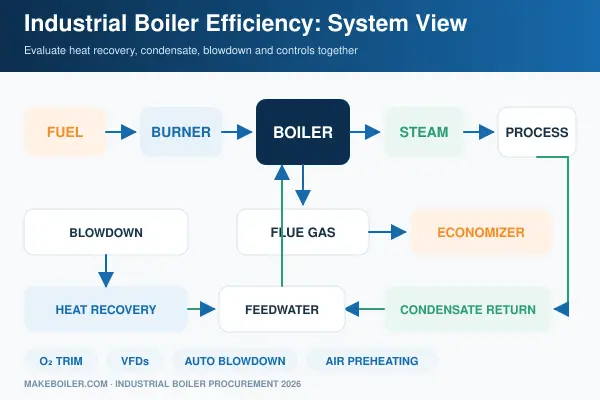
A boiler operates as part of a steam system rather than as an isolated piece of equipment.
Real fuel consumption can be affected by:
- burner modulation;
- excess combustion air;
- flue-gas temperature;
- suhu air umpan;
- pengembalian kondensat;
- blowdown;
- isolasi;
- fouling or scaling;
- steam leakage;
- short cycling;
- variasi beban;
- economizer performance;
- and operator settings.
AS. Department of Energy’s steam-system guidance treats efficiency as a system-level issue and identifies measures such as combustion optimization, kontrol blowdown otomatis, pengembalian kondensat, short-cycling reduction and waste-heat recovery as potential improvement opportunities. KITA. Department of Energy – Steam Systems
That is an important lesson for procurement teams: the highest number on a technical datasheet does not automatically produce the lowest operating cost.
Why Boiler Turndown Ratio Matters
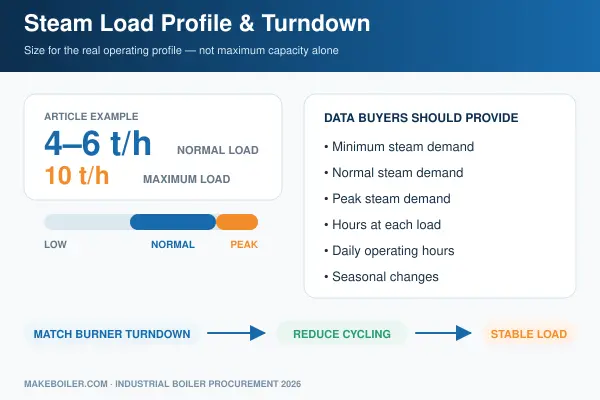
Consider a plant that needs a maximum of 10 t/h of steam.
Its normal production load, Namun, may only be 4–6 t/h, with short periods approaching 10 th.
If the boiler and burner cannot operate effectively at the lower load, the system may cycle repeatedly. Frequent starts and stops can affect pressure stability and increase avoidable operating losses.
For this reason, buyers should provide suppliers with a load profile whenever possible:
- Minimum steam demand
- Normal steam demand
- Permintaan uap puncak
- Hours at each load
- Daily operating hours
- Seasonal changes
This provides much more useful sizing information than maximum capacity alone.
Efficiency Technologies Worth Evaluating
Depending on boiler type, fuel and application, an industrial steam system may benefit from technologies such as:
- penghemat air umpan;
- condensing economizers where technically appropriate;
- pemanasan awal udara pembakaran;
- O₂ trim control;
- penggerak frekuensi variabel;
- kontrol blowdown otomatis;
- pemulihan kondensat;
- pemulihan panas blowdown;
- improved insulation;
- Dan more efficient burners.
Not every technology is appropriate for every project. The correct combination depends on flue-gas conditions, process temperatures, bahan bakar, water chemistry and the expected operating profile.
3. How Should Buyers Compare Industrial Boiler Efficiency?
A reliable comparison requires all suppliers to use comparable assumptions.
The following procurement table can help.
| Parameter |
What the Buyer Should Request |
Why It Matters |
| Rated efficiency |
Test method and operating conditions |
Makes quotations comparable |
| Boiler load |
Efficiency at relevant load points |
Shows part-load performance |
| Fuel specification |
LHV/HHV and fuel properties |
Prevents inconsistent calculations |
| Feedwater temperature |
Temperature used in calculation |
Directly affects heat balance |
| Flue-gas temperature |
Expected stack temperature |
Helps identify heat loss |
| Flue-gas O₂ |
Expected operating level |
Indicates combustion conditions |
| Burner turndown |
Minimum stable firing rate |
Important for variable loads |
| Blowdown |
Expected blowdown basis |
Influences water and heat losses |
| Penghemat |
Included or optional |
Changes recovered heat |
| Auxiliary power |
Penggemar, pumps and controls |
Affects plant energy consumption |
A strong kutipan boiler industri should make these assumptions visible rather than hiding them behind one efficiency percentage.
4. Trend #2: Emissions Are Moving Into the Boiler Selection Process
Industrial boiler emissions can no longer be treated as an issue to investigate only after the equipment has been ordered.
For international projects, the installation country—and sometimes the specific state, province or city—can significantly change the technical requirements.
There Is No Single Global Boiler Emission Limit
A common procurement mistake is asking:
“What is the global NOx standard for industrial boilers?”
There is no single global number that applies to every industrial boiler.
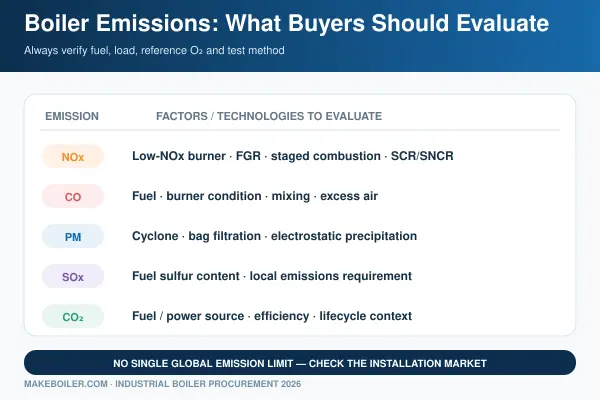
Applicable limits can depend on:
- country;
- local jurisdiction;
- kapasitas ketel;
- bahan bakar;
- process;
- new or existing installation;
- jam operasional;
- and applicable environmental permit.
The United States provides a useful example of why buyers must check the exact regulatory category. EPA requirements for industrial, commercial and institutional boilers distinguish between facility and fuel categories. One area-source rule, Misalnya, addresses boilers burning coal, oil or biomass and covers pollutants including mercury, particulate matter and carbon monoxide; gas-only boilers are treated differently under that specific rule. Other requirements may also apply. KITA. EPA – Industrial, Commercial and Institutional Boilers
Karena itu, an export buyer should identify the applicable local requirement before finalizing the burner, fuel system and emissions-control configuration.
5. Which Boiler Emissions Should Buyers Evaluate?
Nitrogen Oxides (NOx)
NOx formation is strongly influenced by combustion conditions, particularly flame temperature and oxygen availability.
Tergantung pada aplikasinya, reduction strategies may include:
- low-NOx burner design;
- staged combustion;
- flue-gas recirculation (FGR);
- optimized excess air;
- advanced combustion controls;
- or post-combustion treatment where necessary.
The correct solution depends on both the target emission level and the operating conditions.
Carbon Monoxide (CO)
High CO can indicate incomplete combustion or unsuitable burner settings.
Fuel characteristics, burner condition, mixing and excess air can all influence CO formation.
Particulate Matter (PM)
PM is particularly relevant to solid-fuel systems such as biomass and coal boilers.
The overall system may require:
- cyclone separation;
- bag filtration;
- electrostatic precipitation;
- or another dust-control method.
Selection depends on fuel ash characteristics and local emission requirements.
Sulfur Oxides (SOx)
SOx is strongly connected to fuel sulfur content. Fuel specification should therefore be part of both the emissions review and operating-cost analysis.
Carbon Dioxide (CO₂)
Carbon accounting is becoming more relevant to industrial energy planning, particularly for multinational companies and supply chains.
Namun, a low on-site emission level should not automatically be interpreted as low lifecycle emissions. Misalnya, an electric boiler has no combustion emissions at the point of use, but the environmental impact of its electricity depends on the grid or power source.
6. Low-NOx Technologies Buyers Should Understand
| Technology |
Primary Function |
Typical Application |
What to Verify |
| Low-NOx burner |
Reduce NOx formation during combustion |
Gas/oil systems |
Test conditions and guaranteed value |
| Flue Gas Recirculation |
Lower combustion temperature |
Common in gas-fired applications |
FGR ratio and operating range |
| O₂ Trim |
Optimize fuel-air ratio |
Variable-load systems |
Sensor and control strategy |
| Staged Combustion |
Control combustion zones |
Bergantung pada aplikasi |
Burner/furnace compatibility |
| SCR/SNCR |
Post-combustion NOx reduction |
Where stricter control is required |
Reagent/catalyst and operating cost |
| Dust Collection |
Reduce particulate emissions |
Biomass/coal systems |
Required collection performance |
An emissions guarantee should always state its basis.
Buyers should ask:
- What fuel specification was assumed?
- At what boiler load?
- At what reference oxygen level?
- Is the figure measured or calculated?
- What test standard is used?
- Is additional emissions equipment required?
Without these conditions, two emission figures may not be directly comparable.
7. Trend #3: Electrification and Fuel Flexibility Are Changing Boiler Decisions
Industrial heat remains one of the most important energy uses in manufacturing.
IEA analysis published in late 2025 highlights growing interest in the electrification of industrial heat and steam, while emphasizing that energy efficiency should come first. The report also notes that electric boilers are already commercially available, although electricity-to-gas price ratios, grid capacity and connection lead times can limit adoption. IEA – Renewables for Industry
This means the question is not simply:
“Will electric boilers replace fuel-fired boilers?”
The more practical question is:
“Which heat source produces the best technical and economic result at this specific plant?”
Boiler Berbahan Bakar Gas
Gas-fired boilers remain attractive where gas infrastructure is reliable and fuel economics are favorable.
Typical advantages include:
- teknologi pembakar yang matang;
- high automation potential;
- penanganan bahan bakar yang relatif sederhana;
- fast load response;
- compact boiler-room design;
- and compatibility with several heat-recovery technologies.
Buyers should still evaluate gas-price exposure, local emissions requirements and future operating strategy.
For projects evaluating this option, lihat kami gas-fired steam boiler information.
Ketel Uap Listrik
Boiler listrik eliminate on-site combustion and can provide precise control and fast response.
They are particularly interesting where:
- electricity is competitively priced;
- low-carbon electricity is available;
- the site has adequate electrical infrastructure;
- clean local operation is important;
- steam demand is relatively controllable;
- or electric boilers are integrated with other heat sources.
The main procurement question is often not the boiler itself but electrical infrastructure.
A buyer should confirm:
- available grid capacity;
- kapasitas transformator;
- maximum plant demand;
- electricity tariff structure;
- peak-demand charges;
- and potential grid-connection upgrades.
Boiler biomassa
Ketel uap berbahan bakar biomassa can be economically attractive where suitable fuel is abundant and consistently available.
Namun, the boiler cannot be selected correctly without understanding the fuel.
Important biomass parameters include:
- kelembaban;
- nilai kalori;
- abu;
- ukuran partikel;
- kepadatan massal;
- kontaminan;
- and seasonal variation.
Fuel handling, penyimpanan, feeding, ash removal and dust control also become part of the boiler project.
A low biomass fuel price means little if poor fuel quality reduces useful output or creates excessive maintenance.
Dual-Fuel and Multi-Fuel Systems
Fuel flexibility can reduce exposure to supply interruptions or price changes.
But additional flexibility also creates additional complexity.
When comparing a dual-fuel configuration, buyers should consider:
- burner capability;
- persyaratan penyimpanan;
- changeover procedure;
- efficiency on each fuel;
- emission performance on each fuel;
- control logic;
- dan persyaratan pemeliharaan.
8. Gas vs. Electric vs. Biomass Boilers in 2026
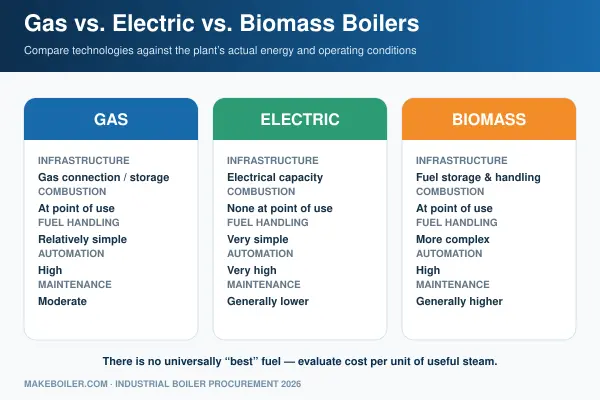
There is no universally “best” industrial boiler fuel.
The correct option depends on the local energy market and production process.
| Faktor |
Boiler gas |
Ketel Listrik |
Ketel Biomassa |
| Infrastruktur Bahan Bakar |
Gas connection/storage |
Electrical capacity |
Penyimpanan bahan bakar & penanganan |
| Point-of-use combustion |
Ya |
TIDAK |
Ya |
| Fuel Handling |
Relatif sederhana |
Sangat sederhana |
Lebih kompleks |
| Otomatisasi |
Tinggi |
Sangat tinggi |
Tinggi |
| Maintenance Complexity |
Sedang |
Umumnya lebih rendah |
Umumnya lebih tinggi |
| Fuel-price Exposure |
pasar gas |
Pasar listrik |
Rantai pasokan biomassa |
| Part-load Control |
Strong with correct burner |
Kuat |
System-dependent |
| Emissions Equipment |
Bergantung pada pasar |
No combustion control |
Seringkali lebih luas |
| Aplikasi Terbaik |
Penggunaan industri yang luas |
Suitable power economics/clean operation |
Reliable low-cost biomass supply |
Instead of asking suppliers which fuel is “best,” calculate the expected cost per unit of useful steam under the plant’s actual conditions.
9. Trend #4: Boiler Automation Is Moving Beyond Basic PLC Control
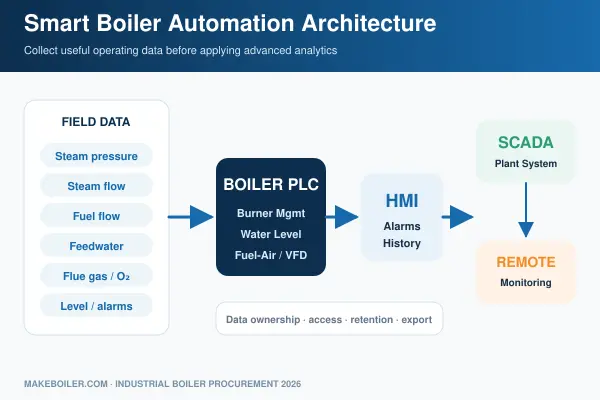
A PLC is now common in modern industrial boiler systems, but installing a PLC does not automatically make a boiler intelligent.
The important question is what the control system can measure, record and optimize.
A modern automation architecture may integrate:
- boiler PLC;
- burner management;
- water-level control;
- fuel-air control;
- pompa air umpan;
- VFDs;
- pressure sensors;
- steam-flow measurement;
- fuel metering;
- flue-gas sensors;
- peralatan pengolahan air;
- riwayat alarm;
- HMI;
- plant SCADA;
- and remote monitoring.
From Automatic Operation to Data-Driven Operation
The next stage is using operating data to improve decisions.
Misalnya, historical data can reveal:
- increasing stack temperature;
- abnormal fuel consumption;
- unstable O₂;
- frequent burner cycling;
- declining heat-transfer performance;
- unusual feedwater demand;
- and recurring alarm patterns.
These signals can support condition-based and predictive maintenance.
Industrial automation organizations are also paying more attention to AI, digital twins, predictive maintenance and real-time optimization, while stressing the importance of data quality, reliability and cybersecurity. International Society of Automation
The practical lesson for boiler buyers is straightforward: collect useful operating data before trying to apply advanced analytics.
10. What Should a Smart Boiler Control System Monitor?
| Data Point |
Procurement Value |
| Tekanan uap |
Monitor process stability |
| Steam flow |
Measure real demand |
| Fuel flow |
Track energy consumption |
| Feedwater flow |
Support mass/energy balance |
| Feedwater temperature |
Evaluate thermal conditions |
| Flue-gas temperature |
Detect heat-loss changes |
| Stack O₂ |
Monitor combustion |
| Water level |
Essential operational/safety parameter |
| Blowdown |
Track water and energy loss |
| Burner firing rate |
Understand load behavior |
| Alarm history |
Diagnose recurring faults |
| Jam operasional |
Plan maintenance |
Sebelum memesan pemantauan jarak jauh, buyers should also specify who owns the data, how long it is retained, who can access it and whether data can be exported.
11. Cybersecurity Is Becoming Part of Boiler Automation
Connecting a boiler control system to a plant network or remote service platform creates operational advantages—but also introduces another procurement question: who can access the system?
Remote access should be designed rather than improvised.
Buyers may need to consider:
- role-based user permissions;
- secure remote connections;
- network segmentation;
- password management;
- change logging;
- software backups;
- recovery procedures;
- firmware update responsibility;
- and coordination with the plant’s OT security policy.
A useful question to include in a tender is:
“If the supplier can remotely access the boiler PLC, who authorizes that connection, how is it secured, and can the plant disable remote access?”
Cybersecurity requirements should be agreed before commissioning, not discovered afterward.
12. Trend #5: Total Cost of Ownership Is Replacing Lowest-Price Procurement
The lowest boiler quotation is not necessarily the lowest-cost boiler.
For many industrial steam projects, fuel consumed during operation can become far more significant than the initial price difference between two boiler configurations.
A useful procurement model is:
10-Year Boiler TCO = Equipment + Bahan bakar + Listrik + Air + Chemicals + Pemeliharaan + Suku cadang + Emissions Compliance + Downtime + Installation − Recoverable Energy Savings
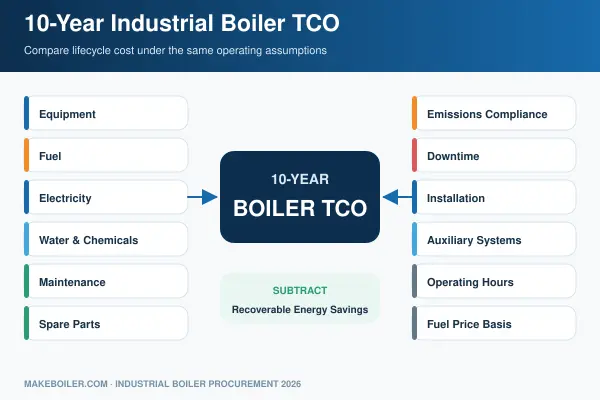
The precise model will vary by project, but the principle is valuable.
What Should Be Included in Boiler TCO?
1. Biaya Peralatan
Include the boiler plus necessary auxiliary systems.
A quotation that excludes major auxiliary equipment can look artificially inexpensive.
2. Biaya Bahan Bakar
Calculate from expected load rather than nameplate capacity alone.
Menggunakan:
- annual operating hours;
- average steam load;
- expected boiler efficiency;
- fuel heating value;
- and local fuel price.
3. Listrik
Consider pumps, penggemar, penanganan bahan bakar, water treatment and emissions-control equipment—not only the boiler control cabinet.
4. Water and Chemicals
Kualitas air umpan, condensate recovery and blowdown strategy affect both water and chemical consumption.
5. Maintenance and Spare Parts
Compare expected:
- burner service;
- refractory work;
- tube cleaning;
- water-side cleaning;
- sensor replacement;
- valve maintenance;
- and recommended spare-parts inventory.
6. Downtime
For critical production processes, one hour without steam may cost more than a small difference in boiler efficiency.
Reliability and redundancy should therefore be included in the procurement discussion.
13. What Information Should Buyers Provide Before Requesting a Boiler Quote?
A manufacturer cannot correctly size an industrial boiler from “I need a steam boiler” atau “I need 10 ton” alone.
For a useful engineering quotation, provide at least:
- Required steam capacity
- Minimum, normal and maximum steam demand
- Tekanan uap
- Suhu uap yang dibutuhkan
- Jenis dan spesifikasi bahan bakar
- Jam operasional per hari
- Hari operasional per tahun
- Feedwater temperature
- Kualitas air umpan
- Expected condensate-return rate
- Negara instalasi
- Persyaratan emisi lokal
- Industry and process application
- Sertifikasi yang diperlukan
- Listrik yang tersedia
- Site altitude and ambient conditions where relevant
- Space or transport limitations
- Tanggal pengiriman yang diperlukan
Providing this information early allows suppliers to compare configurations rather than simply quote equipment.
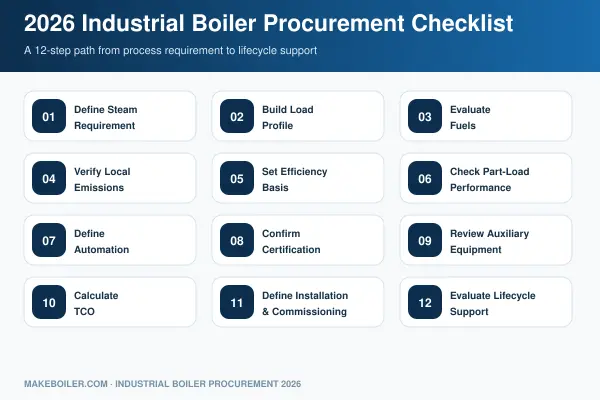
14. 2026 Industrial Boiler Procurement Checklist
Melangkah 1: Define the Process Steam Requirement
Determine capacity, tekanan, temperature and steam-quality requirements.
Melangkah 2: Build a Load Profile
Identify minimum, normal and peak demand.
Melangkah 3: Evaluate Available Fuels
Compare price, keandalan, infrastruktur, storage and future availability.
Melangkah 4: Verify Local Emissions Requirements
Obtain the applicable requirements for the actual installation location.
Melangkah 5: Establish Efficiency Requirements
Define the test basis rather than simply asking for the highest percentage.
Melangkah 6: Evaluate Part-Load Performance
Review burner modulation and turndown against the plant load profile.
Melangkah 7: Define Automation
Specify required measurements, alarms, PLC/SCADA integration and remote monitoring.
Melangkah 8: Confirm Certification Requirements
Asme, CE or other certifications should only be specified after checking what applies to the destination and project.
The certificate scope should also match the equipment being supplied.
Melangkah 9: Review Auxiliary Equipment
This may include:
- pengolahan air;
- deaerator;
- pompa air umpan;
- penghemat;
- cerobong asap;
- sistem bahan bakar;
- blowdown system;
- sistem kondensat;
- and emissions equipment.
Melangkah 10: Calculate Total Cost of Ownership
Compare realistic annual operating costs under the same assumptions.
Melangkah 11: Define Installation and Commissioning Responsibility
Specify what the supplier, local contractor and buyer are each responsible for.
Melangkah 12: Evaluate Lifecycle Support
Ask about training, suku cadang, remote support, documentation and service after commissioning.
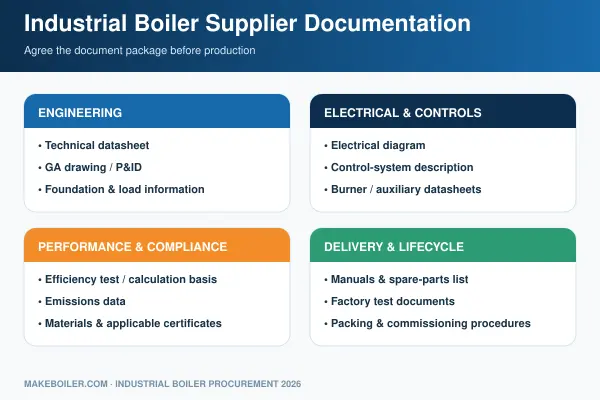
15. What Documents Should an Industrial Boiler Supplier Provide?
Documentation is an important part of international industrial boiler procurement.
Depending on project scope, buyers should request appropriate documents such as:
- technical datasheet;
- general arrangement drawing;
- process flow diagram;
- P&ID where applicable;
- foundation/load information;
- electrical diagram;
- control-system description;
- burner datasheet;
- auxiliary-equipment datasheets;
- efficiency calculation/test basis;
- emissions data;
- material information;
- applicable certificates;
- installation instructions;
- operating manual;
- maintenance manual;
- recommended spare-parts list;
- factory test documents;
- packing list;
- and commissioning procedures.
The exact document package should be agreed before production.
16. Industrial Boiler Procurement Priorities by Industry
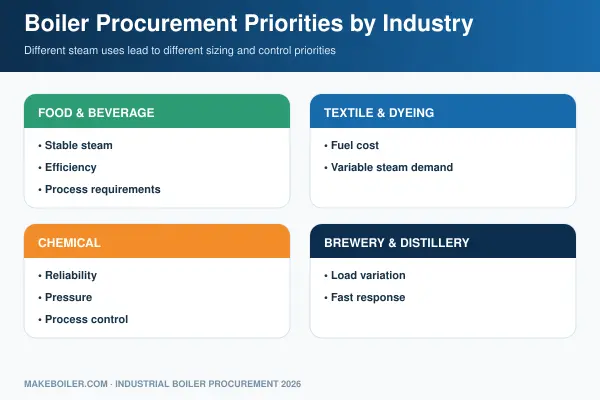
Different industries use steam differently.
| Industri |
Typical Procurement Priority |
| Makanan & Minuman |
Stable steam, efficiency and process requirements |
| Tekstil & Pencelupan |
Fuel cost and variable steam demand |
| Kimia |
Keandalan, pressure and process control |
| Farmasi |
Steam quality, control and documentation |
| Brewery & Distillery |
Load variation and fast response |
| Bubur & Kertas |
Large continuous steam demand |
| Building/Heating |
Seasonal efficiency and modulation |
| Manufaktur |
Keandalan, automation and operating cost |
Industry is therefore not merely a marketing category. It affects sizing, control strategy and auxiliary-system design.
17. Industrial Boiler Procurement Red Flags in 2026
A procurement team should investigate further if a quotation contains any of the following:
1. Efisiensi Tanpa Kondisi Pengujian
A percentage without its calculation basis is difficult to compare.
2. Emissions Guaranteed Without Operating Conditions
Minta bahan bakar, memuat, reference conditions and test method.
3. Ukuran Hanya Berdasarkan Kapasitas Maksimum
The supplier should understand the load profile.
4. Unclear Certification Scope
Confirm which manufacturer, equipment and pressure components the certificate actually covers.
5. Missing Auxiliary Equipment
Determine what is included and excluded.
6. No Feedwater Requirements
Water chemistry affects reliability, efficiency and boiler life.
7. No Commissioning Responsibility Matrix
International projects need clear responsibility boundaries.
8. No Spare-Parts Plan
Remote installations should consider critical spares before shipment.
9. “Smart Boiler” Without a Data List
Ask exactly what parameters are measured, stored and accessible.
10. An Extremely Low Price With Unclear Exclusions
Compare scope before comparing price.
18. An Evidence-First Framework for Industrial Boiler Procurement
One of the simplest ways to improve boiler purchasing decisions is to replace marketing claims with evidence.
| Supplier Claim |
Evidence the Buyer Should Request |
| “Efisiensi tinggi” |
Test basis, load and operating conditions |
| “Low NOx” |
Guaranteed value, reference conditions and test basis |
| “Smart control” |
I/O list, control narrative and monitoring functions |
| “Biaya operasional rendah” |
Calculation assumptions and TCO model |
| “Certified” |
Certificate, scope and equipment applicability |
| “Pemeliharaan yang mudah” |
Maintenance schedule and spare-parts list |
| “Global service” |
Actual service scope and responsibility |
| “Fast installation” |
Project schedule and interface requirements |
This evidence-first approach makes competing industrial boiler proposals easier to compare and reduces procurement risk.
19. What Will Industrial Boiler Procurement Look Like Beyond 2026?
Several current developments are likely to continue influencing industrial boiler projects through the rest of the decade.
More System-Level Efficiency
Boiler-room optimization will increasingly consider the burner, ketel, water system, pemulihan panas, condensate and process demand together.
Greater Electrification Where Economics Support It
Electric boilers and other industrial heat technologies are likely to gain more attention where electricity prices, grid capacity and carbon objectives make the business case attractive.
This does not mean combustion boilers disappear. It means buyers have more technologies to compare.
More Operational Data
Steam flow, aliran bahan bakar, temperatures, emissions-related parameters and alarms can increasingly become part of an integrated plant energy-management system.
More Predictive Maintenance
The shift from fixed maintenance intervals toward condition-based decisions is likely to continue as useful data becomes easier to collect.
More Attention to Lifecycle Service
For overseas projects especially, pelatihan, remote troubleshooting, spare-parts planning and commissioning support can become more important selection criteria.
The direction is clear: industrial boiler procurement is becoming less about purchasing a pressure vessel and more about selecting a complete energy, control and lifecycle-support system.
Frequently Asked Questions About Industrial Boiler Procurement in 2026
What is the most important industrial boiler procurement trend in 2026?
One of the most important trends is the shift from initial purchase price toward lifecycle performance. Buyers increasingly need to compare real operating efficiency, load flexibility, biaya bahan bakar, persyaratan emisi, otomatisasi, maintenance and technical support. A boiler with a higher initial price may deliver a lower total cost if it better matches the plant’s actual steam demand and operating conditions.
What boiler efficiency should buyers look for in 2026?
There is no single efficiency number suitable for every industrial boiler project. Efficiency depends on boiler design, bahan bakar, memuat, suhu air umpan, combustion conditions and heat-recovery equipment. Buyers should ask suppliers to provide the efficiency test or calculation basis and compare all proposals using the same operating assumptions.
How should industrial boiler efficiency be compared?
Compare efficiency using the same fuel basis, boiler load, feedwater temperature and calculation or test method. Also evaluate burner turndown, flue-gas temperature, O₂ level, economizer configuration, condensate recovery and blowdown. These factors can influence actual annual fuel consumption even when two boilers have similar rated efficiencies.
What emissions should industrial boiler buyers consider?
Depending on the fuel and local regulations, relevant emissions may include NOx, CO, materi partikulat, SOx and other regulated pollutants. Requirements vary significantly by country and jurisdiction, so buyers should confirm the applicable local permit or standard before selecting the burner and emissions-control system.
What is a low-NOx industrial boiler?
A low-NOx industrial boiler uses combustion or emissions-control technologies designed to reduce nitrogen oxide formation or release. Possible measures include low-NOx burners, staged combustion, flue-gas recirculation and, for certain applications, post-combustion treatment. The actual guaranteed NOx level should always state the fuel, load and reference test conditions.
Is an electric boiler better than a gas boiler in 2026?
Not universally. Electric boilers eliminate on-site combustion and offer strong controllability, but economics depend heavily on electricity prices, demand charges and available electrical infrastructure. Gas-fired boilers may remain more economical in markets with favorable gas pricing. The correct comparison should use cost per unit of useful steam under the plant’s actual load.
What automation features should an industrial boiler include?
Minimal, automation should safely control critical boiler functions such as burner operation, pressure and water level. More advanced systems may monitor steam flow, konsumsi bahan bakar, flue-gas temperature, O₂, air umpan, alarms and operating history. The correct level of automation depends on process criticality and plant integration requirements.
How do I calculate the total cost of ownership of an industrial boiler?
Include equipment, bahan bakar, listrik, air, bahan kimia, pemeliharaan, suku cadang, emissions compliance, installation and expected downtime over the evaluation period. Subtract credible energy savings or recovered heat where appropriate. Use the same production and fuel-price assumptions when comparing different boiler proposals.
What information is required to size an industrial steam boiler?
A supplier should know the required steam capacity, minimum/normal/peak load, tekanan, suhu, bahan bakar, operating schedule, kondisi air umpan, pengembalian kondensat, installation location, emissions requirements and process application. A real load profile is especially valuable because maximum capacity alone does not describe how the boiler will operate.
How should I compare industrial boiler manufacturers?
Compare more than price. Evaluate engineering capability, manufacturing quality, ruang lingkup sertifikasi, documented performance, otomatisasi, project references, ketersediaan suku cadang, commissioning support and after-sales service. Require each supplier to explain efficiency, emissions and operating-cost claims under clearly defined conditions.
Kesimpulan: How to Make a Smarter Industrial Boiler Investment in 2026
The best industrial boiler in 2026 is not automatically the boiler with the highest quoted efficiency or the lowest purchase price.
A successful project begins with the plant itself.
How much steam is actually required? How does demand change during the day? Which fuels are locally available? What emissions rules apply? How reliable is the electrical infrastructure? How important is remote monitoring? What happens if the boiler stops production? Who will commission and maintain the equipment?
Answering these questions creates the foundation for a better industrial boiler procurement decision.
The strongest purchasing strategy is therefore an evidence-based one:
Define the load → verify local requirements → compare fuel options → evaluate real efficiency → define automation → calculate TCO → verify supplier evidence → plan installation and lifecycle support.
If you are planning an industrial steam project, prepare the following five parameters first:
kapasitas uap, tekanan kerja, bahan bakar, daily operating hours and installation country.
With these inputs, an engineering team can move beyond a generic quotation and begin evaluating a boiler configuration that matches the actual process.
Authoritative References




View Ulasan Pelanggan kami
"Peralatan bantu Fangkuai telah membuat sistem ketel saya menjadi lebih baik. Kualitas peralatannya luar biasa dan harganya sangat masuk akal. Peralatan tersebut telah membantu meningkatkan efisiensi dan kinerja sistem ketel saya, yang telah menyebabkan penghematan biaya yang signifikan. Saya sangat merekomendasikan peralatan bantu Fangkuai kepada siapa pun yang membutuhkan aksesori boiler berkualitas tinggi."
Maryk
Inggris"Saya membeli ketel uap Fangkuai untuk pabrik saya dan telah berfungsi dengan sempurna selama berbulan-bulan sekarang. Kualitas bahan dan konstruksi boiler sangat mengesankan. Ini juga sangat hemat energi, yang telah membantu kami menghemat uang untuk tagihan energi kami. Saya sangat merekomendasikan produk Fangkuai kepada siapa pun yang membutuhkan solusi pemanasan yang andal dan efisien."
Yohanes
Amerika Serikat"Ketel air panas dari Fangkuai luar biasa. Ini memanas dengan cepat dan efisien, dan airnya tetap panas untuk waktu yang lama. Kami tidak pernah mengalami masalah apa pun dengannya dan ini telah memberikan kemajuan yang signifikan dalam operasional kami sehari-hari. Proses instalasi juga sangat lancar dan layanan pelanggan sangat baik. Saya sangat merekomendasikan boiler air panas Fangkuai."
Sarah
Kanada"Saya membeli ketel uap Fangkuai untuk pabrik saya dan telah berfungsi dengan sempurna selama berbulan-bulan sekarang. Kualitas bahan dan konstruksi boiler sangat mengesankan. Ini juga sangat hemat energi, yang telah membantu kami menghemat uang untuk tagihan energi kami. Saya sangat merekomendasikan produk Fangkuai kepada siapa pun yang membutuhkan solusi pemanasan yang andal dan efisien."
Yohanes
Amerika Serikat"Steam boiler dari Fangkuai sangat cocok untuk usaha pengolahan makanan saya. Ini memenuhi semua persyaratan kami dan sangat dapat diandalkan. Kualitas bahan dan konstruksi boiler luar biasa. Pengoperasian dan pemeliharaannya juga sangat mudah, yang telah membantu kami menghemat waktu dan uang untuk pemeliharaan. Saya sangat merekomendasikan ketel uap Fangkuai kepada siapa pun yang membutuhkan solusi pemanasan yang andal."
Jason
Brazil"Peralatan bantu Fangkuai telah membuat sistem ketel saya menjadi lebih baik. Kualitas peralatannya luar biasa dan harganya sangat masuk akal. Peralatan tersebut telah membantu meningkatkan efisiensi dan kinerja sistem ketel saya, yang telah menyebabkan penghematan biaya yang signifikan. Saya sangat merekomendasikan peralatan bantu Fangkuai kepada siapa pun yang membutuhkan aksesori boiler berkualitas tinggi."
Maryk
Inggris"Layanan pelanggan di Fangkuai adalah yang terbaik. Mereka membantu saya memilih boiler yang sempurna untuk kebutuhan saya dan memberikan dukungan yang luar biasa selama proses berlangsung. Proses pemasangannya juga sangat lancar dan ketelnya melebihi ekspektasi saya. Sangat mudah digunakan dan dirawat, dan efisiensi energinya luar biasa. Saya sangat merekomendasikan produk Fangkuai kepada siapa pun yang membutuhkan solusi pemanasan yang andal dan efisien."
Juan
Meksiko"Steam boiler dari Fangkuai sangat cocok untuk usaha pengolahan makanan saya. Ini memenuhi semua persyaratan kami dan sangat dapat diandalkan. Kualitas bahan dan konstruksi boiler luar biasa. Pengoperasian dan pemeliharaannya juga sangat mudah, yang telah membantu kami menghemat waktu dan uang untuk pemeliharaan. Saya sangat merekomendasikan ketel uap Fangkuai kepada siapa pun yang membutuhkan solusi pemanasan yang andal."
Jason
Brazil"Peralatan bantu Fangkuai telah membuat sistem ketel saya menjadi lebih baik. Kualitas peralatannya luar biasa dan harganya sangat masuk akal. Peralatan tersebut telah membantu meningkatkan efisiensi dan kinerja sistem ketel saya, yang telah menyebabkan penghematan biaya yang signifikan. Saya sangat merekomendasikan peralatan bantu Fangkuai kepada siapa pun yang membutuhkan aksesori boiler berkualitas tinggi."
Maryk
Inggris