Industrial boiler procurement in 2026 is increasingly influenced by lifecycle efficiency, emissions compliance, fuel flexibility, automation and operating cost—not simply the initial equipment price.
For industrial buyers, this changes the questions that need to be asked before a boiler is ordered.
A quoted efficiency figure is no longer enough without knowing the operating conditions behind it. An emissions promise has limited value unless it corresponds to the regulations at the installation site. A PLC-controlled boiler is not necessarily a “smart boiler” unless its sensors, data, alarms and remote-access functions support the plant’s actual operating strategy.
The wider industrial energy market is changing as well. The International Energy Agency (IEA) reports that industries relying heavily on low-temperature heat and steam account for a significant share of global industrial energy consumption. It also identifies energy efficiency and increasing electrification of industrial heat as important parts of the transition now taking place across multiple markets. IEA – Renewables for Industry
For buyers planning a new steam or hot-water project, five industrial boiler procurement trends deserve particular attention in 2026:
The result is a more engineering-driven procurement process.
Traditional boiler purchasing often started with three questions:
Those questions remain important, but they are no longer sufficient.
A better industrial boiler procurement process begins with the plant’s operating profile and ends with lifecycle performance.
Modern buyers increasingly need to evaluate:
This creates an important distinction.
A boiler should not be selected simply because it can produce the required maximum steam capacity. It should be selected because the complete boiler system can meet the plant’s real load profile efficiently, safely and reliably.
| Procurement Factor | Traditional Focus | 2026 Procurement Focus |
|---|---|---|
| Ціна | Initial equipment price | Total lifecycle cost |
| Ємність | Maximum t/h | Середній, peak and minimum load |
| Ефективність | Rated efficiency | Efficiency under actual conditions |
| Викиди | General compliance | Installation-market requirements |
| Елементи керування | Basic PLC | PLC + monitoring + data + diagnostics |
| паливо | Single available fuel | Вартість, availability and flexibility |
| Технічне обслуговування | Repair after failure | Preventive and predictive maintenance |
| Supplier | Equipment delivery | Engineering and lifecycle support |
This shift from equipment purchasing to performance purchasing is one of the most important industrial boiler procurement trends in 2026.
Industrial boiler efficiency has always mattered. What is changing is how sophisticated buyers evaluate it.
The first question should not be:
“What is the efficiency of this boiler?”
A more useful question is:
“Under what load, пальне, температура живильної води, excess-air level and test method was this efficiency measured?”
Two boilers with apparently similar efficiency ratings may perform very differently once installed.
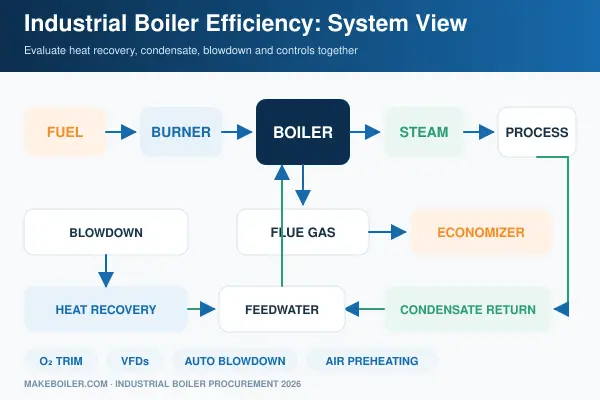
A boiler operates as part of a steam system rather than as an isolated piece of equipment.
Real fuel consumption can be affected by:
США. Department of Energy’s steam-system guidance treats efficiency as a system-level issue and identifies measures such as combustion optimization, automatic blowdown control, повернення конденсату, short-cycling reduction and waste-heat recovery as potential improvement opportunities. США. Департамент енергетики – Парові системи
That is an important lesson for procurement teams: the highest number on a technical datasheet does not automatically produce the lowest operating cost.
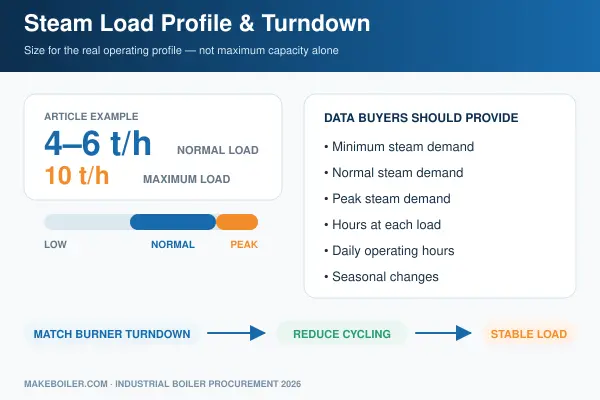
Consider a plant that needs a maximum of 10 t/h of steam.
Its normal production load, однак, may only be 4–6 t/h, with short periods approaching 10 т/год.
If the boiler and burner cannot operate effectively at the lower load, the system may cycle repeatedly. Frequent starts and stops can affect pressure stability and increase avoidable operating losses.
З цієї причини, buyers should provide suppliers with a load profile whenever possible:
This provides much more useful sizing information than maximum capacity alone.
Depending on boiler type, fuel and application, an industrial steam system may benefit from technologies such as:
Not every technology is appropriate for every project. The correct combination depends on flue-gas conditions, process temperatures, пальне, water chemistry and the expected operating profile.
A reliable comparison requires all suppliers to use comparable assumptions.
The following procurement table can help.
| Parameter | What the Buyer Should Request | Why It Matters |
|---|---|---|
| Rated efficiency | Test method and operating conditions | Makes quotations comparable |
| Boiler load | Efficiency at relevant load points | Shows part-load performance |
| Fuel specification | LHV/HHV and fuel properties | Prevents inconsistent calculations |
| Feedwater temperature | Temperature used in calculation | Directly affects heat balance |
| Flue-gas temperature | Expected stack temperature | Helps identify heat loss |
| Flue-gas O₂ | Expected operating level | Indicates combustion conditions |
| Burner turndown | Minimum stable firing rate | Important for variable loads |
| Blowdown | Expected blowdown basis | Influences water and heat losses |
| Економник | Included or optional | Changes recovered heat |
| Auxiliary power | вболівальники, pumps and controls | Affects plant energy consumption |
A strong пропозиція промислових котлів should make these assumptions visible rather than hiding them behind one efficiency percentage.
Industrial boiler emissions can no longer be treated as an issue to investigate only after the equipment has been ordered.
For international projects, the installation country—and sometimes the specific state, province or city—can significantly change the technical requirements.
A common procurement mistake is asking:
“What is the global NOx standard for industrial boilers?”
There is no single global number that applies to every industrial boiler.
Applicable limits can depend on:
The United States provides a useful example of why buyers must check the exact regulatory category. EPA requirements for industrial, commercial and institutional boilers distinguish between facility and fuel categories. One area-source rule, наприклад, addresses boilers burning coal, oil or biomass and covers pollutants including mercury, particulate matter and carbon monoxide; gas-only boilers are treated differently under that specific rule. Other requirements may also apply. США. EPA – Промисловий, Commercial and Institutional Boilers
тому, an export buyer should identify the applicable local requirement before finalizing the burner, fuel system and emissions-control configuration.
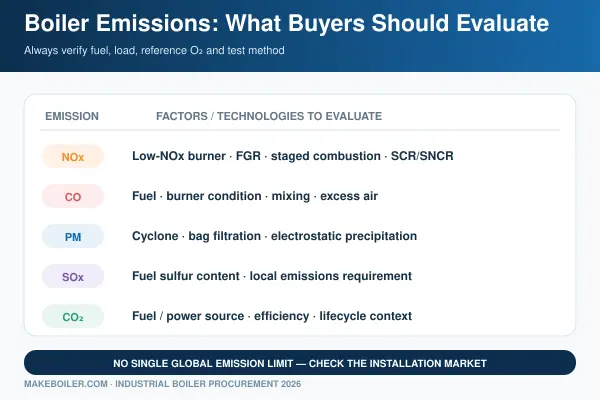
NOx formation is strongly influenced by combustion conditions, particularly flame temperature and oxygen availability.
Залежно від застосування, reduction strategies may include:
The correct solution depends on both the target emission level and the operating conditions.
High CO can indicate incomplete combustion or unsuitable burner settings.
Fuel characteristics, burner condition, mixing and excess air can all influence CO formation.
PM is particularly relevant to solid-fuel systems such as biomass and coal boilers.
The overall system may require:
Selection depends on fuel ash characteristics and local emission requirements.
SOx is strongly connected to fuel sulfur content. Fuel specification should therefore be part of both the emissions review and operating-cost analysis.
Carbon accounting is becoming more relevant to industrial energy planning, particularly for multinational companies and supply chains.
Проте, a low on-site emission level should not automatically be interpreted as low lifecycle emissions. Наприклад, an electric boiler has no combustion emissions at the point of use, but the environmental impact of its electricity depends on the grid or power source.
| Technology | Primary Function | Typical Application | What to Verify |
|---|---|---|---|
| Low-NOx burner | Reduce NOx formation during combustion | Gas/oil systems | Test conditions and guaranteed value |
| Flue Gas Recirculation | Lower combustion temperature | Common in gas-fired applications | FGR ratio and operating range |
| O₂ Trim | Optimize fuel-air ratio | Variable-load systems | Sensor and control strategy |
| Staged Combustion | Control combustion zones | Application-dependent | Burner/furnace compatibility |
| SCR/SNCR | Post-combustion NOx reduction | Where stricter control is required | Reagent/catalyst and operating cost |
| Dust Collection | Reduce particulate emissions | Biomass/coal systems | Required collection performance |
An emissions guarantee should always state its basis.
Buyers should ask:
Without these conditions, two emission figures may not be directly comparable.
Industrial heat remains one of the most important energy uses in manufacturing.
IEA analysis published in late 2025 highlights growing interest in the electrification of industrial heat and steam, while emphasizing that energy efficiency should come first. The report also notes that electric boilers are already commercially available, although electricity-to-gas price ratios, grid capacity and connection lead times can limit adoption. IEA – Renewables for Industry
This means the question is not simply:
“Will electric boilers replace fuel-fired boilers?”
The more practical question is:
“Which heat source produces the best technical and economic result at this specific plant?”
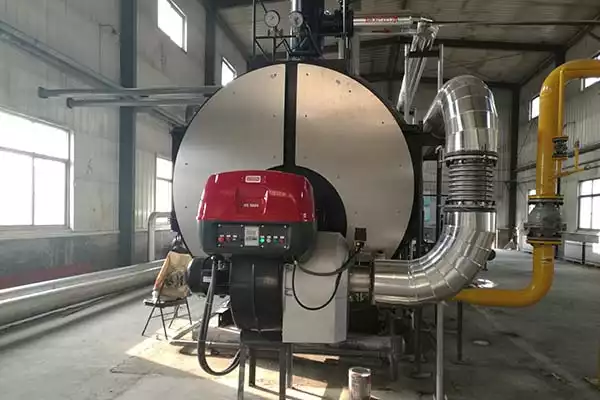
Gas-fired boilers remain attractive where gas infrastructure is reliable and fuel economics are favorable.
Typical advantages include:
Buyers should still evaluate gas-price exposure, local emissions requirements and future operating strategy.
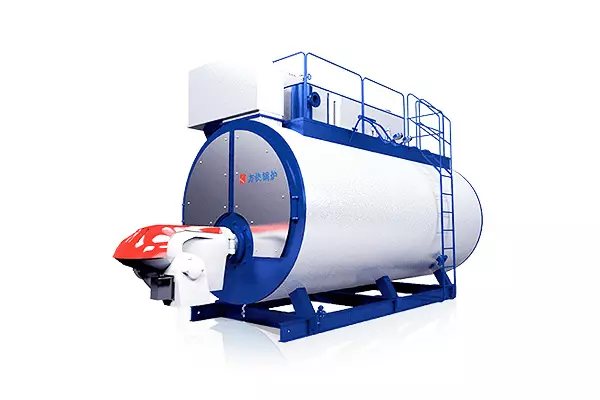
For projects evaluating this option, побачити наш gas-fired steam boiler information.
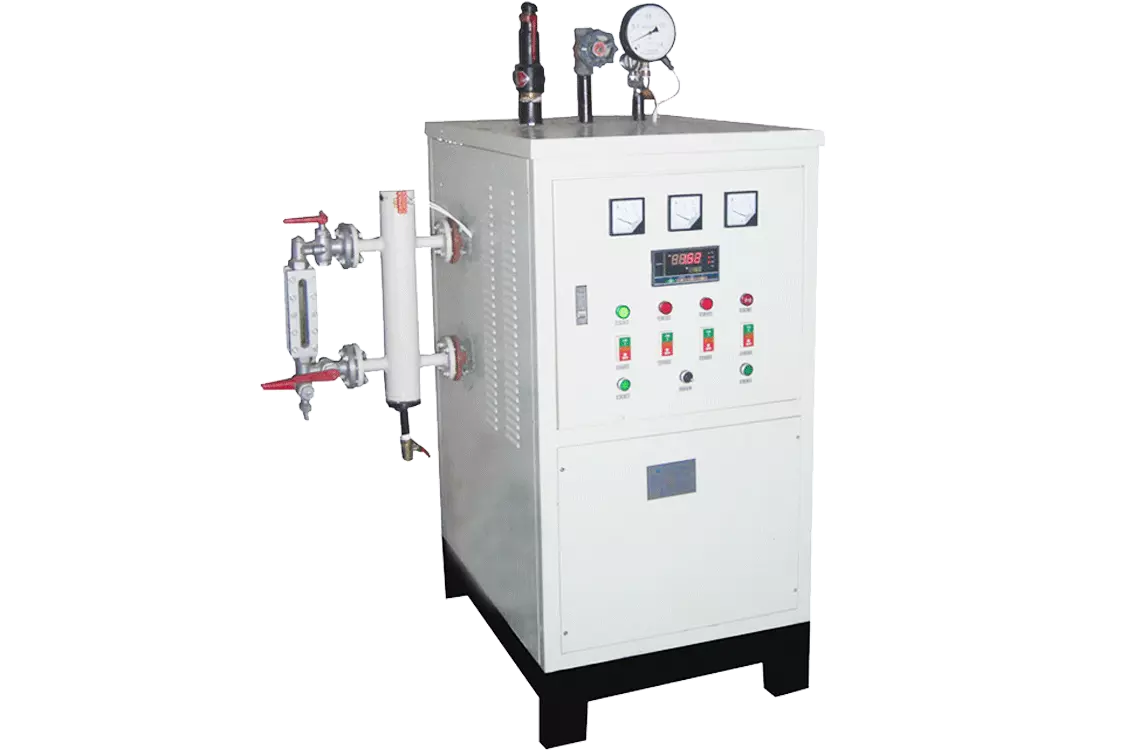
Електричні котли eliminate on-site combustion and can provide precise control and fast response.
They are particularly interesting where:
The main procurement question is often not the boiler itself but electrical infrastructure.
A buyer should confirm:
Biomass-fired steam boilers can be economically attractive where suitable fuel is abundant and consistently available.
Проте, the boiler cannot be selected correctly without understanding the fuel.
Important biomass parameters include:
Fuel handling, зберігання, feeding, ash removal and dust control also become part of the boiler project.
A low biomass fuel price means little if poor fuel quality reduces useful output or creates excessive maintenance.
Fuel flexibility can reduce exposure to supply interruptions or price changes.
But additional flexibility also creates additional complexity.
When comparing a dual-fuel configuration, buyers should consider:
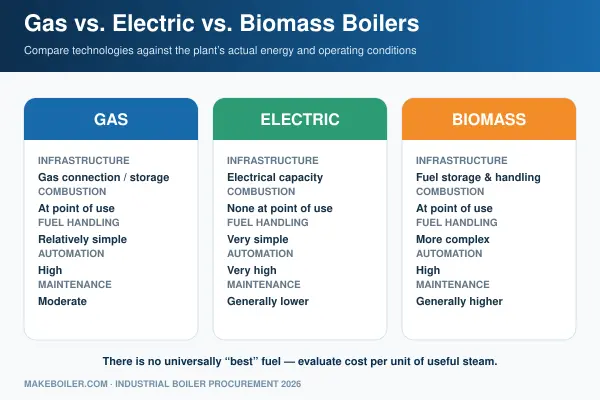
There is no universally “best” industrial boiler fuel.
The correct option depends on the local energy market and production process.
| Фактор | Газовий котел | Електричний котел | Котел на біомасі |
|---|---|---|---|
| Паливна інфраструктура | Gas connection/storage | Electrical capacity | Зберігання палива & поводження |
| Point-of-use combustion | Так | Немає | Так |
| Fuel Handling | Relatively simple | Very simple | Більш складний |
| автоматизація | Високий | Very high | Високий |
| Maintenance Complexity | Помірний | Як правило, нижче | Як правило, вище |
| Fuel-price Exposure | Gas market | Electricity market | Biomass supply chain |
| Part-load Control | Strong with correct burner | Сильний | System-dependent |
| Emissions Equipment | Залежний від ринку | No combustion control | Often more extensive |
| Кращий додаток | Broad industrial use | Suitable power economics/clean operation | Reliable low-cost biomass supply |
Instead of asking suppliers which fuel is “best,” calculate the expected cost per unit of useful steam under the plant’s actual conditions.
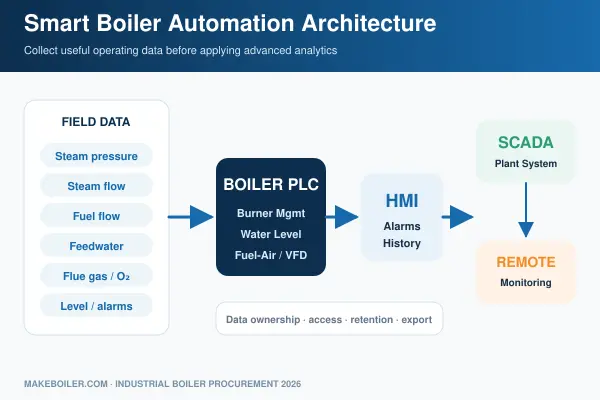
A PLC is now common in modern industrial boiler systems, but installing a PLC does not automatically make a boiler intelligent.
The important question is what the control system can measure, record and optimize.
A modern automation architecture may integrate:
The next stage is using operating data to improve decisions.
Наприклад, historical data can reveal:
These signals can support condition-based and predictive maintenance.
Industrial automation organizations are also paying more attention to AI, digital twins, predictive maintenance and real-time optimization, while stressing the importance of data quality, reliability and cybersecurity. International Society of Automation
The practical lesson for boiler buyers is straightforward: collect useful operating data before trying to apply advanced analytics.
| Data Point | Procurement Value |
|---|---|
| Тиск пари | Monitor process stability |
| Потік пари | Measure real demand |
| Fuel flow | Track energy consumption |
| Feedwater flow | Support mass/energy balance |
| Feedwater temperature | Evaluate thermal conditions |
| Flue-gas temperature | Detect heat-loss changes |
| Stack O₂ | Monitor combustion |
| Water level | Essential operational/safety parameter |
| Blowdown | Track water and energy loss |
| Burner firing rate | Understand load behavior |
| Alarm history | Diagnose recurring faults |
| Operating hours | Plan maintenance |
Before ordering remote monitoring, buyers should also specify who owns the data, how long it is retained, who can access it and whether data can be exported.
Connecting a boiler control system to a plant network or remote service platform creates operational advantages—but also introduces another procurement question: who can access the system?
Remote access should be designed rather than improvised.
Buyers may need to consider:
A useful question to include in a tender is:
“If the supplier can remotely access the boiler PLC, who authorizes that connection, how is it secured, and can the plant disable remote access?”
Cybersecurity requirements should be agreed before commissioning, not discovered afterward.
The lowest boiler quotation is not necessarily the lowest-cost boiler.
For many industrial steam projects, fuel consumed during operation can become far more significant than the initial price difference between two boiler configurations.
A useful procurement model is:
10-Year Boiler TCO = Equipment + паливо + Електрика + вода + Chemicals + Технічне обслуговування + Запчастини + Emissions Compliance + Downtime + Installation − Recoverable Energy Savings
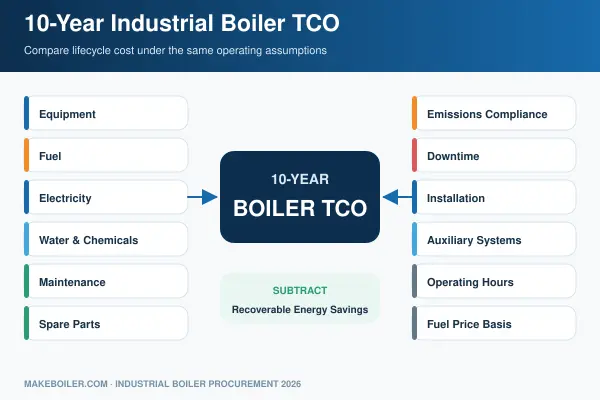
The precise model will vary by project, but the principle is valuable.
Include the boiler plus necessary auxiliary systems.
A quotation that excludes major auxiliary equipment can look artificially inexpensive.
Calculate from expected load rather than nameplate capacity alone.
використання:
Consider pumps, вболівальники, поводження з паливом, water treatment and emissions-control equipment—not only the boiler control cabinet.
Feedwater quality, condensate recovery and blowdown strategy affect both water and chemical consumption.
Compare expected:
For critical production processes, one hour without steam may cost more than a small difference in boiler efficiency.
Reliability and redundancy should therefore be included in the procurement discussion.
A manufacturer cannot correctly size an industrial boiler from “I need a steam boiler” або “I need 10 тонн” alone.
For a useful engineering quotation, provide at least:
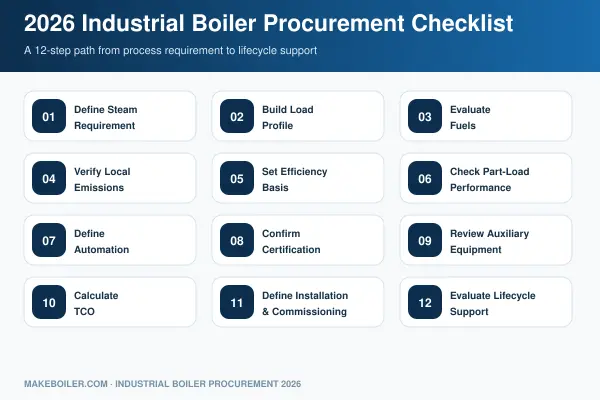
Providing this information early allows suppliers to compare configurations rather than simply quote equipment.
Determine capacity, тиск, temperature and steam-quality requirements.
Identify minimum, normal and peak demand.
Compare price, надійність, infrastructure, storage and future availability.
Obtain the applicable requirements for the actual installation location.
Define the test basis rather than simply asking for the highest percentage.
Review burner modulation and turndown against the plant load profile.
Specify required measurements, сигналізації, PLC/SCADA integration and remote monitoring.
Asme, CE or other certifications should only be specified after checking what applies to the destination and project.
The certificate scope should also match the equipment being supplied.
This may include:
Compare realistic annual operating costs under the same assumptions.
Specify what the supplier, local contractor and buyer are each responsible for.
Ask about training, запчастини, remote support, documentation and service after commissioning.
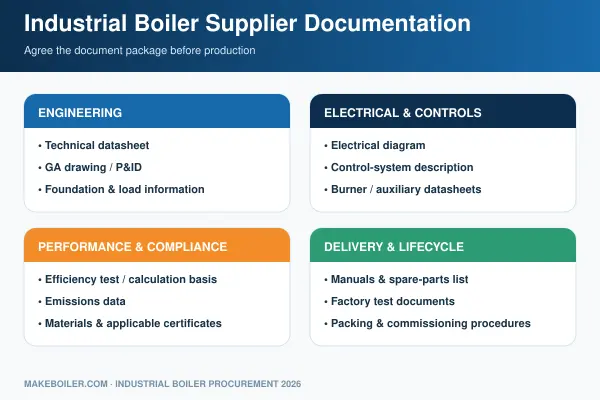
Documentation is an important part of international industrial boiler procurement.
Depending on project scope, buyers should request appropriate documents such as:
The exact document package should be agreed before production.
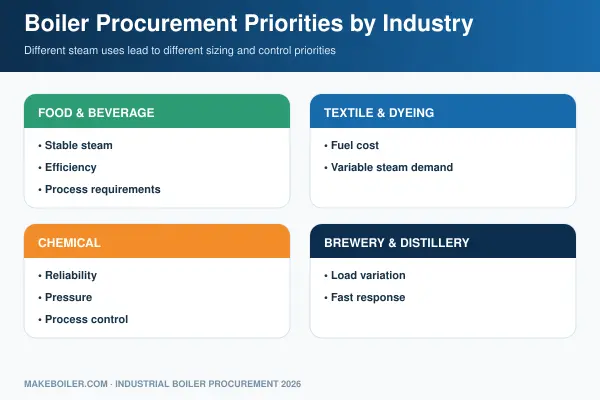
Different industries use steam differently.
| Промисловість | Typical Procurement Priority |
|---|---|
| харчування & Напій | Stable steam, efficiency and process requirements |
| Текстиль & Фарбування | Fuel cost and variable steam demand |
| хімічний | Надійність, pressure and process control |
| Фармацевтичний | Steam quality, control and documentation |
| Brewery & Distillery | Load variation and fast response |
| целюлоза & Папір | Large continuous steam demand |
| Building/Heating | Seasonal efficiency and modulation |
| Виробництво | Надійність, automation and operating cost |
Industry is therefore not merely a marketing category. It affects sizing, control strategy and auxiliary-system design.
A procurement team should investigate further if a quotation contains any of the following:
A percentage without its calculation basis is difficult to compare.
Ask for fuel, навантаження, reference conditions and test method.
The supplier should understand the load profile.
Confirm which manufacturer, обладнання та компоненти тиску, на які фактично поширюється сертифікат.
Визначте, що включено, а що виключено.
Хімічний склад води впливає на надійність, ефективність і термін служби котла.
Міжнародні проекти потребують чітких меж відповідальності.
При дистанційній установці перед відправленням слід враховувати важливі запчастини.
Запитайте, які саме параметри вимірюють, зберігаються та доступні.
Порівняйте обсяг, перш ніж порівнювати ціну.
Один із найпростіших способів покращити рішення про купівлю котла – замінити маркетингові заяви доказами.
| Претензія постачальника | Докази, які має вимагати покупець |
|---|---|
| “Висока ефективність” | Тестова основа, навантаження та умови експлуатації |
| “Низький NOx” | Guaranteed value, reference conditions and test basis |
| “Smart control” | I/O list, control narrative and monitoring functions |
| “Низька експлуатаційна вартість” | Calculation assumptions and TCO model |
| “Certified” | Certificate, scope and equipment applicability |
| “Легке обслуговування” | Maintenance schedule and spare-parts list |
| “Global service” | Actual service scope and responsibility |
| “Fast installation” | Project schedule and interface requirements |
This evidence-first approach makes competing industrial boiler proposals easier to compare and reduces procurement risk.
Several current developments are likely to continue influencing industrial boiler projects through the rest of the decade.
Boiler-room optimization will increasingly consider the burner, котел, water system, рекуперація тепла, condensate and process demand together.
Electric boilers and other industrial heat technologies are likely to gain more attention where electricity prices, grid capacity and carbon objectives make the business case attractive.
This does not mean combustion boilers disappear. It means buyers have more technologies to compare.
Потік пари, витрата палива, temperatures, emissions-related parameters and alarms can increasingly become part of an integrated plant energy-management system.
The shift from fixed maintenance intervals toward condition-based decisions is likely to continue as useful data becomes easier to collect.
For overseas projects especially, навчання, remote troubleshooting, spare-parts planning and commissioning support can become more important selection criteria.
The direction is clear: industrial boiler procurement is becoming less about purchasing a pressure vessel and more about selecting a complete energy, control and lifecycle-support system.
One of the most important trends is the shift from initial purchase price toward lifecycle performance. Buyers increasingly need to compare real operating efficiency, load flexibility, вартість палива, вимоги до викидів, автоматизація, maintenance and technical support. A boiler with a higher initial price may deliver a lower total cost if it better matches the plant’s actual steam demand and operating conditions.
There is no single efficiency number suitable for every industrial boiler project. Efficiency depends on boiler design, пальне, навантаження, температура живильної води, combustion conditions and heat-recovery equipment. Buyers should ask suppliers to provide the efficiency test or calculation basis and compare all proposals using the same operating assumptions.
Compare efficiency using the same fuel basis, навантаження котла, feedwater temperature and calculation or test method. Also evaluate burner turndown, flue-gas temperature, O₂ level, economizer configuration, condensate recovery and blowdown. These factors can influence actual annual fuel consumption even when two boilers have similar rated efficiencies.
Depending on the fuel and local regulations, relevant emissions may include NOx, CO, тверді частинки, SOx and other regulated pollutants. Requirements vary significantly by country and jurisdiction, so buyers should confirm the applicable local permit or standard before selecting the burner and emissions-control system.
A low-NOx industrial boiler uses combustion or emissions-control technologies designed to reduce nitrogen oxide formation or release. Possible measures include low-NOx burners, staged combustion, flue-gas recirculation and, for certain applications, post-combustion treatment. The actual guaranteed NOx level should always state the fuel, load and reference test conditions.
Not universally. Electric boilers eliminate on-site combustion and offer strong controllability, but economics depend heavily on electricity prices, demand charges and available electrical infrastructure. Gas-fired boilers may remain more economical in markets with favorable gas pricing. The correct comparison should use cost per unit of useful steam under the plant’s actual load.
At minimum, automation should safely control critical boiler functions such as burner operation, pressure and water level. More advanced systems may monitor steam flow, ПИТАННЯ Палива, flue-gas temperature, O₂, feedwater, alarms and operating history. The correct level of automation depends on process criticality and plant integration requirements.
Include equipment, пальне, електрика, води, хімічні речовини, обслуговування, запчастини, emissions compliance, installation and expected downtime over the evaluation period. Subtract credible energy savings or recovered heat where appropriate. Use the same production and fuel-price assumptions when comparing different boiler proposals.
A supplier should know the required steam capacity, мінімальне/нормальне/пікове навантаження, тиск, температура, пальне, operating schedule, умови живильної води, повернення конденсату, installation location, emissions requirements and process application. A real load profile is especially valuable because maximum capacity alone does not describe how the boiler will operate.
Compare more than price. Evaluate engineering capability, manufacturing quality, область сертифікації, documented performance, автоматизація, project references, spare-parts availability, commissioning support and after-sales service. Require each supplier to explain efficiency, emissions and operating-cost claims under clearly defined conditions.
The best industrial boiler in 2026 is not automatically the boiler with the highest quoted efficiency or the lowest purchase price.
A successful project begins with the plant itself.
How much steam is actually required? How does demand change during the day? Which fuels are locally available? Які правила викидів застосовуються? How reliable is the electrical infrastructure? How important is remote monitoring? What happens if the boiler stops production? Who will commission and maintain the equipment?
Answering these questions creates the foundation for a better industrial boiler procurement decision.
The strongest purchasing strategy is therefore an evidence-based one:
Define the load → verify local requirements → compare fuel options → evaluate real efficiency → define automation → calculate TCO → verify supplier evidence → plan installation and lifecycle support.
If you are planning an industrial steam project, prepare the following five parameters first:
пароємність, робочий тиск, пальне, daily operating hours and installation country.
With these inputs, an engineering team can move beyond a generic quotation and begin evaluating a boiler configuration that matches the actual process.
БЕЗКОШТОВНІ КОТЛИ
Жодної затримки, отримати 3 цитати сьогодні Порівняйте за найкращими цінами Безпечний і надійнийВІДГУКИ
ЩО В ЦІЙ СТАТТІ?

Якщо вам подобається Fang Kuai, будь ласка, залиште своє повідомлення.



Вiew Відгуки нашого Замовника
"Обслуговування клієнтів у Fangkuai є першокласним. Вони допомогли мені вибрати ідеальний котел для моїх потреб і надали чудову підтримку протягом усього процесу. Процес встановлення також пройшов легко, і котел перевершив мої очікування. Він дуже простий у використанні та обслуговуванні, і енергоефективність чудова. Я настійно рекомендую продукцію Fangkuai усім, хто потребує надійних та ефективних рішень для опалення."
Хуан
Мексика"Ми роками використовуємо термальний масляний котел Fangkuai для нашого хімічного заводу, і він ніколи не підводив нас. Котел дуже міцний і може витримувати суворі умови. Він також дуже простий в експлуатації та обслуговуванні, що допомогло нам заощадити час і гроші на технічне обслуговування. Термомасляні котли Fangkuai є першокласними, і я настійно рекомендую їх усім, хто потребує надійних рішень для опалення."
Чанг
Китай"Парогенератори Fangkuai чудові. Вони дуже прості у використанні та вимагають мінімального обслуговування. Обслуговування клієнтів у Fangkuai також виняткове. Вони дуже чуйні і завжди готові допомогти. Енергоефективність парогенераторів також чудова, що допомогло мені заощадити гроші на рахунках за електроенергію. Я дуже рекомендую парогенератори Fangkuai."
Марія
Іспанія"Допоміжне обладнання Fangkuai зробило мою котельню ще кращою. Якість обладнання виняткова, а ціни дуже прийнятні. Обладнання допомогло підвищити ефективність і продуктивність моєї котельної системи, що призвело до значної економії коштів. Я настійно рекомендую допоміжне обладнання Fangkuai усім, хто потребує високоякісних аксесуарів для котлів."
Марик
Великобританія"Обслуговування клієнтів у Fangkuai є першокласним. Вони допомогли мені вибрати ідеальний котел для моїх потреб і надали чудову підтримку протягом усього процесу. Процес встановлення також пройшов легко, і котел перевершив мої очікування. Він дуже простий у використанні та обслуговуванні, і енергоефективність чудова. Я настійно рекомендую продукцію Fangkuai усім, хто потребує надійних та ефективних рішень для опалення."
Хуан
Мексика"Паровий котел від Fangkuai ідеально підходить для мого харчового підприємства. Він відповідає всім нашим вимогам і є дуже надійним. Якість матеріалів і конструкції котла виняткові. Він також дуже простий в експлуатації та обслуговуванні, що допомогло нам заощадити час і гроші на технічне обслуговування. Я настійно рекомендую парові котли Fangkuai усім, хто потребує надійних рішень для опалення."
Json
Бразилія"Термомасляний котел від Fangkuai дуже простий в експлуатації та обслуговуванні. Це допомогло нам заощадити час і гроші на технічне обслуговування, що призвело до значної економії коштів. Якість матеріалів і конструкції котла виняткові. Це також дуже енергоефективно, що допомогло нам заощадити гроші на наших рахунках за електроенергію. Я настійно рекомендую термальний масляний котел Fangkuai ."
Аллен
Бразилія"Паровий котел від Fangkuai ідеально підходить для мого харчового підприємства. Він відповідає всім нашим вимогам і є дуже надійним. Якість матеріалів і конструкції котла виняткові. Він також дуже простий в експлуатації та обслуговуванні, що допомогло нам заощадити час і гроші на технічне обслуговування. Я настійно рекомендую парові котли Fangkuai усім, хто потребує надійних рішень для опалення."
Json
Бразилія"Допоміжне обладнання Fangkuai зробило мою котельню ще кращою. Якість обладнання виняткова, а ціни дуже прийнятні. Обладнання допомогло підвищити ефективність і продуктивність моєї котельної системи, що призвело до значної економії коштів. Я настійно рекомендую допоміжне обладнання Fangkuai усім, хто потребує високоякісних аксесуарів для котлів."
Марик
Великобританія