Buying an industrial steam boiler in 2026 is not simply a matter of choosing a capacity, asking for a price, and comparing quotations.
A boiler that looks attractive on a datasheet may be a poor fit once it is connected to a real production process. Steam demand changes throughout the day. Fuel prices vary by location. Feedwater conditions affect efficiency and reliability. Emissions rules depend on the installation market. Automation requirements differ from one plant to another, and a low initial price can be offset by years of higher fuel consumption, обслуговування, or downtime.
For most industrial buyers, a better boiler selection starts with four questions:
These four variables—capacity, тиск, fuel and total cost of ownership (TCO)—form the foundation of a practical industrial steam boiler buying strategy.
This guide explains how to evaluate them, what information to request from suppliers, and how to compare industrial steam boiler proposals on a consistent engineering basis.
To choose an industrial steam boiler, first define the plant’s minimum, нормальна та пікова потреба в парі. Then determine the required working pressure, температура пари, available fuels, умови живильної води, години роботи, emissions requirements and applicable certification.
After that, compare boiler designs based on:
The best boiler is not necessarily the largest, cheapest or highest-rated-efficiency option. It is the boiler system that most reliably matches the plant’s actual operating conditions.
A useful boiler quotation starts with useful process data.
Requests such as “I need a 10-ton boiler” або “Please quote a gas boiler” provide too little information for accurate engineering selection.
Before contacting an industrial boiler manufacturer, prepare the following information.
| Parameter | What the Buyer Should Provide | Why It Matters |
|---|---|---|
| Пароємність | Minimum, normal and peak demand | Determines boiler sizing |
| Робочий тиск | Required process pressure | Affects boiler design |
| Температура пари | Saturated or superheated | Defines steam conditions |
| паливо | газ, масло, біомаса, електрика, тощо. | Determines combustion/energy system |
| Operating profile | Hours/day and days/year | Affects annual operating cost |
| Feedwater | Temperature and water quality | Influences efficiency and treatment |
| Condensate return | Expected percentage/flow | Affects heat and water balance |
| Installation location | Country and region | Determines regulatory requirements |
| Викиди | Applicable local limits | Influences burner/control equipment |
| Сертифікація | Project-specific requirements | Influences design and documentation |
| автоматизація | PLC, SCADA, remote monitoring | Defines control scope |
| Site limits | Простір, доступу, altitude, transport | Influences physical configuration |
The earlier these variables are defined, the easier it becomes to compare competing boiler proposals fairly.
Steam boiler capacity is normally selected from process steam demand—not simply from the maximum theoretical capacity of the production line.
Industrial steam demand may be expressed in:
Regardless of the unit, the important question is how much steam the plant needs at different operating conditions.
A useful steam-load profile should identify:
Consider a simplified example.
A factory may have a calculated maximum requirement of 10 t/h but operate at only 4–6 t/h during most production hours. Short production peaks occasionally approach 10 т/год.
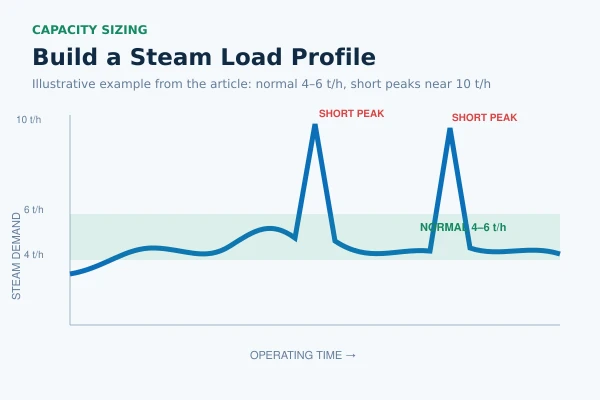
This does not automatically mean that maximum capacity should be ignored. It means boiler selection must consider both the peak and the much more common part-load condition.
An oversized boiler can create several problems.
If the burner cannot modulate down to match lower steam demand, the boiler may repeatedly start and stop. Frequent cycling can increase avoidable losses, create pressure fluctuations and add operating wear.
Oversizing can also mean:
A boiler that is too small may:
The goal is therefore not to minimize or maximize capacity. It is to match boiler capacity and configuration to a documented load profile.
For variable-load plants, buyers should also evaluate burner turndown, boiler sequencing and whether multiple smaller boilers would provide better flexibility than one large unit.
Capacity answers the question “How much steam?”
Pressure answers another question:
At what condition must that steam reach the process?
Boiler pressure should not be selected simply because a higher-pressure model appears more capable.
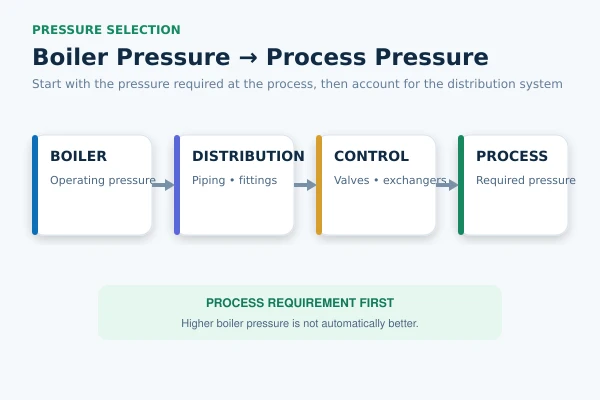
The required pressure should come from the process.
The boiler’s operating pressure and the pressure available at the steam-consuming equipment are not always identical.
Pressure can be lost through:
A buyer should therefore identify the pressure required at the actual process and allow the system designer to evaluate reasonable distribution losses and control requirements.
Unnecessarily high boiler pressure can increase equipment requirements and may create operating conditions that the process does not need.
Most process-heating applications use saturated steam, while some specialized industrial and power applications may require superheated steam.
| Фактор | Saturated Steam | Superheated Steam |
|---|---|---|
| Температура | Related to saturation pressure | Above saturation temperature |
| Common role | Процес опалення | Specialized processes/power |
| Heat-transfer behavior | Strong for many heating duties | Application-dependent |
| System complexity | Generally simpler | Як правило, вище |
| Selection basis | Process requirement | Specific engineering requirement |
A supplier should therefore know capacity, pressure and steam-temperature requirements before recommending a boiler configuration.
There is no universally best industrial boiler fuel.
Fuel selection is increasingly a site-specific economic and engineering decision.
Buyers should compare:
Газові парові котли remain widely applicable where natural gas or another suitable gaseous fuel is reliably available.
Potential advantages include:
Але покупці все одно повинні досліджувати вплив ціни на газ, тиск живлення, місцеві вимоги до викидів і довгострокова доступність палива.
Системи, що працюють на рідкому паливі, можуть бути корисними там, де газова інфраструктура недоступна або де об’єкт вимагає незалежного або резервного джерела палива..
Можливо, потрібно включити обсяг закупівлі:
Нижчу вартість придбання котла не слід розглядати окремо від вартості всієї паливної системи.
Парові електричні котли усуває горіння в точці використання та може забезпечити точне керування навантаженням.
Проте, сам котел – це лише частина рішення.
Buyers should check:
The International Energy Agency notes that electric boilers are commercially available for industrial heat and steam, while electricity-to-gas price ratios and grid connection constraints can materially affect deployment.
This is why an electric boiler should be evaluated as part of the plant’s electrical system rather than as an isolated piece of equipment.
Biomass-fired steam boilers may be economically attractive where a consistent, suitable and competitively priced biomass fuel is locally available.
But “біомаса” is not a complete fuel specification.
Buyers should provide data for:
The project may also require:
A cheap biomass fuel can become expensive if inconsistent quality reduces useful steam output or causes operating problems.
Fuel flexibility may be valuable where fuel prices fluctuate or where uninterrupted steam production is critical.
Проте, flexibility also adds complexity.
Compare:
Fuel flexibility is valuable when it solves a real supply or operating risk—not simply because “more fuels” sounds better on a specification sheet.
The answer depends on the site.
| Фактор | Газовий котел | Електричний котел | Котел на біомасі |
|---|---|---|---|
| Energy infrastructure | Gas supply | Electrical capacity | Biomass supply/storage |
| On-site combustion | Так | Немає | Так |
| Fuel handling | Relatively simple | Very simple | Більш складний |
| Automation potential | Високий | Very high | Високий |
| Складність обслуговування | Помірний | Як правило, нижче | Як правило, вище |
| Local emissions equipment | Залежний від ринку | No combustion system | Often more extensive |
| Energy-price exposure | Gas market | Electricity market | Biomass supply chain |
| Best fit | Broad industrial use | Favorable electrical economics | Reliable biomass availability |
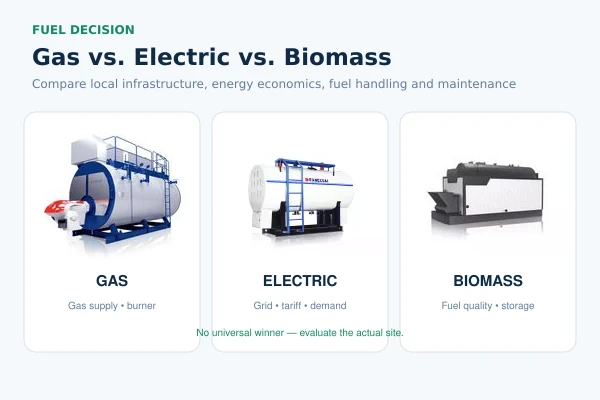
Instead of asking which fuel is universally cheapest, calculate the expected cost of useful steam under the plant’s actual conditions.
That requires actual energy prices, години роботи, steam demand and realistic system efficiency.
Boiler construction is another important purchasing decision.
Neither design is automatically superior.
У жаротрубному котлі, hot combustion gases pass through tubes surrounded by water.
Залежно від проекту, fire-tube designs can offer relatively straightforward operation and a compact solution for many industrial steam applications.
У водотрубному котлі, water/steam flows through tubes heated externally by combustion gases.
Water-tube systems are frequently considered for applications involving higher capacities, pressures or demanding operating conditions, but the correct selection remains project-specific.
A detailed fire-tube vs. water-tube boiler comparison should consider:
| Selection Factor | Questions to Ask |
|---|---|
| Ємність | What is minimum, normal and peak demand? |
| Тиск | What process pressure is required? |
| Load changes | How quickly does steam demand vary? |
| Простір | What boiler-room dimensions are available? |
| Якість води | What treatment system is available? |
| Технічне обслуговування | What service capability exists locally? |
| монтаж | Are there transport or site restrictions? |
| Expansion | Is future steam-demand growth expected? |
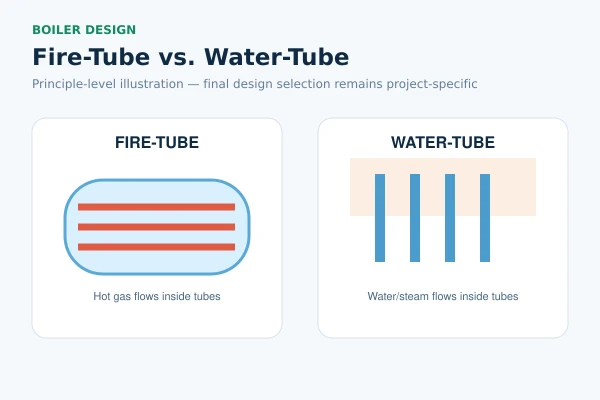
Boiler type should follow the process requirement, not the other way around.
“ККД котла: 95%.”
By itself, that number tells a buyer surprisingly little.
A meaningful efficiency figure should state the conditions under which it was calculated or tested.
Ask:
A boiler operates inside a steam system.
Real annual fuel consumption can be affected by:
The США. Department of Energy’s steam-system resources identify system-level improvement opportunities including combustion optimization, повернення конденсату, blowdown control, efficient burners and waste-heat recovery.
This is an important procurement lesson.
The highest quoted efficiency is not automatically the lowest annual fuel cost.
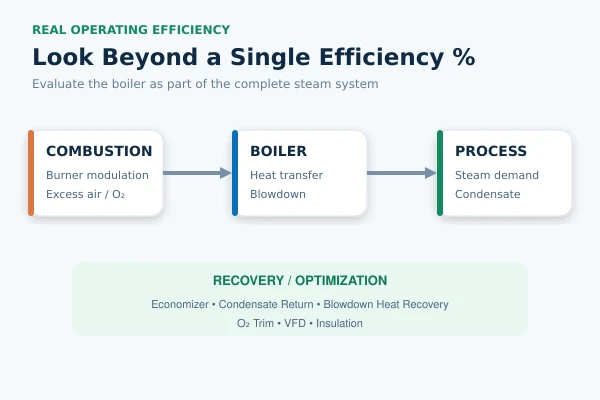
Залежно від проекту, options may include:
Each option should be evaluated against actual operating conditions.
Feedwater is not a secondary issue.
Water conditions influence boiler reliability, ефективність, maintenance and service life.
Залежно від системи, engineers may need to evaluate:
Poor water management can contribute to scale, корозія, carryover and unnecessary blowdown.
Scale on heat-transfer surfaces can reduce effective heat transfer, while corrosion can create serious reliability problems.
The complete project may therefore require:
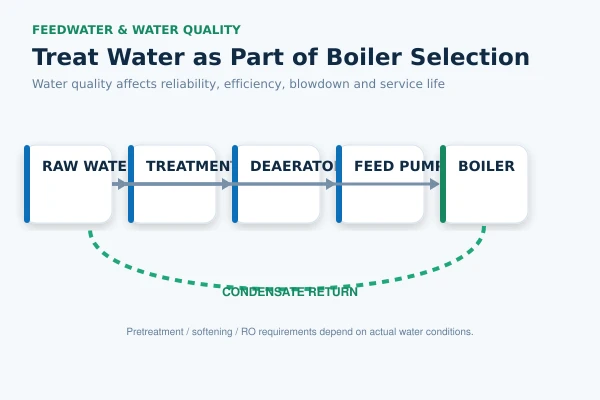
A boiler manufacturer should receive basic feedwater information before final equipment selection rather than discovering severe water-quality problems during commissioning.
A quotation for “one boiler” does not necessarily include a complete steam plant.
This is one of the easiest ways for two supplier quotations to appear similar while actually covering very different scopes.
Залежно від проекту, auxiliary equipment may include:
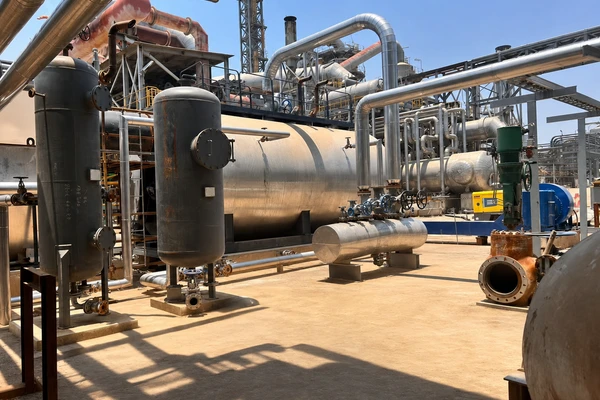
Buyers should request a clear list of inclusions and exclusions.
If Supplier A includes the boiler, пальник, економайзер, pumps and controls while Supplier B quotes only the pressure vessel and basic burner, their prices are not directly comparable.
A PLC-controlled boiler is not automatically a “smart boiler.”
The procurement question should be:
What does the control system measure, record, communicate and optimize?
At minimum, industrial boiler automation may need to control or monitor:
More advanced systems may monitor:
Integration may extend to:
Sensors → PLC → HMI → SCADA → Data Storage → Remote Monitoring
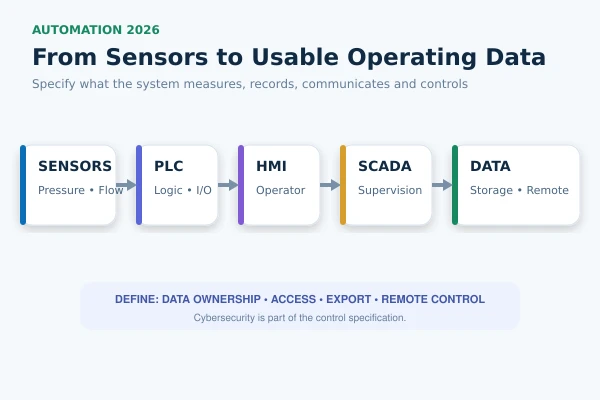
Before ordering remote monitoring, also define:
For connected industrial systems, cybersecurity should be part of the control specification. NIST SP 800-82 Rev. 3 provides guidance for operational technology security, including industrial control environments.
There is no single global emissions limit that applies to every industrial steam boiler.
Requirements may vary by:
Наприклад, з США. EPA’s industrial, commercial and institutional boiler rules illustrate how boiler requirements can depend on facility and fuel category.
For an export project, buyers should identify the applicable emissions requirement before final burner and emissions-control selection.
Potential regulated emissions can include:
The required solution may involve low-NOx burners, рециркуляція димових газів, combustion controls, dust collection or other technologies depending on fuel and local requirements.
Certification also depends on destination and project scope.
Examples can include applicable requirements under the ASME Boiler and Pressure Vessel Code або, for relevant EU pressure equipment, з Pressure Equipment Directive.
Do not simply ask a supplier:
“Do you have CE/ASME?”
Instead ask:
Certification should be verified before production.
There is no reliable universal price for an industrial steam boiler.
Price depends on much more than nominal capacity.
Major cost drivers include:
This creates three different numbers:
Boiler Purchase Price ≠ Installed Project Cost ≠ Lifecycle Cost
A low equipment quotation can become expensive when important systems are excluded.
Instead of asking only:
“How much is a 10-ton steam boiler?”
ask:
“What is included in the complete 10 t/h steam system for my specified pressure, пальне, feedwater, emissions requirements and operating profile?”
That question produces a much more useful quotation.
Total cost of ownership considers what the boiler will cost throughout an evaluation period—not only what it costs to purchase.
A practical model is:
Boiler TCO = Equipment + паливо + Електрика + вода + Chemicals + Технічне обслуговування + Запчастини + Emissions Compliance + монтаж + Downtime − Recoverable Energy Savings
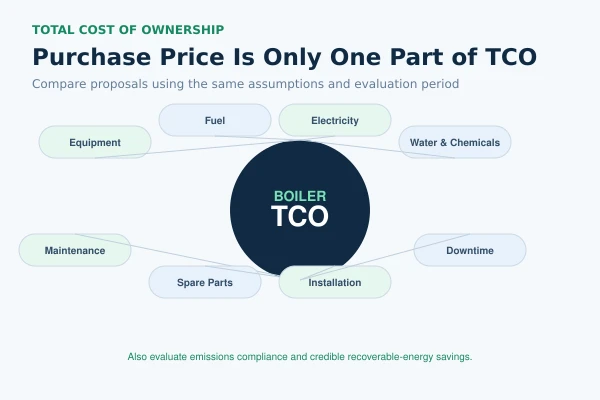
A five-, ten- or longer-year model can be used depending on the company’s investment process.
Include the boiler and all equipment necessary to achieve the defined scope.
For many steam plants, fuel becomes one of the largest lifecycle expenses.
Annual fuel calculations should use realistic steam demand and operating hours rather than assuming continuous operation at nameplate capacity.
Important inputs include:
Include electrical consumption from:
For electric boilers, electricity becomes the primary energy input and tariff structure becomes particularly important.
Розглянемо:
Estimate:
Downtime is often underestimated.
In some manufacturing facilities, an hour without process steam can cost far more than a small difference in quoted boiler efficiency.
Critical processes should therefore evaluate:
When comparing industrial steam boiler suppliers, most buyers make a critical mistake: they compare only the quotation price instead of comparing the full lifecycle cost under identical operating assumptions.
To make a fair decision, all suppliers must be evaluated using the same technical and economic baseline:
Without this normalization, the comparison becomes meaningless.
Assumptions for this example:
| TCO Item | Supplier A (Basic System) | Supplier B (Optimized System) | Supplier C (High-Efficiency System) |
|---|---|---|---|
| Equipment cost | $180,000 | $210,000 | $260,000 |
| Auxiliaries (насос, танк, управління) | $45,000 | $60,000 | $85,000 |
| монтаж & введення в експлуатацію | $50,000 | $55,000 | $70,000 |
| Subtotal CAPEX | $275,000 | $325,000 | $415,000 |
| Річна вартість палива | $310,000 | $295,000 | $275,000 |
| 10-year fuel cost | $3,100,000 | $2,950,000 | $2,750,000 |
| Annual electricity | $18,000 | $16,000 | $15,000 |
| 10-year electricity | $180,000 | $160,000 | $150,000 |
| вода & хімічні речовини | $25,000 | $22,000 | $20,000 |
| 10-year water/chemicals | $250,000 | $220,000 | $200,000 |
| Річний ремонт | $20,000 | $18,000 | $16,000 |
| 10-year maintenance | $200,000 | $180,000 | $160,000 |
| Spare parts (10-рік) | $60,000 | $55,000 | $50,000 |
| Emissions compliance cost | $30,000 | $25,000 | $20,000 |
| Estimated downtime cost | $120,000 | $80,000 | $50,000 |
| Heat recovery benefit | -$50,000 | -$90,000 | -$130,000 |
| 10-year total TCO | $4,165,000 | $3,925,000 | $3,665,000 |
Although Supplier C has the highest initial investment, it delivers the lowest total lifecycle cost due to:
Тим часом, Supplier A appears attractive at purchase stage but becomes the most expensive option over 10 роки due to fuel inefficiency.
A correct TCO decision is not:
“Which boiler is cheapest?»
Це так:
“Which boiler produces steam at the lowest cost per ton over its real operating life?»
У більшості промислових випадків, fuel cost represents 70–85% of total lifecycle cost, meaning even a 2–3% efficiency difference can outweigh the entire equipment price difference within a few years.
Industrial boiler quotations are often misleading because different suppliers:
тому, the first step is not price comparison — it is scope normalization.
Перш ніж порівнювати ціни, force all suppliers to use the same baseline:
If suppliers refuse to align assumptions, their quotations are not comparable.
A real industrial steam system includes more than the pressure vessel.
A proper comparison must include:
| Item | Supplier A | Supplier B | Supplier C |
|---|---|---|---|
| Boiler type | Fire-tube | Fire-tube | Water-tube |
| Rated efficiency | 90% | 92% | 94% |
| Part-load efficiency | Not specified | Помірний | High stability |
| Burner turndown ratio | 1:3 | 1:5 | 1:8 |
| Economizer included | Немає | Так | Так (high efficiency type) |
| Condensate recovery system | Додатково | Included | Included + optimized |
| Система контролю | Basic PLC | PLC + HMI | PLC + SCADA + remote monitoring |
| Emissions system | Standard burner | Low-NOx burner | Ultra-low NOx + FGR |
| Очищення води | Not included | Included | Fully integrated system |
| Installation scope | Equipment only | Partial installation | Full turnkey |
| Commissioning | Not included | Included | Full performance guarantee |
| Гарантія | 12 months | 18 months | 24 months + performance guarantee |
| Spare parts | Limited | Standard kit | Full 2-year critical kit |
| Документація | Basic manual | Full technical package | Full + digital twin model |
Many low-price quotations exclude critical systems such as:
These exclusions often shift 20–40% of total project cost back to the buyer.
After normalization, the decision should follow this logic:
- Does the system meet process requirements?
- Does it minimize lifecycle cost (TCO)?
- Does it reduce operational risk (downtime, instability)?
- Does it comply with emissions and certification rules?
- Is supplier support reliable for 10+ роки?
Тільки якщо всі п’ять відповідей позитивні, ціна повинна стати вирішальним фактором.
Професійне рішення щодо закупівлі котлів – це не порівняння цін.
Це а задача оптимізації системної інженерії залучення:
Якщо хочеш, Потім я можу оновити цю статтю до a «версія для створення потенційних клієнтів» (SEO + CTA + позиціонування продукту для MakeBoiler) або перетворити його на a структура цільової сторінки для трафіку Google Ads.
Професійна пропозиція промислового парового котла повинна чітко визначати технічну та комерційну сферу.
Залежно від проекту, запит:
Чітка пропозиція зменшує непорозуміння в подальшому проекті.
Щоб оцінити постачальника котлів, однієї лише ціни недостатньо.
Промисловий котел – це система під тиском, яка розрахована на роботу протягом багатьох років, часто всередині виробничого процесу, де доступність пари є критичною.
Оцініть постачальника за кількома напрямками.
Чи може постачальник пояснити, чому конкретна ємність, тиск, було обрано пальник і допоміжну конфігурацію?
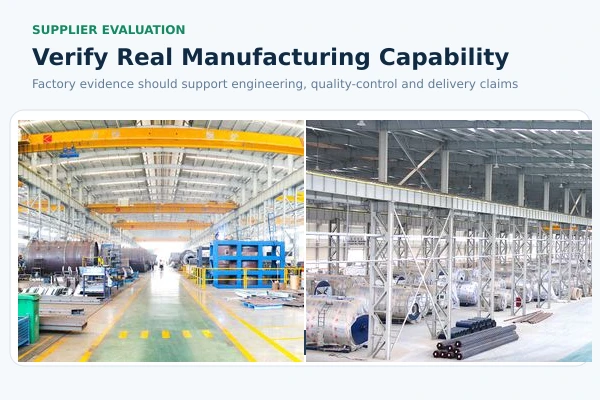
Ask about:
For statements such as:
“Висока ефективність”
ask for:
Calculation/test basis + пальне + навантаження + температура живильної води.
для:
“Низький NOx”
ask for:
Guaranteed value + пальне + навантаження + reference conditions + test method.
для:
“Smart boiler”
ask for:
PLC architecture + I/O list + monitored parameters + communication functions.
Для експортних проектів, also evaluate:
A good supplier should be able to explain what it will deliver, what the buyer must provide and where each party’s responsibility begins and ends.
A procurement team should investigate further when it sees any of the following.
A percentage alone is not enough.
The supplier should ask about normal and minimum load.
Variable demand affects burner and boiler operation.
Ask for fuel, навантаження, reference oxygen and test basis.
A low price may reflect an incomplete scope.
Verify the manufacturer, equipment and applicability.
Water conditions affect boiler operation and life.
International projects need clear interface boundaries.
Critical spares should be identified before shipment.
Порівняйте обсяг, перш ніж порівнювати ціну.
Use this process before placing an order.
Determine capacity, тиск, temperature and steam quality.
Identify minimum, normal and peak demand.
Include process requirements and distribution considerations.
Compare price, infrastructure, supply reliability and storage.
Evaluate fire-tube, water-tube or another configuration against actual requirements.
Use consistent test/calculation assumptions and examine part-load operation.
Define treatment, деаерація, condensate return and blowdown requirements.
Use requirements applicable to the installation market.
Specify measurements, PLC/HMI/SCADA integration, alarms and remote access.
Compare lifecycle operating costs—not just purchase price.
Review engineering, виробництво, тестування, documentation and service.
Clearly define inclusions, виключення, встановлення, введення в експлуатацію, навчання, spare parts and warranty.
Якщо коротко:
Steam Demand → Load Profile → Pressure → Fuel → Boiler Type → Efficiency → Water → Compliance → Automation → TCO → Supplier → Contract
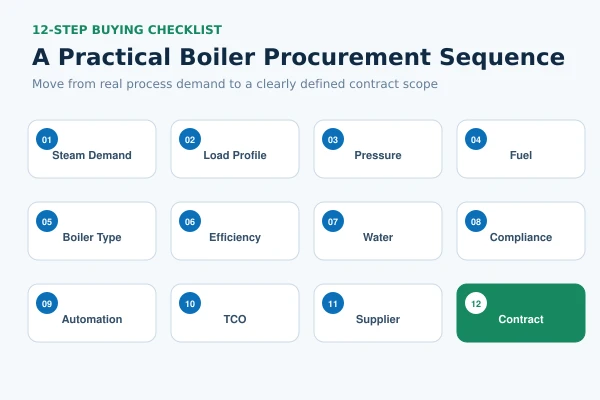
To receive a useful engineering quotation, prepare the following information.
Providing these parameters allows the engineering team to evaluate an actual boiler system instead of producing a generic price quotation.
The correct size depends on minimum, normal and peak steam demand rather than maximum production capacity alone. Buyers should build a steam-load profile that also considers daily operating hours, batch loads, seasonal changes and future production requirements.
Start by determining steam consumption from all relevant process equipment and identifying which loads operate simultaneously. Separate normal demand from short peak loads and include reasonable system requirements. Final sizing should be verified through an engineering heat and mass balance rather than relying only on a simple rule of thumb.
The boiler should supply sufficient pressure for the process after accounting for steam-distribution and control requirements. Більш високий тиск автоматично не означає кращий. Define the pressure required at the process first, then select an appropriate boiler operating and design pressure.
Neither is universally better. Electric boilers eliminate point-of-use combustion and offer precise control, but electricity prices, grid capacity and demand charges can affect operating cost. Gas boilers may offer favorable economics where gas is readily available. Compare both using actual local energy prices and steam demand.
It can be in locations with reliable low-cost biomass, but fuel price alone is not enough. Biomass moisture, calorific value, попіл, зберігання, feeding, dust control and maintenance must also be included in the economic comparison.
Fire-tube boilers pass hot gases through tubes surrounded by water, while water-tube boilers circulate water/steam through tubes heated externally. The appropriate design depends on capacity, тиск, load response, простір, water conditions and process requirements.
Compare suppliers using the same fuel basis, навантаження котла, feedwater temperature and test/calculation method. Also evaluate burner turndown, температура стека, надлишок повітря, economizer configuration, condensate recovery and blowdown because these influence real operating cost.
Залежно від проекту, auxiliary systems may include burners, насос, очищення води, deaerators, економайзери, димарі, паливні системи, condensate systems, blowdown systems, controls and emissions equipment. Always confirm quotation inclusions and exclusions.
There is no reliable universal price. Cost varies with capacity, тиск, пальне, boiler design, пальник, управління, рекуперація тепла, очищення води, certification, emissions equipment and auxiliary-system scope. Installed project cost should be evaluated separately from boiler purchase price.
Add equipment, пальне, електрика, води, хімічні речовини, обслуговування, запчастини, встановлення, emissions compliance and expected downtime over the selected evaluation period. Subtract credible recovered-energy savings where appropriate. Compare all proposals using the same assumptions.
At minimum, provide capacity, профіль навантаження, робочий тиск, температура пари, пальне, години роботи, умови живильної води, повернення конденсату, application, країна встановлення, emissions requirements and certification requirements.
Compare engineering capability, manufacturing quality, область сертифікації, documented efficiency and emissions performance, factory testing, автоматизація, project experience, documentation, commissioning support, spare-parts availability and after-sales service—not only price.
The best industrial steam boiler in 2026 is not automatically the one with the highest capacity, highest quoted efficiency or lowest purchase price.
A successful boiler project begins with the production process.
Ask:
Тому найсильнішою стратегією купівлі є:
Визначити потужність → створити профіль навантаження → визначити тиск → порівняти види палива → вибрати тип котла → оцінити реальну ефективність → підтвердити вимоги до води та відповідності → визначити автоматизацію → розрахувати TCO → перевірити докази постачальника → підтвердити повний обсяг проекту.
Якщо ви готуєте проект промислового парового котла, почати з п'яти параметрів:
Пароємність + робочий тиск + пальне + години роботи + країна встановлення
Маючи ці вхідні дані — і бажано справжній профіль парового навантаження — виробник котлів може вийти за рамки загальної пропозиції та розпочати проектування системи, яка відповідає фактичному процесу.
Потрібна допомога у виборі правильного промислового парового котла? Надішліть свою потужність, тиск, палива та країни установки, зв’яжіться з нами через WhatsApp, щоб отримати рекомендацію та цінову пропозицію щодо конкретного котла. Отримайте пропозицію Boiler у WhatsApp → +86-132-1322-2805。
БЕЗКОШТОВНІ КОТЛИ
Жодної затримки, отримати 3 цитати сьогодні Порівняйте за найкращими цінами Безпечний і надійнийВІДГУКИ
ЩО В ЦІЙ СТАТТІ?
Якщо вам подобається Fang Kuai, будь ласка, залиште своє повідомлення.



Вiew Відгуки нашого Замовника
"Парогенератор від Fangkuai ідеально підходить для мого малого бізнесу. Він дуже простий у використанні та вимагає мінімального обслуговування. Це також дуже енергоефективно, що допомогло мені заощадити гроші на рахунках за електроенергію. Обслуговування клієнтів у Fangkuai також чудове. Вони дуже чуйні і завжди готові допомогти. Я дуже рекомендую парогенератори Fangkuai."
Ахмед
Єгипет"Бойлер для гарячої води від Fangkuai дивовижний. Нагрівається швидко і ефективно, і вода довго залишається гарячою. У нас ніколи не було з ним проблем, і це значно покращило нашу щоденну роботу. Процес встановлення також пройшов дуже гладко, а обслуговування клієнтів було чудовим. Я дуже рекомендую водогрійні котли Fangkuai."
Сара
Канада"Парогенератори Fangkuai чудові. Вони дуже прості у використанні та вимагають мінімального обслуговування. Обслуговування клієнтів у Fangkuai також виняткове. Вони дуже чуйні і завжди готові допомогти. Енергоефективність парогенераторів також чудова, що допомогло мені заощадити гроші на рахунках за електроенергію. Я дуже рекомендую парогенератори Fangkuai."
Марія
Іспанія"Обслуговування клієнтів у Fangkuai є першокласним. Вони допомогли мені вибрати ідеальний котел для моїх потреб і надали чудову підтримку протягом усього процесу. Процес встановлення також пройшов легко, і котел перевершив мої очікування. Він дуже простий у використанні та обслуговуванні, і енергоефективність чудова. Я настійно рекомендую продукцію Fangkuai усім, хто потребує надійних та ефективних рішень для опалення."
Хуан
Мексика"Термомасляний котел від Fangkuai дуже простий в експлуатації та обслуговуванні. Це допомогло нам заощадити час і гроші на технічне обслуговування, що призвело до значної економії коштів. Якість матеріалів і конструкції котла виняткові. Це також дуже енергоефективно, що допомогло нам заощадити гроші на наших рахунках за електроенергію. Я настійно рекомендую термальний масляний котел Fangkuai ."
Аллен
Бразилія"Бойлер для гарячої води від Fangkuai дивовижний. Нагрівається швидко і ефективно, і вода довго залишається гарячою. У нас ніколи не було з ним проблем, і це значно покращило нашу щоденну роботу. Процес встановлення також пройшов дуже гладко, а обслуговування клієнтів було чудовим. Я дуже рекомендую водогрійні котли Fangkuai."
Сара
Канада"Парогенератори Fangkuai чудові. Вони дуже прості у використанні та вимагають мінімального обслуговування. Обслуговування клієнтів у Fangkuai також виняткове. Вони дуже чуйні і завжди готові допомогти. Енергоефективність парогенераторів також чудова, що допомогло мені заощадити гроші на рахунках за електроенергію. Я дуже рекомендую парогенератори Fangkuai."
Марія
Іспанія"Обслуговування клієнтів у Fangkuai є першокласним. Вони допомогли мені вибрати ідеальний котел для моїх потреб і надали чудову підтримку протягом усього процесу. Процес встановлення також пройшов легко, і котел перевершив мої очікування. Він дуже простий у використанні та обслуговуванні, і енергоефективність чудова. Я настійно рекомендую продукцію Fangkuai усім, хто потребує надійних та ефективних рішень для опалення."
Хуан
Мексика"Бойлер для гарячої води від Fangkuai дивовижний. Нагрівається швидко і ефективно, і вода довго залишається гарячою. У нас ніколи не було з ним проблем, і це значно покращило нашу щоденну роботу. Процес встановлення також пройшов дуже гладко, а обслуговування клієнтів було чудовим. Я дуже рекомендую водогрійні котли Fangkuai."
Сара
Канада