Buying an industrial steam boiler in 2026 is not simply a matter of choosing a capacity, asking for a price, and comparing quotations.
A boiler that looks attractive on a datasheet may be a poor fit once it is connected to a real production process. Steam demand changes throughout the day. Fuel prices vary by location. Feedwater conditions affect efficiency and reliability. Emissions rules depend on the installation market. Automation requirements differ from one plant to another, and a low initial price can be offset by years of higher fuel consumption, Wartung, or downtime.
For most industrial buyers, a better boiler selection starts with four questions:
These four variables—capacity, Druck, fuel and total cost of ownership (Gesamtbetriebskosten)—form the foundation of a practical industrial steam boiler buying strategy.
This guide explains how to evaluate them, what information to request from suppliers, and how to compare industrial steam boiler proposals on a consistent engineering basis.
To choose an industrial steam boiler, first define the plant’s minimum, Normal- und Spitzendampfbedarf. Then determine the required working pressure, Dampftemperatur, available fuels, Speisewasserbedingungen, Betriebsstunden, emissions requirements and applicable certification.
After that, compare boiler designs based on:
The best boiler is not necessarily the largest, cheapest or highest-rated-efficiency option. It is the boiler system that most reliably matches the plant’s actual operating conditions.
A useful boiler quotation starts with useful process data.
Requests such as “I need a 10-ton boiler” oder “Please quote a gas boiler” provide too little information for accurate engineering selection.
Before contacting an industrial boiler manufacturer, prepare the following information.
| Parameter | What the Buyer Should Provide | Warum es wichtig ist |
|---|---|---|
| Dampfkapazität | Minimum, normal and peak demand | Determines boiler sizing |
| Arbeitsdruck | Required process pressure | Affects boiler design |
| Dampftemperatur | Saturated or superheated | Defines steam conditions |
| Kraftstoff | Gas, Öl, Biomasse, Strom, usw. | Determines combustion/energy system |
| Operating profile | Hours/day and days/year | Affects annual operating cost |
| Feedwater | Temperature and water quality | Influences efficiency and treatment |
| Condensate return | Expected percentage/flow | Affects heat and water balance |
| Installation location | Country and region | Determines regulatory requirements |
| Emissionen | Applicable local limits | Influences burner/control equipment |
| Zertifizierung | Project-specific requirements | Influences design and documentation |
| Automatisierung | Plc, SCADA, remote monitoring | Defines control scope |
| Site limits | Raum, Zugang, altitude, transport | Influences physical configuration |
The earlier these variables are defined, the easier it becomes to compare competing boiler proposals fairly.
Steam boiler capacity is normally selected from process steam demand—not simply from the maximum theoretical capacity of the production line.
Industrial steam demand may be expressed in:
Regardless of the unit, the important question is how much steam the plant needs at different operating conditions.
A useful steam-load profile should identify:
Consider a simplified example.
A factory may have a calculated maximum requirement of 10 t/h but operate at only 4–6 t/h during most production hours. Short production peaks occasionally approach 10 t/h.
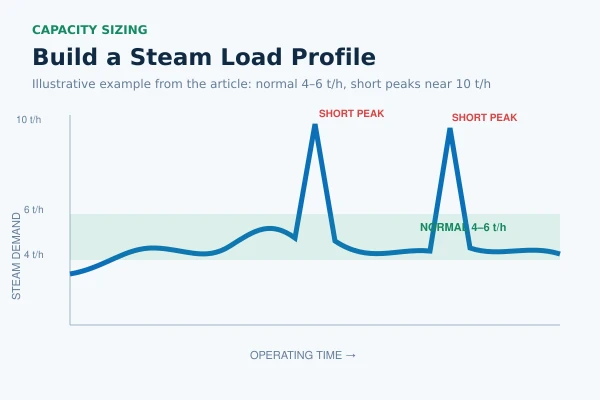
This does not automatically mean that maximum capacity should be ignored. It means boiler selection must consider both the peak and the much more common part-load condition.
An oversized boiler can create several problems.
If the burner cannot modulate down to match lower steam demand, the boiler may repeatedly start and stop. Frequent cycling can increase avoidable losses, create pressure fluctuations and add operating wear.
Oversizing can also mean:
A boiler that is too small may:
The goal is therefore not to minimize or maximize capacity. It is to match boiler capacity and configuration to a documented load profile.
For variable-load plants, buyers should also evaluate burner turndown, boiler sequencing and whether multiple smaller boilers would provide better flexibility than one large unit.
Capacity answers the question “How much steam?”
Pressure answers another question:
At what condition must that steam reach the process?
Boiler pressure should not be selected simply because a higher-pressure model appears more capable.
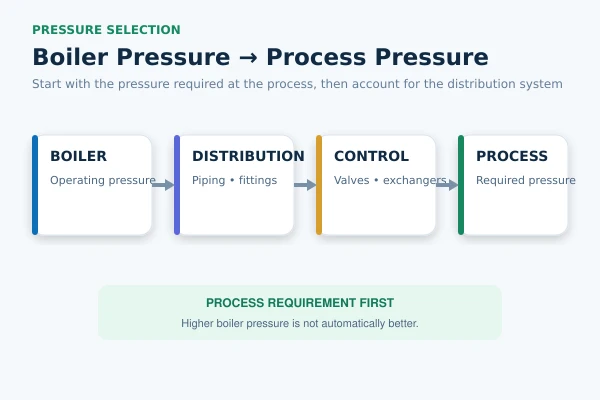
The required pressure should come from the process.
The boiler’s operating pressure and the pressure available at the steam-consuming equipment are not always identical.
Pressure can be lost through:
A buyer should therefore identify the pressure required at the actual process and allow the system designer to evaluate reasonable distribution losses and control requirements.
Unnecessarily high boiler pressure can increase equipment requirements and may create operating conditions that the process does not need.
Most process-heating applications use saturated steam, while some specialized industrial and power applications may require superheated steam.
| Faktor | Saturated Steam | Superheated Steam |
|---|---|---|
| Temperatur | Related to saturation pressure | Above saturation temperature |
| Common role | Prozesserwärmung | Specialized processes/power |
| Heat-transfer behavior | Strong for many heating duties | Application-dependent |
| System complexity | Generally simpler | Generell höher |
| Selection basis | Process requirement | Specific engineering requirement |
A supplier should therefore know capacity, pressure and steam-temperature requirements before recommending a boiler configuration.
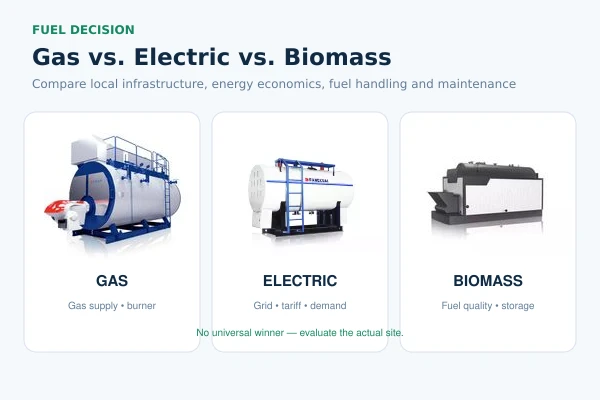
There is no universally best industrial boiler fuel.
Fuel selection is increasingly a site-specific economic and engineering decision.
Buyers should compare:
Gasbefeuerte Dampfkessel remain widely applicable where natural gas or another suitable gaseous fuel is reliably available.
Potential advantages include:
But buyers should still investigate gas-price exposure, supply pressure, local emissions requirements and the long-term availability of the fuel.
Liquid-fuel systems may be useful where gas infrastructure is unavailable or where a site requires an independent or backup fuel supply.
The procurement scope may need to include:
A lower boiler purchase price should not be considered separately from the cost of the complete fuel system.
Elektrische Dampfkessel eliminate combustion at the point of use and can provide precise load control.
Jedoch, the boiler itself is only part of the decision.
Buyers should check:
The International Energy Agency notes that electric boilers are commercially available for industrial heat and steam, while electricity-to-gas price ratios and grid connection constraints can materially affect deployment.
This is why an electric boiler should be evaluated as part of the plant’s electrical system rather than as an isolated piece of equipment.
Biomass-fired steam boilers may be economically attractive where a consistent, suitable and competitively priced biomass fuel is locally available.
But “Biomasse” is not a complete fuel specification.
Buyers should provide data for:
The project may also require:
A cheap biomass fuel can become expensive if inconsistent quality reduces useful steam output or causes operating problems.
Fuel flexibility may be valuable where fuel prices fluctuate or where uninterrupted steam production is critical.
Jedoch, flexibility also adds complexity.
Compare:
Fuel flexibility is valuable when it solves a real supply or operating risk—not simply because “more fuels” sounds better on a specification sheet.
The answer depends on the site.
| Faktor | Gas Boiler | Elektrokessel | Biomassekessel |
|---|---|---|---|
| Energy infrastructure | Gas supply | Electrical capacity | Biomass supply/storage |
| On-site combustion | Ja | NEIN | Ja |
| Fuel handling | Relatively simple | Very simple | Komplexer |
| Automation potential | Hoch | Very high | Hoch |
| Wartungskomplexität | Mäßig | Im Allgemeinen niedriger | Generell höher |
| Local emissions equipment | Marktabhängig | No combustion system | Often more extensive |
| Energy-price exposure | Gas market | Electricity market | Biomass supply chain |
| Best fit | Broad industrial use | Favorable electrical economics | Reliable biomass availability |
Instead of asking which fuel is universally cheapest, calculate the expected cost of useful steam under the plant’s actual conditions.
That requires actual energy prices, Betriebsstunden, steam demand and realistic system efficiency.
Boiler construction is another important purchasing decision.
Neither design is automatically superior.
In einem Feuerrohrkessel, hot combustion gases pass through tubes surrounded by water.
Je nach Projekt, fire-tube designs can offer relatively straightforward operation and a compact solution for many industrial steam applications.
In einem Wasserrohrkessel, water/steam flows through tubes heated externally by combustion gases.
Water-tube systems are frequently considered for applications involving higher capacities, pressures or demanding operating conditions, but the correct selection remains project-specific.
A detailed fire-tube vs. water-tube boiler comparison should consider:
| Selection Factor | Questions to Ask |
|---|---|
| Kapazität | What is minimum, normal and peak demand? |
| Druck | What process pressure is required? |
| Load changes | How quickly does steam demand vary? |
| Raum | What boiler-room dimensions are available? |
| Wasserqualität | What treatment system is available? |
| Wartung | What service capability exists locally? |
| Installation | Are there transport or site restrictions? |
| Expansion | Is future steam-demand growth expected? |
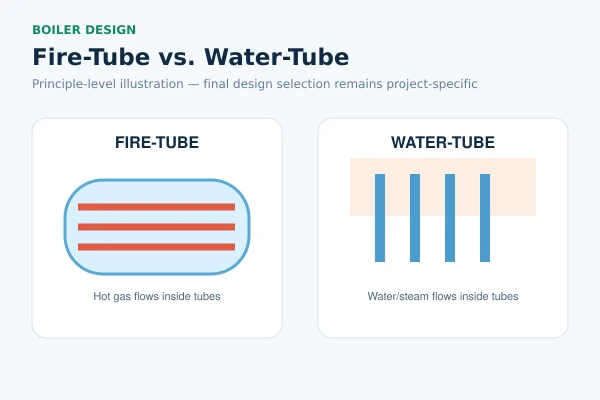
Boiler type should follow the process requirement, not the other way around.
“Kesseleffizienz: 95%.”
By itself, that number tells a buyer surprisingly little.
A meaningful efficiency figure should state the conditions under which it was calculated or tested.
Ask:
A boiler operates inside a steam system.
Real annual fuel consumption can be affected by:
Der UNS. Department of Energy’s steam-system resources identify system-level improvement opportunities including combustion optimization, Kondensatrückführung, Abschlämmkontrolle, efficient burners and waste-heat recovery.
This is an important procurement lesson.
The highest quoted efficiency is not automatically the lowest annual fuel cost.
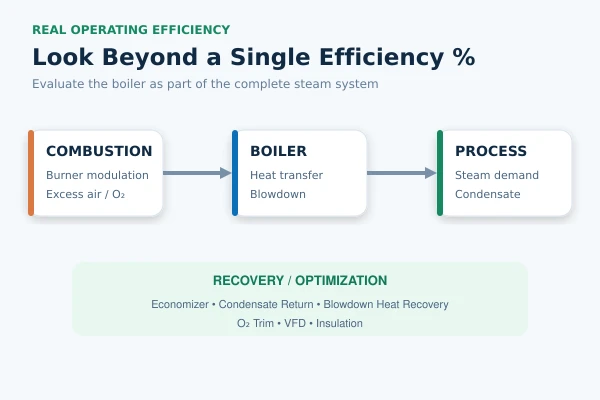
Je nach Projekt, options may include:
Each option should be evaluated against actual operating conditions.
Feedwater is not a secondary issue.
Water conditions influence boiler reliability, Effizienz, maintenance and service life.
Abhängig vom System, engineers may need to evaluate:
Schlechtes Wassermanagement kann zur Größenordnung beitragen, Korrosion, carryover and unnecessary blowdown.
Scale on heat-transfer surfaces can reduce effective heat transfer, while corrosion can create serious reliability problems.
The complete project may therefore require:
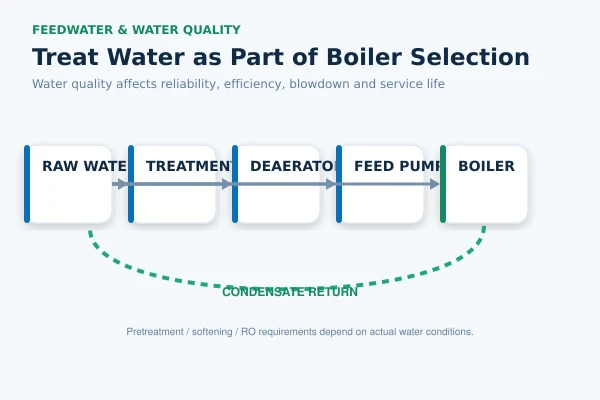
A boiler manufacturer should receive basic feedwater information before final equipment selection rather than discovering severe water-quality problems during commissioning.
A quotation for “one boiler” does not necessarily include a complete steam plant.
This is one of the easiest ways for two supplier quotations to appear similar while actually covering very different scopes.
Je nach Projekt, auxiliary equipment may include:
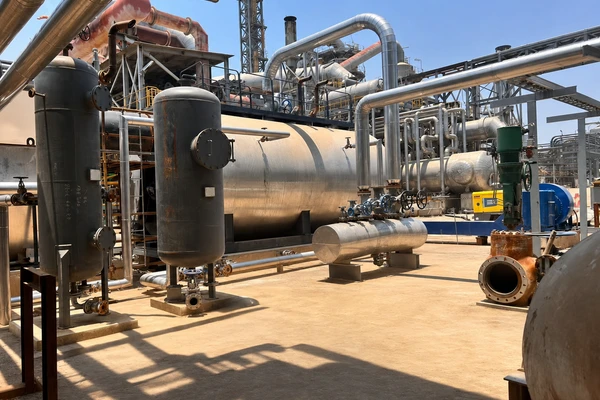
Buyers should request a clear list of inclusions and exclusions.
If Supplier A includes the boiler, Brenner, Ökonom, pumps and controls while Supplier B quotes only the pressure vessel and basic burner, their prices are not directly comparable.
A PLC-controlled boiler is not automatically a “smart boiler.”
The procurement question should be:
What does the control system measure, record, communicate and optimize?
At minimum, industrial boiler automation may need to control or monitor:
More advanced systems may monitor:
Integration may extend to:
Sensors → PLC → HMI → SCADA → Data Storage → Remote Monitoring
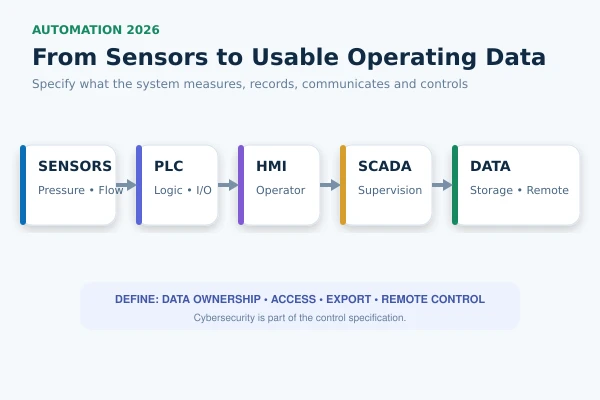
Before ordering remote monitoring, also define:
For connected industrial systems, cybersecurity should be part of the control specification. NIST SP 800-82 Rev. 3 provides guidance for operational technology security, including industrial control environments.
There is no single global emissions limit that applies to every industrial steam boiler.
Requirements may vary by:
Zum Beispiel, Die UNS. EPA’s industrial, commercial and institutional boiler rules illustrate how boiler requirements can depend on facility and fuel category.
For an export project, buyers should identify the applicable emissions requirement before final burner and emissions-control selection.
Potential regulated emissions can include:
The required solution may involve low-NOx burners, Rauchgasrückführung, combustion controls, dust collection or other technologies depending on fuel and local requirements.
Die Zertifizierung hängt auch vom Zielort und Projektumfang ab.
Beispiele können geltende Anforderungen gemäß der sein ASME-Kessel- und Druckbehältercode oder, für relevante EU-Druckgeräte, Die Druckgeräterichtlinie.
Fragen Sie nicht einfach einen Lieferanten:
“Haben Sie CE/ASME??”
Fragen Sie stattdessen:
Die Zertifizierung sollte vor der Produktion überprüft werden.
Es gibt keinen verlässlichen Universalpreis für einen Industriedampfkessel.
Der Preis hängt von viel mehr als der Nennkapazität ab.
Zu den wesentlichen Kostentreibern gehören::
Dadurch entstehen drei verschiedene Zahlen:
Boiler Purchase Price ≠ Installed Project Cost ≠ Lifecycle Cost
A low equipment quotation can become expensive when important systems are excluded.
Instead of asking only:
“How much is a 10-ton steam boiler?”
ask:
“What is included in the complete 10 t/h steam system for my specified pressure, Kraftstoff, feedwater, emissions requirements and operating profile?”
That question produces a much more useful quotation.
Total cost of ownership considers what the boiler will cost throughout an evaluation period—not only what it costs to purchase.
A practical model is:
Boiler TCO = Equipment + Kraftstoff + Strom + Wasser + Chemicals + Wartung + Ersatzteile + Emissions Compliance + Installation + Downtime − Recoverable Energy Savings
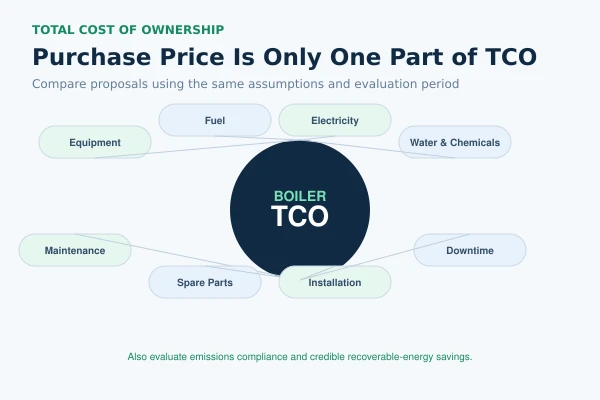
A five-, ten- or longer-year model can be used depending on the company’s investment process.
Include the boiler and all equipment necessary to achieve the defined scope.
For many steam plants, fuel becomes one of the largest lifecycle expenses.
Annual fuel calculations should use realistic steam demand and operating hours rather than assuming continuous operation at nameplate capacity.
Important inputs include:
Include electrical consumption from:
For electric boilers, electricity becomes the primary energy input and tariff structure becomes particularly important.
In Betracht ziehen:
Estimate:
Ausfallzeiten werden oft unterschätzt.
In einigen Produktionsstätten, Eine Stunde ohne Prozessdampf kann weit mehr kosten als ein kleiner Unterschied in der angegebenen Kesseleffizienz.
Kritische Prozesse sollten daher evaluiert werden:
Beim Vergleich von Lieferanten für Industriedampfkessel, Die meisten Käufer machen einen entscheidenden Fehler: Sie vergleichen nur den Angebotspreis, anstatt den Gesamtlebenszykluskosten unter identischen Betriebsannahmen.
Um eine faire Entscheidung zu treffen, Alle Lieferanten müssen anhand der gleichen technischen und wirtschaftlichen Basis bewertet werden:
Without this normalization, the comparison becomes meaningless.
Assumptions for this example:
| TCO Item | Supplier A (Basic System) | Supplier B (Optimized System) | Supplier C (High-Efficiency System) |
|---|---|---|---|
| Equipment cost | $180,000 | $210,000 | $260,000 |
| Auxiliaries (Pumpe, Tank, Kontrollen) | $45,000 | $60,000 | $85,000 |
| Installation & Inbetriebnahme | $50,000 | $55,000 | $70,000 |
| Subtotal CAPEX | $275,000 | $325,000 | $415,000 |
| Jährliche Kraftstoffkosten | $310,000 | $295,000 | $275,000 |
| 10-year fuel cost | $3,100,000 | $2,950,000 | $2,750,000 |
| Annual electricity | $18,000 | $16,000 | $15,000 |
| 10-year electricity | $180,000 | $160,000 | $150,000 |
| Wasser & Chemikalien | $25,000 | $22,000 | $20,000 |
| 10-year water/chemicals | $250,000 | $220,000 | $200,000 |
| Jährliche Wartung | $20,000 | $18,000 | $16,000 |
| 10-year maintenance | $200,000 | $180,000 | $160,000 |
| Spare parts (10-Jahr) | $60,000 | $55,000 | $50,000 |
| Emissions compliance cost | $30,000 | $25,000 | $20,000 |
| Estimated downtime cost | $120,000 | $80,000 | $50,000 |
| Heat recovery benefit | -$50,000 | -$90,000 | -$130,000 |
| 10-year total TCO | $4,165,000 | $3,925,000 | $3,665,000 |
Although Supplier C has the highest initial investment, it delivers the lowest total lifecycle cost due to:
In der Zwischenzeit, Lieferant A erscheint in der Kaufphase attraktiv, wird aber zum teuerste Option vorbei 10 Jahre aufgrund von Kraftstoffineffizienz.
Eine korrekte TCO-Entscheidung ist es nicht:
„Welcher Heizkessel ist der günstigste??”
Es ist:
„Welcher Kessel erzeugt während seiner tatsächlichen Betriebsdauer Dampf zu den niedrigsten Kosten pro Tonne??”
In den meisten industriellen Fällen, Die Kraftstoffkosten machen 70–85 % der gesamten Lebenszykluskosten aus, Das heißt, selbst ein Effizienzunterschied von 2–3 % kann innerhalb weniger Jahre den gesamten Preisunterschied bei der Ausrüstung wettmachen.
Angebote für Industriekessel sind aufgrund unterschiedlicher Anbieter oft irreführend:
Deshalb, the first step is not price comparison — it is scope normalization.
Vor dem Preisvergleich, force all suppliers to use the same baseline:
If suppliers refuse to align assumptions, their quotations are not comparable.
A real industrial steam system includes more than the pressure vessel.
A proper comparison must include:
| Item | Supplier A | Supplier B | Supplier C |
|---|---|---|---|
| Boiler type | Fire-tube | Fire-tube | Water-tube |
| Rated efficiency | 90% | 92% | 94% |
| Part-load efficiency | Not specified | Mäßig | High stability |
| Burner turndown ratio | 1:3 | 1:5 | 1:8 |
| Economizer included | NEIN | Ja | Ja (high efficiency type) |
| Condensate recovery system | Optional | Included | Included + optimized |
| Kontrollsystem | Basic PLC | Plc + HMI | Plc + SCADA + remote monitoring |
| Emissions system | Standard burner | Low-NOx burner | Ultra-low NOx + FGR |
| Wasserbehandlung | Not included | Included | Fully integrated system |
| Installation scope | Equipment only | Partial installation | Full turnkey |
| Commissioning | Not included | Included | Full performance guarantee |
| Garantie | 12 months | 18 months | 24 months + performance guarantee |
| Spare parts | Limited | Standard kit | Full 2-year critical kit |
| Dokumentation | Basic manual | Full technical package | Full + digital twin model |
Many low-price quotations exclude critical systems such as:
These exclusions often shift 20–40% of total project cost back to the buyer.
After normalization, the decision should follow this logic:
- Does the system meet process requirements?
- Does it minimize lifecycle cost (Gesamtbetriebskosten)?
- Does it reduce operational risk (downtime, instability)?
- Does it comply with emissions and certification rules?
- Is supplier support reliable for 10+ Jahre?
Only when all five answers are positive should price become the deciding factor.
A professional boiler procurement decision is not a price comparison exercise.
It is a system engineering optimization problem involving:
If you want, I can next upgrade this article further into a “lead-generation version” (SEO + CTA + product positioning for MakeBoiler) or convert it into a landing page structure for Google Ads traffic.
A professional industrial steam boiler quotation should clearly define the technical and commercial scope.
Je nach Projekt, request:
A clear quotation reduces misunderstandings later in the project.
Price alone is not enough to evaluate a boiler supplier.
An industrial boiler is a pressure system expected to operate for many years, often inside a production process where steam availability is critical.
Evaluate the supplier in several areas.
Can the supplier explain why a particular capacity, Druck, burner and auxiliary configuration has been selected?
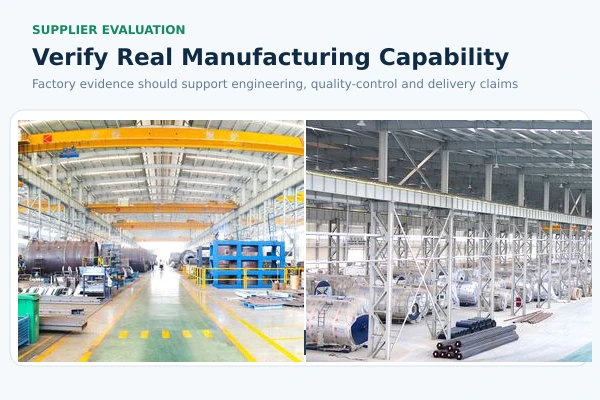
Ask about:
For statements such as:
“Hohe Effizienz”
ask for:
Calculation/test basis + Kraftstoff + laden + Speisewassertemperatur.
Für:
“Low NOx”
ask for:
Guaranteed value + Kraftstoff + laden + reference conditions + test method.
Für:
“Smart boiler”
ask for:
PLC architecture + I/O list + monitored parameters + communication functions.
Für Exportprojekte, also evaluate:
A good supplier should be able to explain what it will deliver, what the buyer must provide and where each party’s responsibility begins and ends.
A procurement team should investigate further when it sees any of the following.
A percentage alone is not enough.
The supplier should ask about normal and minimum load.
Variable demand affects burner and boiler operation.
Ask for fuel, laden, reference oxygen and test basis.
A low price may reflect an incomplete scope.
Verify the manufacturer, equipment and applicability.
Water conditions affect boiler operation and life.
International projects need clear interface boundaries.
Kritische Ersatzteile sollten vor dem Versand identifiziert werden.
Vergleichen Sie den Umfang, bevor Sie den Preis vergleichen.
Nutzen Sie diesen Vorgang, bevor Sie eine Bestellung aufgeben.
Kapazität ermitteln, Druck, Temperatur und Dampfqualität.
Minimum ermitteln, normal and peak demand.
Beziehen Sie Prozessanforderungen und Verteilungsüberlegungen ein.
Preis vergleichen, infrastructure, Versorgungssicherheit und Lagerhaltung.
Feuerrohr bewerten, Wasserrohr oder eine andere Konfiguration entsprechend den tatsächlichen Anforderungen.
Verwenden Sie konsistente Test-/Berechnungsannahmen und prüfen Sie den Teillastbetrieb.
Behandlung definieren, Deaeration, Anforderungen an Kondensatrückführung und Abschlämmung.
Use requirements applicable to the installation market.
Specify measurements, PLC/HMI/SCADA integration, alarms and remote access.
Compare lifecycle operating costs—not just purchase price.
Review engineering, Herstellung, Testen, documentation and service.
Clearly define inclusions, exclusions, Installation, Inbetriebnahme, Ausbildung, spare parts and warranty.
Zusamenfassend:
Steam Demand → Load Profile → Pressure → Fuel → Boiler Type → Efficiency → Water → Compliance → Automation → TCO → Supplier → Contract
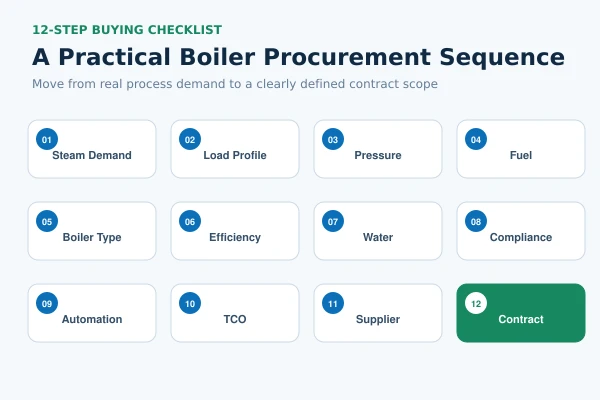
To receive a useful engineering quotation, prepare the following information.
Providing these parameters allows the engineering team to evaluate an actual boiler system instead of producing a generic price quotation.
The correct size depends on minimum, normal and peak steam demand rather than maximum production capacity alone. Buyers should build a steam-load profile that also considers daily operating hours, batch loads, seasonal changes and future production requirements.
Start by determining steam consumption from all relevant process equipment and identifying which loads operate simultaneously. Separate normal demand from short peak loads and include reasonable system requirements. Final sizing should be verified through an engineering heat and mass balance rather than relying only on a simple rule of thumb.
The boiler should supply sufficient pressure for the process after accounting for steam-distribution and control requirements. Höherer Druck ist nicht automatisch besser. Define the pressure required at the process first, then select an appropriate boiler operating and design pressure.
Neither is universally better. Electric boilers eliminate point-of-use combustion and offer precise control, but electricity prices, grid capacity and demand charges can affect operating cost. Gas boilers may offer favorable economics where gas is readily available. Compare both using actual local energy prices and steam demand.
It can be in locations with reliable low-cost biomass, but fuel price alone is not enough. Biomass moisture, calorific value, Asche, Lagerung, feeding, dust control and maintenance must also be included in the economic comparison.
Fire-tube boilers pass hot gases through tubes surrounded by water, while water-tube boilers circulate water/steam through tubes heated externally. The appropriate design depends on capacity, Druck, Lastantwort, Raum, water conditions and process requirements.
Compare suppliers using the same fuel basis, Kessellast, feedwater temperature and test/calculation method. Also evaluate burner turndown, Stapeltemperatur, überschüssige Luft, economizer configuration, condensate recovery and blowdown because these influence real operating cost.
Je nach Projekt, auxiliary systems may include burners, Pumps, Wasseraufbereitung, Entlüfter, Ökonomen, Schornsteine, Kraftstoffsysteme, condensate systems, blowdown systems, controls and emissions equipment. Always confirm quotation inclusions and exclusions.
There is no reliable universal price. Cost varies with capacity, Druck, Kraftstoff, Kesseldesign, Brenner, Kontrollen, Wärmerückgewinnung, Wasseraufbereitung, Zertifizierung, emissions equipment and auxiliary-system scope. Installed project cost should be evaluated separately from boiler purchase price.
Add equipment, Kraftstoff, Strom, Wasser, Chemikalien, Wartung, Ersatzteile, Installation, emissions compliance and expected downtime over the selected evaluation period. Subtract credible recovered-energy savings where appropriate. Compare all proposals using the same assumptions.
At minimum, provide capacity, Lastprofil, Arbeitsdruck, Dampftemperatur, Kraftstoff, Betriebsstunden, Speisewasserbedingungen, Kondensatrückführung, application, Installationsland, emissions requirements and certification requirements.
Compare engineering capability, manufacturing quality, Zertifizierungsumfang, documented efficiency and emissions performance, factory testing, Automatisierung, project experience, documentation, commissioning support, spare-parts availability and after-sales service—not only price.
The best industrial steam boiler in 2026 is not automatically the one with the highest capacity, highest quoted efficiency or lowest purchase price.
A successful boiler project begins with the production process.
Ask:
Die stärkste Einkaufsstrategie ist daher:
Definieren Sie die Kapazität → Erstellen Sie das Lastprofil → Definieren Sie den Druck → Vergleichen Sie Brennstoffe → Wählen Sie den Kesseltyp aus → Bewerten Sie die tatsächliche Effizienz → Bestätigen Sie die Wasser- und Compliance-Anforderungen → Definieren Sie die Automatisierung → Berechnen Sie die Gesamtbetriebskosten → Überprüfen Sie die Lieferantennachweise → Bestätigen Sie den gesamten Projektumfang.
Wenn Sie ein Industriedampfkesselprojekt vorbereiten, Beginnen Sie mit fünf Parametern:
Dampfkapazität + Arbeitsdruck + Kraftstoff + Betriebsstunden + Installationsland
Mit diesen Eingaben – und vorzugsweise einem echten Dampflastprofil – kann ein Kesselhersteller über ein allgemeines Angebot hinausgehen und mit der Entwicklung eines Systems beginnen, das dem tatsächlichen Prozess entspricht.
Need help choosing the right industrial steam boiler? Send your capacity, Druck, fuel and installation country to us on WhatsApp for a project-specific boiler recommendation and quotation. Get a Boiler Quote on WhatsApp → +86-132-1322-2805。
KOSTENLOSE KESSELANGEBOTE
Keine Verzögerung, erhalten 3 Zitate heute Vergleichen Sie für die besten Preise Sicher und zuverlässigBEWERTUNGEN
WAS IN DIESEM ARTIKEL STEHT?
Wenn Sie Fang Kuai mögen, Bitte hinterlassen Sie Ihre Nachricht.



vSehen Sie sich die Bewertungen unserer Kunden an
"Die Dampferzeuger von Fangkuai sind ausgezeichnet. Sie sind sehr einfach zu bedienen und erfordern nur minimale Wartung. Auch der Kundenservice bei Fangkuai ist außergewöhnlich. Sie sind sehr reaktionsschnell und immer bereit zu helfen. Bemerkenswert ist auch die Energieeffizienz der Dampferzeuger, was mir geholfen hat, Geld bei meinen Energierechnungen zu sparen. Ich kann die Dampfgeneratoren von Fangkuai sehr empfehlen."
Maria
Spanien"Der Kundenservice bei Fangkuai ist erstklassig. Sie halfen mir bei der Auswahl des perfekten Kessels für meine Bedürfnisse und boten während des gesamten Prozesses großartige Unterstützung. Der Installationsprozess verlief auch sehr reibungslos und der Kessel hat meine Erwartungen übertroffen. Es ist sehr einfach zu bedienen und zu warten, und die Energieeffizienz ist bemerkenswert. Ich kann die Produkte von Fangkuai jedem wärmstens empfehlen, der zuverlässige und effiziente Heizlösungen benötigt."
Juan
Mexiko"Der Thermalölkessel von Fangkuai ist sehr einfach zu bedienen und zu warten. Es hat uns geholfen, Zeit und Geld bei der Wartung zu sparen, was zu erheblichen Kosteneinsparungen geführt hat. Die Qualität der Materialien und die Konstruktion des Kessels sind außergewöhnlich. Es ist auch sehr energieeffizient, was uns geholfen hat, Geld bei unseren Energierechnungen zu sparen. Ich kann den Thermalölkessel von Fangkuai sehr empfehlen ."
Allen
Brasilien"Die Dampferzeuger von Fangkuai sind ausgezeichnet. Sie sind sehr einfach zu bedienen und erfordern nur minimale Wartung. Auch der Kundenservice bei Fangkuai ist außergewöhnlich. Sie sind sehr reaktionsschnell und immer bereit zu helfen. Bemerkenswert ist auch die Energieeffizienz der Dampferzeuger, was mir geholfen hat, Geld bei meinen Energierechnungen zu sparen. Ich kann die Dampfgeneratoren von Fangkuai sehr empfehlen."
Maria
Spanien"Der Thermalölkessel von Fangkuai ist sehr einfach zu bedienen und zu warten. Es hat uns geholfen, Zeit und Geld bei der Wartung zu sparen, was zu erheblichen Kosteneinsparungen geführt hat. Die Qualität der Materialien und die Konstruktion des Kessels sind außergewöhnlich. Es ist auch sehr energieeffizient, was uns geholfen hat, Geld bei unseren Energierechnungen zu sparen. Ich kann den Thermalölkessel von Fangkuai sehr empfehlen ."
Allen
Brasilien"Der Dampfkessel von Fangkuai ist perfekt für meinen Lebensmittelverarbeitungsbetrieb. Es erfüllt alle unsere Anforderungen und ist sehr zuverlässig. Die Qualität der Materialien und die Konstruktion des Kessels sind außergewöhnlich. Außerdem ist es sehr einfach zu bedienen und zu warten, Das hat uns geholfen, Zeit und Geld bei der Wartung zu sparen. Ich kann die Dampfkessel von Fangkuai jedem wärmstens empfehlen, der zuverlässige Heizlösungen benötigt."
Json
Brasilien"Der Heißwasserboiler von Fangkuai ist erstaunlich. Es heizt schnell und effizient auf, und das Wasser bleibt lange heiß. Wir hatten nie Probleme damit und es hat unsere täglichen Abläufe erheblich verbessert. Auch die Installation verlief reibungslos und der Kundenservice war ausgezeichnet. Ich kann die Heißwasserboiler von Fangkuai sehr empfehlen."
Sarah
Kanada"Wir verwenden den Fangkuai-Thermalölkessel seit Jahren für unsere Chemieanlage und er hat uns nie im Stich gelassen. Der Kessel ist sehr langlebig und hält rauen Bedingungen stand. Außerdem ist es sehr einfach zu bedienen und zu warten, Das hat uns geholfen, Zeit und Geld bei der Wartung zu sparen. Die Thermalölkessel von Fangkuai sind erstklassig und ich kann sie jedem wärmstens empfehlen, der zuverlässige Heizlösungen benötigt."
Chang
China"Der Kundenservice bei Fangkuai ist erstklassig. Sie halfen mir bei der Auswahl des perfekten Kessels für meine Bedürfnisse und boten während des gesamten Prozesses großartige Unterstützung. Der Installationsprozess verlief auch sehr reibungslos und der Kessel hat meine Erwartungen übertroffen. Es ist sehr einfach zu bedienen und zu warten, und die Energieeffizienz ist bemerkenswert. Ich kann die Produkte von Fangkuai jedem wärmstens empfehlen, der zuverlässige und effiziente Heizlösungen benötigt."
Juan
Mexiko