Guía de compra de calderas de vapor industriales 2026: Capacidad, Presión, Fuel and TCO
Buying an industrial steam boiler in 2026 is not simply a matter of choosing a capacity, asking for a price, and comparing quotations.
A boiler that looks attractive on a datasheet may be a poor fit once it is connected to a real production process. Steam demand changes throughout the day. Fuel prices vary by location. Feedwater conditions affect efficiency and reliability. Emissions rules depend on the installation market. Automation requirements differ from one plant to another, and a low initial price can be offset by years of higher fuel consumption, mantenimiento, or downtime.
For most industrial buyers, a better boiler selection starts with four questions:
- How much steam does the process actually require?
- What steam pressure and temperature are needed?
- Which fuels are realistically available at the site?
- What will the complete boiler system cost to own and operate?
These four variables—capacity, presión, fuel and total cost of ownership (costo total de propiedad)—form the foundation of a practical industrial steam boiler buying strategy.
This guide explains how to evaluate them, what information to request from suppliers, and how to compare industrial steam boiler proposals on a consistent engineering basis.
Respuesta rápida: How Do You Choose an Industrial Steam Boiler?
To choose an industrial steam boiler, first define the plant’s minimum, demanda de vapor normal y pico. Then determine the required working pressure, temperatura del vapor, available fuels, condiciones del agua de alimentación, horas de funcionamiento, emissions requirements and applicable certification.
After that, compare boiler designs based on:
- part-load performance;
- consumo de combustible;
- reducción del quemador;
- steam pressure and quality;
- water-treatment requirements;
- heat-recovery options;
- automatización;
- equipo auxiliar;
- mantenimiento;
- instalación;
- supplier support;
- y costo total de propiedad.
The best boiler is not necessarily the largest, cheapest or highest-rated-efficiency option. It is the boiler system that most reliably matches the plant’s actual operating conditions.
1. What Should You Know Before Buying an Industrial Steam Boiler?
A useful boiler quotation starts with useful process data.
Requests such as “I need a 10-ton boiler” o “Please quote a gas boiler” provide too little information for accurate engineering selection.
Before contacting an industrial boiler manufacturer, prepare the following information.
| Parámetro |
What the Buyer Should Provide |
Por qué es importante |
| Capacidad de vapor |
Minimum, normal and peak demand |
Determines boiler sizing |
| Presión de trabajo |
Required process pressure |
Affects boiler design |
| Temperatura del vapor |
Saturated or superheated |
Defines steam conditions |
| Combustible |
Gas, aceite, biomasa, electricidad, etc.. |
Determines combustion/energy system |
| Operating profile |
Hours/day and days/year |
Affects annual operating cost |
| Agua de alimentación |
Temperature and water quality |
Influences efficiency and treatment |
| Condensate return |
Expected percentage/flow |
Affects heat and water balance |
| Installation location |
Country and region |
Determines regulatory requirements |
| Emisiones |
Applicable local limits |
Influences burner/control equipment |
| Proceso de dar un título |
Project-specific requirements |
Influences design and documentation |
| Automatización |
SOCIEDAD ANÓNIMA, SCADA, remote monitoring |
Defines control scope |
| Site limits |
Espacio, acceso, altitude, transport |
Influences physical configuration |
The earlier these variables are defined, the easier it becomes to compare competing boiler proposals fairly.
2. How Do You Determine the Correct Steam Boiler Capacity?
Steam boiler capacity is normally selected from process steam demand—not simply from the maximum theoretical capacity of the production line.
Industrial steam demand may be expressed in:
- kg/hora;
- t/h;
- lb/h;
- boiler horsepower;
- or thermal power.
Regardless of the unit, the important question is how much steam the plant needs at different operating conditions.
Minimum, Normal and Peak Steam Demand
A useful steam-load profile should identify:
- demanda mínima de vapor;
- demanda normal de vapor;
- demanda máxima de vapor;
- duration of peak demand;
- daily operating hours;
- shift patterns;
- batch processes;
- simultaneous equipment operation;
- seasonal changes;
- and expected future production expansion.
Consider a simplified example.
A factory may have a calculated maximum requirement of 10 t/h but operate at only 4–6 t/h during most production hours. Short production peaks occasionally approach 10 t/h.
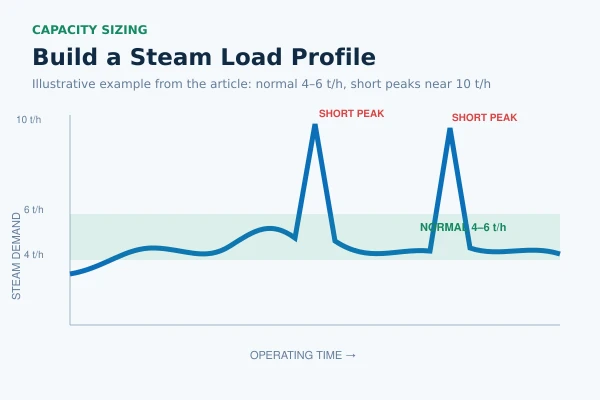
This does not automatically mean that maximum capacity should be ignored. It means boiler selection must consider both the peak and the much more common part-load condition.
Why Boiler Oversizing Can Be Expensive
An oversized boiler can create several problems.
If the burner cannot modulate down to match lower steam demand, the boiler may repeatedly start and stop. Frequent cycling can increase avoidable losses, create pressure fluctuations and add operating wear.
Oversizing can also mean:
- unnecessary initial investment;
- larger auxiliary equipment;
- additional installation space;
- excessive standby losses;
- and poorer utilization of the installed system.
Why Undersizing Is Also a Risk
A boiler that is too small may:
- fail to maintain required steam pressure;
- limit production capacity;
- operate continuously near maximum firing;
- struggle with short high-load periods;
- and leave little reserve for future production changes.
The goal is therefore not to minimize or maximize capacity. It is to match boiler capacity and configuration to a documented load profile.
For variable-load plants, buyers should also evaluate burner turndown, boiler sequencing and whether multiple smaller boilers would provide better flexibility than one large unit.
3. What Steam Pressure Does Your Process Require?
Capacity answers the question “How much steam?”
Pressure answers another question:
At what condition must that steam reach the process?
Boiler pressure should not be selected simply because a higher-pressure model appears more capable.
The required pressure should come from the process.
Boiler Pressure vs. Process Pressure
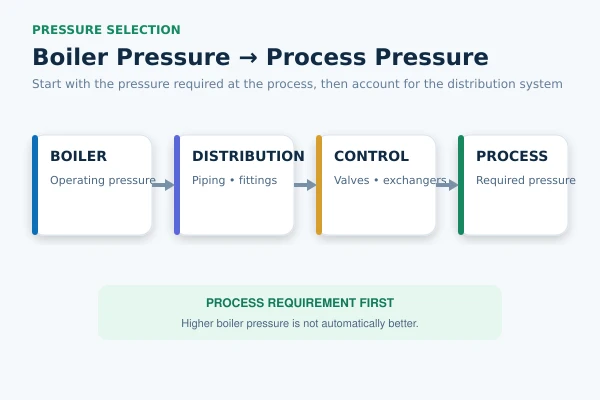
The boiler’s operating pressure and the pressure available at the steam-consuming equipment are not always identical.
Pressure can be lost through:
- steam piping;
- válvulas;
- guarniciones;
- intercambiadores de calor;
- control valves;
- distribution distance;
- and changing steam flow.
A buyer should therefore identify the pressure required at the actual process and allow the system designer to evaluate reasonable distribution losses and control requirements.
Unnecessarily high boiler pressure can increase equipment requirements and may create operating conditions that the process does not need.
Saturated Steam vs. Superheated Steam
Most process-heating applications use saturated steam, while some specialized industrial and power applications may require superheated steam.
| Factor |
Saturated Steam |
Superheated Steam |
| Temperatura |
Related to saturation pressure |
Above saturation temperature |
| Common role |
Calentamiento de proceso |
Specialized processes/power |
| Heat-transfer behavior |
Strong for many heating duties |
Application-dependent |
| System complexity |
Generally simpler |
Generally higher |
| Selection basis |
Process requirement |
Specific engineering requirement |
A supplier should therefore know capacity, pressure and steam-temperature requirements before recommending a boiler configuration.
4. Which Fuel Should You Choose for an Industrial Steam Boiler?
There is no universally best industrial boiler fuel.
Fuel selection is increasingly a site-specific economic and engineering decision.
Buyers should compare:
- local fuel price;
- long-term supply reliability;
- storage requirements;
- infrastructure;
- burner/fuel-system complexity;
- requisitos de emisiones;
- mantenimiento;
- automatización;
- and expected operating hours.
Gas-Fired Steam Boilers
Calderas de vapor a gas remain widely applicable where natural gas or another suitable gaseous fuel is reliably available.
Potential advantages include:
- mature burner technology;
- relatively simple fuel handling;
- strong load response;
- high automation potential;
- compact fuel infrastructure;
- and compatibility with heat-recovery equipment.
But buyers should still investigate gas-price exposure, supply pressure, local emissions requirements and the long-term availability of the fuel.
Oil and Diesel-Fired Boilers
Liquid-fuel systems may be useful where gas infrastructure is unavailable or where a site requires an independent or backup fuel supply.
The procurement scope may need to include:
- fuel tanks;
- pumping;
- filtración;
- fuel heating where applicable;
- burner configuration;
- spill-control measures;
- and local environmental requirements.
A lower boiler purchase price should not be considered separately from the cost of the complete fuel system.
Calderas de vapor eléctricas
Calderas de vapor eléctrico eliminate combustion at the point of use and can provide precise load control.
Sin embargo, the boiler itself is only part of the decision.
Buyers should check:
- available electrical capacity;
- transformer capacity;
- plant maximum demand;
- connection voltage;
- grid-upgrade requirements;
- electricity tariff;
- demand charges;
- and expected operating schedule.
The International Energy Agency notes that electric boilers are commercially available for industrial heat and steam, while electricity-to-gas price ratios and grid connection constraints can materially affect deployment.
This is why an electric boiler should be evaluated as part of the plant’s electrical system rather than as an isolated piece of equipment.
Calderas de vapor de biomasa
Biomass-fired steam boilers may be economically attractive where a consistent, suitable and competitively priced biomass fuel is locally available.
But “biomasa” is not a complete fuel specification.
Buyers should provide data for:
- moisture;
- calorific value;
- ash content;
- particle size;
- bulk density;
- contaminants;
- and seasonal variation.
The project may also require:
- fuel storage;
- conveying;
- feeding;
- manejo de cenizas;
- dust collection;
- and additional maintenance.
A cheap biomass fuel can become expensive if inconsistent quality reduces useful steam output or causes operating problems.
Dual-Fuel and Multi-Fuel Boilers
Fuel flexibility may be valuable where fuel prices fluctuate or where uninterrupted steam production is critical.
Sin embargo, flexibility also adds complexity.
Compare:
- burner capability;
- almacenamiento;
- switching procedure;
- efficiency on each fuel;
- emissions on each fuel;
- control logic;
- y mantenimiento.
Fuel flexibility is valuable when it solves a real supply or operating risk—not simply because “more fuels” sounds better on a specification sheet.
5. Gas vs. Electric vs. Calderas de Biomasa: Which Is Better?
The answer depends on the site.
| Factor |
Caldera de gas |
Caldera electrica |
Caldera de biomasa |
| Energy infrastructure |
Gas supply |
Electrical capacity |
Biomass supply/storage |
| On-site combustion |
Sí |
No |
Sí |
| Fuel handling |
Relatively simple |
Very simple |
Mas complejo |
| Automation potential |
Alto |
Very high |
Alto |
| Complejidad del mantenimiento |
Moderado |
Generally lower |
Generally higher |
| Local emissions equipment |
Dependiente del mercado |
No combustion system |
Often more extensive |
| Energy-price exposure |
Gas market |
Electricity market |
Biomass supply chain |
| Best fit |
Broad industrial use |
Favorable electrical economics |
Reliable biomass availability |
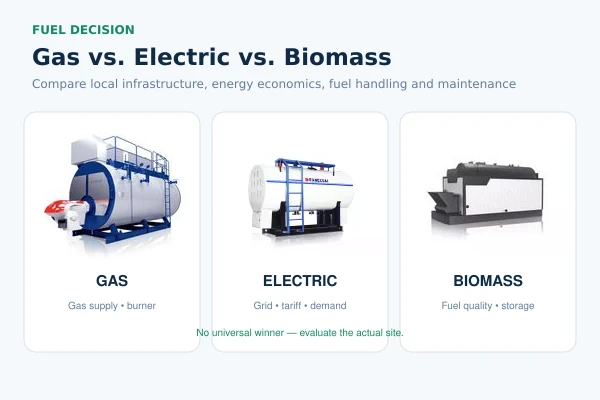
Instead of asking which fuel is universally cheapest, calculate the expected cost of useful steam under the plant’s actual conditions.
That requires actual energy prices, horas de funcionamiento, steam demand and realistic system efficiency.
6. Fire-Tube vs. Caldera acuotubular: Which Design Should You Choose?
Boiler construction is another important purchasing decision.
Neither design is automatically superior.
Calderas pirotubulares
En una caldera pirotubular, hot combustion gases pass through tubes surrounded by water.
Dependiendo del proyecto, fire-tube designs can offer relatively straightforward operation and a compact solution for many industrial steam applications.
Calderas acuotubulares
En una caldera acuotubular, water/steam flows through tubes heated externally by combustion gases.
Water-tube systems are frequently considered for applications involving higher capacities, pressures or demanding operating conditions, but the correct selection remains project-specific.
A detailed fire-tube vs. water-tube boiler comparison should consider:
| Selection Factor |
Questions to Ask |
| Capacidad |
What is minimum, normal and peak demand? |
| Presión |
What process pressure is required? |
| Load changes |
How quickly does steam demand vary? |
| Espacio |
What boiler-room dimensions are available? |
| Calidad del agua |
What treatment system is available? |
| Mantenimiento |
What service capability exists locally? |
| Instalación |
Are there transport or site restrictions? |
| Expansion |
Is future steam-demand growth expected? |
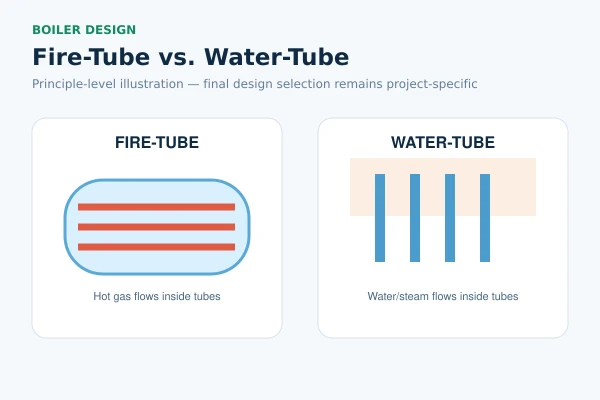
Boiler type should follow the process requirement, not the other way around.
7. How Should Industrial Steam Boiler Efficiency Be Compared?
“Eficiencia de la caldera: 95%.”
By itself, that number tells a buyer surprisingly little.
A meaningful efficiency figure should state the conditions under which it was calculated or tested.
Ask:
- Which fuel was used?
- Was the calculation based on LHV or HHV?
- What boiler load was assumed?
- What was the feedwater temperature?
- What was the stack temperature?
- What excess-air or O₂ condition was used?
- Was an economizer included?
- Was auxiliary electricity included?
- Was the value measured or calculated?
Rated Efficiency vs. Real Operating Efficiency
A boiler operates inside a steam system.
Real annual fuel consumption can be affected by:
- modulación del quemador;
- exceso de aire;
- short cycling;
- incrustaciones o incrustaciones;
- temperatura del agua de alimentación;
- retorno de condensado;
- purga;
- aislamiento;
- fuga de vapor;
- economizer performance;
- and operator settings.
El A NOSOTROS. Department of Energy’s steam-system resources identify system-level improvement opportunities including combustion optimization, retorno de condensado, blowdown control, efficient burners and waste-heat recovery.
This is an important procurement lesson.
The highest quoted efficiency is not automatically the lowest annual fuel cost.
Heat-Recovery Technologies Worth Evaluating
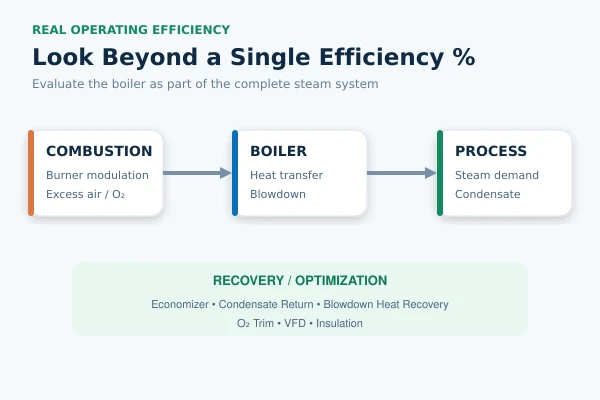
Dependiendo del proyecto, options may include:
- feedwater economizers;
- condensing economizers where technically suitable;
- combustion-air preheating;
- blowdown heat recovery;
- condensate recovery;
- automatic blowdown control;
- O₂ trim;
- variable-frequency drives;
- and improved insulation.
Each option should be evaluated against actual operating conditions.
8. Why Feedwater Quality Matters Before You Buy a Boiler
Feedwater is not a secondary issue.
Water conditions influence boiler reliability, eficiencia, maintenance and service life.
Dependiendo del sistema, engineers may need to evaluate:
- dureza;
- dissolved solids;
- oxígeno disuelto;
- alcalinidad;
- pH;
- sílice;
- agua de maquillaje;
- condensate quality;
- and treatment chemicals.
Poor water management can contribute to scale, corrosión, carryover and unnecessary blowdown.
Scale on heat-transfer surfaces can reduce effective heat transfer, while corrosion can create serious reliability problems.
The complete project may therefore require:
- pretreatment;
- reblandecimiento;
- reverse osmosis where appropriate;
- dosificación química;
- desaa;
- feedwater storage;
- condensate recovery;
- and blowdown control.
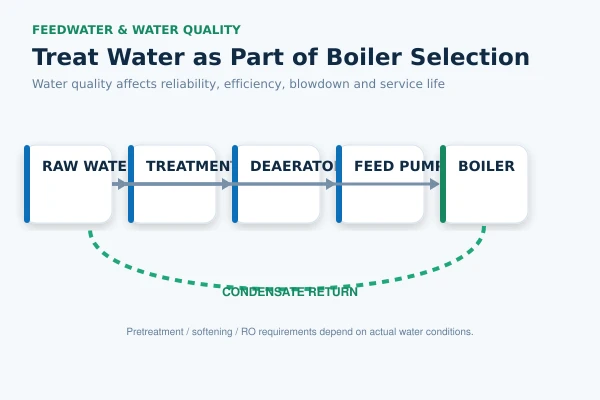
A boiler manufacturer should receive basic feedwater information before final equipment selection rather than discovering severe water-quality problems during commissioning.
9. What Auxiliary Equipment Does an Industrial Steam Boiler Need?
A quotation for “one boiler” does not necessarily include a complete steam plant.
This is one of the easiest ways for two supplier quotations to appear similar while actually covering very different scopes.
Dependiendo del proyecto, auxiliary equipment may include:
- quemador;
- feedwater pumps;
- feedwater tank;
- deaerator;
- water-treatment equipment;
- economizador;
- air preheater;
- tubo de lámpara;
- fuel system;
- gas train;
- biomass feeding equipment;
- manejo de cenizas;
- blowdown equipment;
- sistema de condensado;
- control cabinet;
- emissions-control equipment;
- valves and instrumentation.
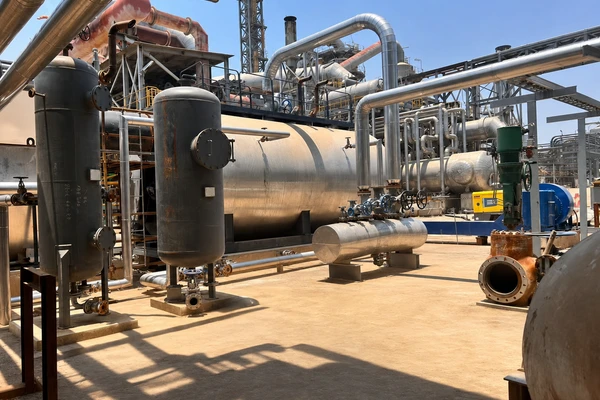
Buyers should request a clear list of inclusions and exclusions.
If Supplier A includes the boiler, quemador, economizador, pumps and controls while Supplier B quotes only the pressure vessel and basic burner, their prices are not directly comparable.
10. What Boiler Automation Should You Specify in 2026?
A PLC-controlled boiler is not automatically a “smart boiler.”
The procurement question should be:
What does the control system measure, record, communicate and optimize?
At minimum, industrial boiler automation may need to control or monitor:
- burner operation;
- steam pressure;
- nivel del agua;
- agua de alimentación;
- safety interlocks;
- alarm conditions.
More advanced systems may monitor:
- steam flow;
- flujo de combustible;
- feedwater flow;
- temperatura del agua de alimentación;
- temperatura de la pila;
- stack O₂;
- burner firing rate;
- purga;
- horas de funcionamiento;
- alarm history;
- y consumo de energía.
Integration may extend to:
Sensors → PLC → HMI → SCADA → Data Storage → Remote Monitoring
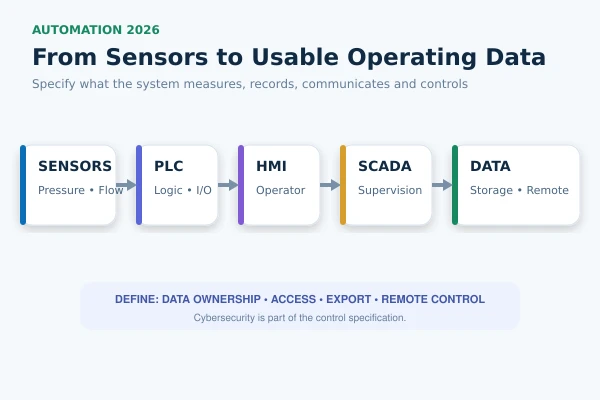
Before ordering remote monitoring, also define:
- who owns the operating data;
- who can access it;
- how long data is retained;
- whether it can be exported;
- who can change PLC settings;
- and whether remote access can be disabled by the plant.
For connected industrial systems, cybersecurity should be part of the control specification. NIST SP 800-82 Rev. 3 provides guidance for operational technology security, including industrial control environments.
11. Emissions and Certification: Check the Installation Market First
There is no single global emissions limit that applies to every industrial steam boiler.
Requirements may vary by:
- country;
- state/province;
- local jurisdiction;
- capacidad de la caldera;
- combustible;
- process;
- horas de funcionamiento;
- and environmental permit.
Por ejemplo, el A NOSOTROS. EPA’s industrial, commercial and institutional boiler rules illustrate how boiler requirements can depend on facility and fuel category.
For an export project, buyers should identify the applicable emissions requirement before final burner and emissions-control selection.
Potential regulated emissions can include:
- NOx;
- CO;
- partícula;
- SOx;
- and other market-specific pollutants.
The required solution may involve low-NOx burners, flue-gas recirculation, combustion controls, dust collection or other technologies depending on fuel and local requirements.
Certification Requirements
Certification also depends on destination and project scope.
Examples can include applicable requirements under the Código ASME para calderas y recipientes a presión o, for relevant EU pressure equipment, el Pressure Equipment Directive.
Do not simply ask a supplier:
“Do you have CE/ASME?”
Instead ask:
- Which equipment is covered?
- Which manufacturer is named?
- What is the certificate scope?
- Does it apply to the exact equipment being quoted?
- What project documentation will be supplied?
Certification should be verified before production.
12. How Much Does an Industrial Steam Boiler Cost?
There is no reliable universal price for an industrial steam boiler.
Price depends on much more than nominal capacity.
Major cost drivers include:
- capacidad de vapor;
- design pressure;
- temperatura del vapor;
- boiler construction;
- combustible;
- quemador;
- materiales;
- automatización;
- recuperación de calor;
- tratamiento de agua;
- emissions equipment;
- certification;
- auxiliary systems;
- transport;
- instalación;
- and commissioning.
This creates three different numbers:
Boiler Purchase Price ≠ Installed Project Cost ≠ Lifecycle Cost
A low equipment quotation can become expensive when important systems are excluded.
Instead of asking only:
“How much is a 10-ton steam boiler?”
ask:
“What is included in the complete 10 t/h steam system for my specified pressure, combustible, agua de alimentación, emissions requirements and operating profile?”
That question produces a much more useful quotation.
13. How Do You Calculate Industrial Boiler Total Cost of Ownership?
Total cost of ownership considers what the boiler will cost throughout an evaluation period—not only what it costs to purchase.
A practical model is:
Boiler TCO = Equipment + Combustible + Electricidad + Agua + Chemicals + Mantenimiento + Piezas de repuesto + Emissions Compliance + Instalación + Downtime − Recoverable Energy Savings
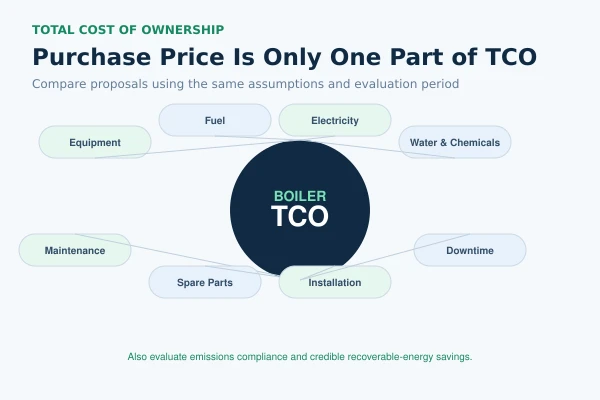
A five-, ten- or longer-year model can be used depending on the company’s investment process.
Costo del equipo
Include the boiler and all equipment necessary to achieve the defined scope.
Costo de combustible
For many steam plants, fuel becomes one of the largest lifecycle expenses.
Annual fuel calculations should use realistic steam demand and operating hours rather than assuming continuous operation at nameplate capacity.
Important inputs include:
- annual operating hours;
- steam load profile;
- temperatura del agua de alimentación;
- fuel heating value;
- boiler efficiency basis;
- retorno de condensado;
- and local fuel price.
Electricidad
Include electrical consumption from:
- fans;
- zapatillas;
- controles;
- manejo de combustible;
- tratamiento de agua;
- emissions equipment;
- and related auxiliaries.
For electric boilers, electricity becomes the primary energy input and tariff structure becomes particularly important.
Water and Chemicals
Considerar:
- agua de maquillaje;
- feedwater treatment;
- chemical consumption;
- condensate recovery;
- and blowdown.
Maintenance and Spare Parts
Estimate:
- burner service;
- tube cleaning;
- refractory maintenance where applicable;
- sensors;
- válvulas;
- zapatillas;
- water-treatment consumables;
- and critical spare parts.
Downtime
Downtime is often underestimated.
In some manufacturing facilities, an hour without process steam can cost far more than a small difference in quoted boiler efficiency.
Critical processes should therefore evaluate:
- redundancy;
- backup capacity;
- spare-parts availability;
- service response;
- and maintenance planning.
14. A Practical 10-Year Boiler TCO Comparison Worksheet
When comparing industrial steam boiler suppliers, most buyers make a critical mistake: they compare only the quotation price instead of comparing the full lifecycle cost under identical operating assumptions.
To make a fair decision, all suppliers must be evaluated using the same technical and economic baseline:
- identical steam demand profile
- identical operating hours
- identical fuel price assumptions
- identical feedwater conditions
- identical efficiency basis (LHV or HHV)
- identical maintenance strategy
Without this normalization, the comparison becomes meaningless.
Ejemplo: 10-Year TCO Comparison (10 t/h Gas Boiler Case)
Assumptions for this example:
- Steam demand: 10 t/h (average 6.5 t/h)
- Operating hours: 6,000 h/year
- Combustible: Gas natural
- Gas price: 0.35 USD/Nm³
- Eficiencia de la caldera: 90% (Supplier A), 92% (Supplier B), 94% (Supplier C)
- Project life: 10 años
10-Year TCO Comparison Table (Example Filled)
| TCO Item |
Supplier A (Basic System) |
Supplier B (Optimized System) |
Supplier C (High-Efficiency System) |
| Equipment cost |
$180,000 |
$210,000 |
$260,000 |
| Auxiliaries (bomba, tanque, controles) |
$45,000 |
$60,000 |
$85,000 |
| Instalación & puesta en marcha |
$50,000 |
$55,000 |
$70,000 |
| Subtotal CAPEX |
$275,000 |
$325,000 |
$415,000 |
| Costo anual de combustible |
$310,000 |
$295,000 |
$275,000 |
| 10-year fuel cost |
$3,100,000 |
$2,950,000 |
$2,750,000 |
| Annual electricity |
$18,000 |
$16,000 |
$15,000 |
| 10-year electricity |
$180,000 |
$160,000 |
$150,000 |
| Agua & quimicos |
$25,000 |
$22,000 |
$20,000 |
| 10-year water/chemicals |
$250,000 |
$220,000 |
$200,000 |
| Mantenimiento anual |
$20,000 |
$18,000 |
$16,000 |
| 10-year maintenance |
$200,000 |
$180,000 |
$160,000 |
| Spare parts (10-año) |
$60,000 |
$55,000 |
$50,000 |
| Emissions compliance cost |
$30,000 |
$25,000 |
$20,000 |
| Estimated downtime cost |
$120,000 |
$80,000 |
$50,000 |
| Heat recovery benefit |
-$50,000 |
-$90,000 |
-$130,000 |
| 10-year total TCO |
$4,165,000 |
$3,925,000 |
$3,665,000 |
Key Insight from the Comparison
Although Supplier C has the highest initial investment, it delivers the lowest total lifecycle cost due to:
- higher efficiency (lower fuel consumption)
- better heat recovery integration
- lower downtime risk
- improved automation stability
Mientras tanto, Supplier A appears attractive at purchase stage but becomes the most expensive option over 10 años due to fuel inefficiency.
Engineering Conclusion
A correct TCO decision is not:
“Which boiler is cheapest?"
Es:
“Which boiler produces steam at the lowest cost per ton over its real operating life?"
En la mayoría de los casos industriales, fuel cost represents 70–85% of total lifecycle cost, meaning even a 2–3% efficiency difference can outweigh the entire equipment price difference within a few years.
15. How Should Buyers Compare Industrial Steam Boiler Quotations?
Industrial boiler quotations are often misleading because different suppliers:
- include different equipment scopes
- assume different operating conditions
- use different efficiency definitions
- exclude critical auxiliary systems
- or shift responsibility to the buyer
Por lo tanto, the first step is not price comparison — it is scope normalization.
Paso 1: Normalize Technical Assumptions
Before comparing prices, force all suppliers to use the same baseline:
- Capacidad de vapor: identical (p.ej., 10 t/h)
- Presión: identical (p.ej., 10 bar / 16 bar)
- Combustible: same specification and price basis
- Operating hours: same annual runtime
- Temperatura del agua de alimentación: same assumption
- Condensate return: same percentage
- Efficiency basis: LHV or HHV clearly defined
If suppliers refuse to align assumptions, their quotations are not comparable.
Paso 2: Compare “System Scope”, Not Just Boiler
A real industrial steam system includes more than the pressure vessel.
A proper comparison must include:
- boiler body
- burner system
- feedwater system
- tratamiento de agua
- economizador (si corresponde)
- sistema de control (PLC/HMI)
- safety valves and instrumentation
- fuel system (gas train / oil system / biomass feeding)
- chimney and flue system
- installation and commissioning scope
Paso 3: Real Engineering Comparison Table
| Item |
Supplier A |
Supplier B |
Supplier C |
| Boiler type |
Fire-tube |
Fire-tube |
Water-tube |
| Rated efficiency |
90% |
92% |
94% |
| Part-load efficiency |
Not specified |
Moderado |
High stability |
| Burner turndown ratio |
1:3 |
1:5 |
1:8 |
| Economizer included |
No |
Sí |
Sí (high efficiency type) |
| Condensate recovery system |
Opcional |
Included |
Included + optimized |
| Sistema de control |
Basic PLC |
SOCIEDAD ANÓNIMA + HMI |
SOCIEDAD ANÓNIMA + SCADA + remote monitoring |
| Emissions system |
Standard burner |
Low-NOx burner |
Ultra-low NOx + FGR |
| Tratamiento de agua |
Not included |
Included |
Fully integrated system |
| Installation scope |
Equipment only |
Partial installation |
Full turnkey |
| Puesta en servicio |
Not included |
Included |
Full performance guarantee |
| Garantía |
12 meses |
18 meses |
24 meses + performance guarantee |
| Spare parts |
Limited |
Standard kit |
Full 2-year critical kit |
| Documentación |
Basic manual |
Full technical package |
Full + digital twin model |
Paso 4: Identify Hidden Cost Gaps
Many low-price quotations exclude critical systems such as:
- water treatment system
- condensate return system
- blowdown heat recovery
- mano de obra de instalación
- control integration
- emissions compliance equipment
These exclusions often shift 20–40% of total project cost back to the buyer.
Paso 5: Final Decision Rule
After normalization, the decision should follow this logic:
- Does the system meet process requirements?
- Does it minimize lifecycle cost (costo total de propiedad)?
- Does it reduce operational risk (downtime, instability)?
- Does it comply with emissions and certification rules?
- Is supplier support reliable for 10+ años?
Only when all five answers are positive should price become the deciding factor.
Final Engineering Insight
A professional boiler procurement decision is not a price comparison exercise.
It is a system engineering optimization problem involving:
- thermodynamics (eficiencia)
- process engineering (steam demand)
- economics (fuel cost over time)
- reliability engineering (downtime risk)
- compliance engineering (emisiones + certification)
If you want, I can next upgrade this article further into a “lead-generation version” (SEO + CTA + product positioning for MakeBoiler) or convert it into a landing page structure for Google Ads traffic.
16. What Should Be Included in an Industrial Boiler Quotation?
A professional industrial steam boiler quotation should clearly define the technical and commercial scope.
Dependiendo del proyecto, request:
Boiler Data
- modelo;
- capacidad;
- operating/design pressure;
- temperatura del vapor;
- combustible;
- efficiency and calculation/test basis.
Major Equipment
- caldera;
- quemador;
- economizador;
- feedwater pumps;
- deaerator/feedwater system;
- tratamiento de agua;
- fuel system;
- controles;
- emissions equipment.
Documentación
- technical datasheet;
- general arrangement drawing;
- process flow diagram;
- PAG&ID where required;
- electrical drawings;
- control description;
- applicable certificates;
- operating manual;
- maintenance manual;
- spare-parts list;
- factory test records.
Commercial Scope
- precio;
- delivery time;
- packing;
- transportation responsibility;
- installation responsibility;
- puesta en marcha;
- capacitación;
- garantía;
- after-sales support;
- exclusions.
A clear quotation reduces misunderstandings later in the project.
17. How Do You Evaluate an Industrial Steam Boiler Manufacturer?
Price alone is not enough to evaluate a boiler supplier.
An industrial boiler is a pressure system expected to operate for many years, often inside a production process where steam availability is critical.
Evaluate the supplier in several areas.
Engineering Capability
Can the supplier explain why a particular capacity, presión, burner and auxiliary configuration has been selected?
Manufacturing Capability
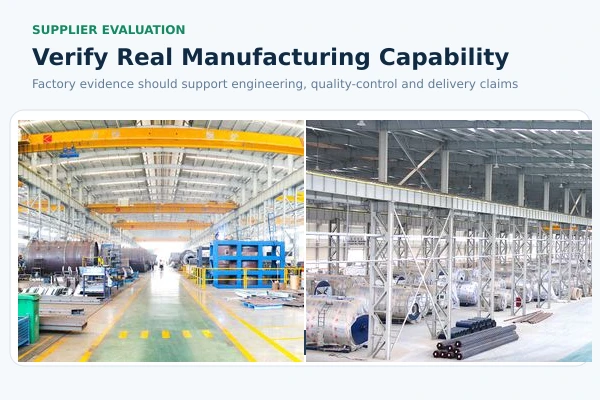
Ask about:
- manufacturing process;
- soldadura;
- material traceability;
- inspección;
- pressure testing;
- factory acceptance testing;
- and quality-control documentation.
Performance Evidence
For statements such as:
“Alta eficiencia”
ask for:
Calculation/test basis + combustible + carga + temperatura del agua de alimentación.
Para:
“Low NOx”
ask for:
Guaranteed value + combustible + carga + reference conditions + test method.
Para:
“Smart boiler”
ask for:
PLC architecture + I/O list + monitored parameters + communication functions.
International Project Capability
For export projects, also evaluate:
- packaging;
- shipping experience;
- documentation;
- installation coordination;
- remote technical support;
- spare-parts delivery;
- language capability;
- and commissioning responsibility.
A good supplier should be able to explain what it will deliver, what the buyer must provide and where each party’s responsibility begins and ends.
18. Industrial Steam Boiler Buying Red Flags
A procurement team should investigate further when it sees any of the following.
1. Efficiency Without Test Conditions
A percentage alone is not enough.
2. Sizing Based Only on Maximum Capacity
The supplier should ask about normal and minimum load.
3. No Load-Profile Discussion
Variable demand affects burner and boiler operation.
4. Emissions Guaranteed Without Reference Conditions
Ask for fuel, carga, reference oxygen and test basis.
5. Important Auxiliary Equipment Is Missing
A low price may reflect an incomplete scope.
6. Certification Scope Is Unclear
Verify the manufacturer, equipment and applicability.
7. The Supplier Never Asks About Feedwater
Water conditions affect boiler operation and life.
8. Installation Responsibility Is Undefined
International projects need clear interface boundaries.
9. There Is No Spare-Parts Plan
Critical spares should be identified before shipment.
10. The Price Is Extremely Low but Exclusions Are Vague
Compare scope before comparing price.
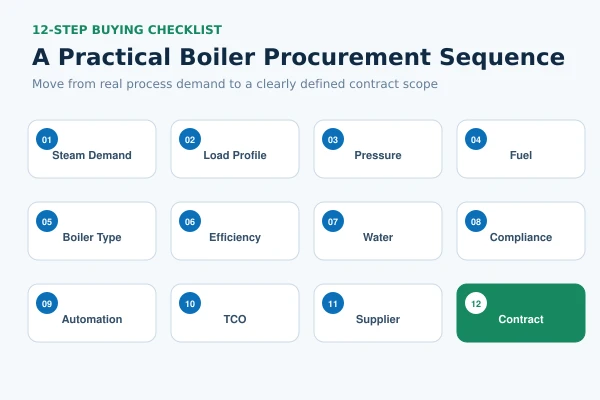
19. 12-Step Industrial Steam Boiler Buying Checklist for 2026
Use this process before placing an order.
Paso 1: Define Steam Demand
Determine capacity, presión, temperature and steam quality.
Paso 2: Build a Load Profile
Identify minimum, normal and peak demand.
Paso 3: Define Required Pressure
Include process requirements and distribution considerations.
Paso 4: Evaluate Fuel Options
Compare price, infrastructure, supply reliability and storage.
Paso 5: Select the Appropriate Boiler Design
Evaluate fire-tube, water-tube or another configuration against actual requirements.
Paso 6: Compare Real Efficiency
Use consistent test/calculation assumptions and examine part-load operation.
Paso 7: Confirm Feedwater Conditions
Define treatment, desaa, condensate return and blowdown requirements.
Paso 8: Verify Emissions and Certification
Use requirements applicable to the installation market.
Paso 9: Define Automation
Specify measurements, PLC/HMI/SCADA integration, alarms and remote access.
Paso 10: Calculate TCO
Compare lifecycle operating costs—not just purchase price.
Paso 11: Evaluate the Supplier
Review engineering, fabricación, pruebas, documentation and service.
Paso 12: Confirm Contract Scope
Clearly define inclusions, exclusions, instalación, puesta en marcha, capacitación, spare parts and warranty.
En breve:
Steam Demand → Load Profile → Pressure → Fuel → Boiler Type → Efficiency → Water → Compliance → Automation → TCO → Supplier → Contract
20. What Information Should You Send to a Boiler Manufacturer?
To receive a useful engineering quotation, prepare the following information.
Essential Boiler RFQ Data
- Required steam capacity
- Demanda mínima de vapor
- Demanda normal de vapor
- Demanda máxima de vapor
- Presión de trabajo
- Required steam temperature
- Fuel type and specification
- Horas de funcionamiento por día
- Días de funcionamiento al año
- Temperatura del agua de alimentación
- Feedwater quality
- Expected condensate return
- Industry/application
- País de instalación
- Local emissions requirements
- Required certification
- Site altitude where relevant
- Available electricity
- Space/transport restrictions
- Fecha de entrega requerida
Providing these parameters allows the engineering team to evaluate an actual boiler system instead of producing a generic price quotation.
Frequently Asked Questions About Buying an Industrial Steam Boiler
What size industrial steam boiler do I need?
The correct size depends on minimum, normal and peak steam demand rather than maximum production capacity alone. Buyers should build a steam-load profile that also considers daily operating hours, batch loads, seasonal changes and future production requirements.
How do I calculate industrial steam boiler capacity?
Start by determining steam consumption from all relevant process equipment and identifying which loads operate simultaneously. Separate normal demand from short peak loads and include reasonable system requirements. Final sizing should be verified through an engineering heat and mass balance rather than relying only on a simple rule of thumb.
What pressure should an industrial steam boiler operate at?
The boiler should supply sufficient pressure for the process after accounting for steam-distribution and control requirements. Higher pressure is not automatically better. Define the pressure required at the process first, then select an appropriate boiler operating and design pressure.
Is a gas or electric steam boiler better?
Neither is universally better. Electric boilers eliminate point-of-use combustion and offer precise control, but electricity prices, grid capacity and demand charges can affect operating cost. Gas boilers may offer favorable economics where gas is readily available. Compare both using actual local energy prices and steam demand.
Is a biomass boiler cheaper than a gas boiler?
It can be in locations with reliable low-cost biomass, but fuel price alone is not enough. Biomass moisture, calorific value, ash, almacenamiento, feeding, dust control and maintenance must also be included in the economic comparison.
What is the difference between fire-tube and water-tube boilers?
Fire-tube boilers pass hot gases through tubes surrounded by water, while water-tube boilers circulate water/steam through tubes heated externally. The appropriate design depends on capacity, presión, load response, espacio, water conditions and process requirements.
How should industrial boiler efficiency be compared?
Compare suppliers using the same fuel basis, carga de caldera, feedwater temperature and test/calculation method. Also evaluate burner turndown, temperatura de la pila, exceso de aire, economizer configuration, condensate recovery and blowdown because these influence real operating cost.
What auxiliary equipment does an industrial steam boiler need?
Dependiendo del proyecto, auxiliary systems may include burners, zapatillas, tratamiento de agua, desaireadores, economizadores, chimeneas, sistemas de combustible, condensate systems, blowdown systems, controls and emissions equipment. Always confirm quotation inclusions and exclusions.
How much does an industrial steam boiler cost?
There is no reliable universal price. Cost varies with capacity, presión, combustible, diseño de caldera, quemador, controles, recuperación de calor, tratamiento de agua, certification, emissions equipment and auxiliary-system scope. Installed project cost should be evaluated separately from boiler purchase price.
How do I calculate boiler total cost of ownership?
Add equipment, combustible, electricidad, agua, quimicos, mantenimiento, piezas de repuesto, instalación, emissions compliance and expected downtime over the selected evaluation period. Subtract credible recovered-energy savings where appropriate. Compare all proposals using the same assumptions.
What information does a manufacturer need to quote a boiler?
At minimum, provide capacity, perfil de carga, presión de trabajo, temperatura del vapor, combustible, horas de funcionamiento, condiciones del agua de alimentación, retorno de condensado, application, installation country, emissions requirements and certification requirements.
How should I compare industrial boiler manufacturers?
Compare engineering capability, manufacturing quality, alcance de la certificación, documented efficiency and emissions performance, factory testing, automatización, project experience, documentation, commissioning support, spare-parts availability and after-sales service—not only price.
Conclusión: Buy the Boiler That Fits the Process
The best industrial steam boiler in 2026 is not automatically the one with the highest capacity, highest quoted efficiency or lowest purchase price.
A successful boiler project begins with the production process.
Ask:
- How much steam is really required?
- How does demand change during the day?
- What pressure must reach the process?
- Which fuels are locally available?
- What does each fuel actually cost?
- What is the feedwater quality?
- What emissions rules apply?
- What automation is needed?
- What equipment is included?
- Who will install and commission the system?
- What happens if the boiler stops?
- What will the system cost over ten years?
The strongest purchasing strategy is therefore:
Define capacity → build the load profile → define pressure → compare fuels → select the boiler type → evaluate real efficiency → confirm water and compliance requirements → define automation → calculate TCO → verify supplier evidence → confirm the complete project scope.
If you are preparing an industrial steam boiler project, start with five parameters:
Capacidad de vapor + presión de trabajo + combustible + horas de funcionamiento + installation country
With those inputs—and preferably a real steam-load profile—a boiler manufacturer can move beyond a generic quotation and begin engineering a system that matches the actual process.
Need help choosing the right industrial steam boiler? Send your capacity, presión, fuel and installation country to us on WhatsApp for a project-specific boiler recommendation and quotation. Get a Boiler Quote on WhatsApp → +86-132-1322-2805。
Referencias autorizadas



VVer opiniones de nuestro cliente
"Llevamos años utilizando la caldera de aceite térmico Fangkuai para nuestra planta química y nunca nos ha defraudado.. La caldera es muy duradera y puede soportar condiciones adversas.. También es muy fácil de operar y mantener., lo que nos ha ayudado a ahorrar tiempo y dinero en mantenimiento. Las calderas de aceite térmico de Fangkuai son de primera y las recomiendo a cualquiera que necesite soluciones de calefacción confiables."
chang
Porcelana"Los generadores de vapor de Fangkuai son excelentes. Son muy fáciles de usar y requieren un mantenimiento mínimo.. El servicio al cliente en Fangkuai también es excepcional.. Son muy receptivos y siempre dispuestos a ayudar.. La eficiencia energética de los generadores de vapor también es destacable, que me ha ayudado a ahorrar dinero en mis facturas de energía. Recomiendo encarecidamente los generadores de vapor de Fangkuai."
María
España"La caldera de vapor de Fangkuai es perfecta para mi negocio de procesamiento de alimentos. Cumple con todos nuestros requisitos y es muy fiable.. La calidad de los materiales y la construcción de la caldera son excepcionales. También es muy fácil de operar y mantener., lo que nos ha ayudado a ahorrar tiempo y dinero en mantenimiento. Recomiendo encarecidamente las calderas de vapor de Fangkuai a cualquiera que necesite soluciones de calefacción fiables."
json
Brasil"La caldera de aceite térmico de Fangkuai es muy fácil de operar y mantener. Nos ha ayudado a ahorrar tiempo y dinero en mantenimiento., lo que ha supuesto un importante ahorro de costes. La calidad de los materiales y la construcción de la caldera son excepcionales. También es muy eficiente energéticamente., lo que nos ha ayudado a ahorrar dinero en nuestras facturas de energía. Recomiendo encarecidamente la caldera de aceite térmico de Fangkuai. ."
allen
Brasil"Los generadores de vapor de Fangkuai son excelentes. Son muy fáciles de usar y requieren un mantenimiento mínimo.. El servicio al cliente en Fangkuai también es excepcional.. Son muy receptivos y siempre dispuestos a ayudar.. La eficiencia energética de los generadores de vapor también es destacable, que me ha ayudado a ahorrar dinero en mis facturas de energía. Recomiendo encarecidamente los generadores de vapor de Fangkuai."
María
España"Llevamos años utilizando la caldera de aceite térmico Fangkuai para nuestra planta química y nunca nos ha defraudado.. La caldera es muy duradera y puede soportar condiciones adversas.. También es muy fácil de operar y mantener., lo que nos ha ayudado a ahorrar tiempo y dinero en mantenimiento. Las calderas de aceite térmico de Fangkuai son de primera y las recomiendo a cualquiera que necesite soluciones de calefacción confiables."
chang
Porcelana"La caldera de vapor de Fangkuai es perfecta para mi negocio de procesamiento de alimentos. Cumple con todos nuestros requisitos y es muy fiable.. La calidad de los materiales y la construcción de la caldera son excepcionales. También es muy fácil de operar y mantener., lo que nos ha ayudado a ahorrar tiempo y dinero en mantenimiento. Recomiendo encarecidamente las calderas de vapor de Fangkuai a cualquiera que necesite soluciones de calefacción fiables."
json
Brasil"El servicio al cliente en Fangkuai es de primera categoría.. Me ayudaron a elegir la caldera perfecta para mis necesidades y me brindaron un gran apoyo durante todo el proceso.. El proceso de instalación también fue muy sencillo y la caldera ha superado mis expectativas.. Es muy fácil de usar y mantener., y la eficiencia energética es notable. Recomiendo encarecidamente los productos de Fangkuai a cualquiera que necesite soluciones de calefacción fiables y eficientes."
Juan
México"Estoy muy impresionado con la calidad de la caldera de agua caliente de Fangkuai.. Está construido para durar y ha superado mis expectativas.. El proceso de instalación también fue muy sencillo y el servicio al cliente fue excelente.. La caldera de agua caliente es muy fácil de operar y mantener, y la eficiencia energética es notable. Recomiendo encarecidamente las calderas de agua caliente de Fangkuai."
Jacobo
Australia