
Buying an industrial steam boiler in 2026 is not simply a matter of choosing a capacity, asking for a price, and comparing quotations.
A boiler that looks attractive on a datasheet may be a poor fit once it is connected to a real production process. Steam demand changes throughout the day. Fuel prices vary by location. Feedwater conditions affect efficiency and reliability. Emissions rules depend on the installation market. Automation requirements differ from one plant to another, and a low initial price can be offset by years of higher fuel consumption, 维护, or downtime.
For most industrial buyers, 更好的锅炉选择从四个问题开始:
这四个变量——容量, 压力, 燃料和总拥有成本 (总拥有成本)—形成实用的工业蒸汽锅炉购买策略的基础.
本指南解释了如何评估它们, 需要向供应商索取哪些信息, 以及如何在一致的工程基础上比较工业蒸汽锅炉建议.
选择工业蒸汽锅炉, 首先定义工厂的最小值, 正常和高峰蒸汽需求. 然后确定所需的工作压力, 蒸汽温度, 可用燃料, 给水条件, 营业时间, 排放要求和适用的认证.
在那之后, 比较锅炉设计的基础:
最好的锅炉不一定是最大的, 最便宜或最高效率的选择. 是最可靠符合工厂实际运行工况的锅炉系统.
有用的锅炉报价始于有用的过程数据.
请求如 “我需要一台10吨锅炉” 或者 “请报价燃气锅炉” 为准确的工程选择提供的信息太少.
在联系工业锅炉制造商之前, 准备以下信息.
| 范围 | 买家应提供什么 | 为什么它很重要 |
|---|---|---|
| 蒸汽容量 | 最低限度, 正常和高峰需求 | 确定锅炉尺寸 |
| 工作压力 | 所需的过程压力 | 影响锅炉设计 |
| 蒸汽温度 | 饱和或过热 | Defines steam conditions |
| 燃料 | 气体, 油, 生物质, 电, ETC. | Determines combustion/energy system |
| Operating profile | Hours/day and days/year | Affects annual operating cost |
| Feedwater | Temperature and water quality | Influences efficiency and treatment |
| Condensate return | Expected percentage/flow | Affects heat and water balance |
| Installation location | Country and region | Determines regulatory requirements |
| 排放量 | Applicable local limits | Influences burner/control equipment |
| 认证 | Project-specific requirements | Influences design and documentation |
| 自动化 | 可编程逻辑控制器, SCADA, remote monitoring | Defines control scope |
| Site limits | 空间, 使用权, altitude, transport | Influences physical configuration |
The earlier these variables are defined, the easier it becomes to compare competing boiler proposals fairly.
Steam boiler capacity is normally selected from process steam demand—not simply from the maximum theoretical capacity of the production line.
Industrial steam demand may be expressed in:
Regardless of the unit, the important question is how much steam the plant needs at different operating conditions.
A useful steam-load profile should identify:
Consider a simplified example.
A factory may have a calculated maximum requirement of 10 t/h but operate at only 4–6 t/h during most production hours. Short production peaks occasionally approach 10 吨/小时.
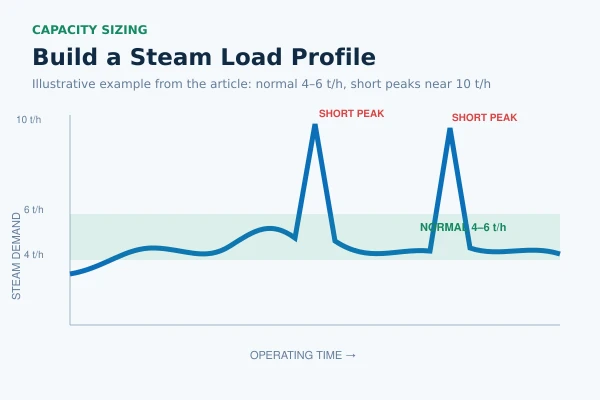
This does not automatically mean that maximum capacity should be ignored. It means boiler selection must consider both the peak and the much more common part-load condition.
An oversized boiler can create several problems.
If the burner cannot modulate down to match lower steam demand, the boiler may repeatedly start and stop. Frequent cycling can increase avoidable losses, create pressure fluctuations and add operating wear.
Oversizing can also mean:
A boiler that is too small may:
The goal is therefore not to minimize or maximize capacity. It is to match boiler capacity and configuration to a documented load profile.
For variable-load plants, buyers should also evaluate burner turndown, boiler sequencing and whether multiple smaller boilers would provide better flexibility than one large unit.
Capacity answers the question “How much steam?”
Pressure answers another question:
At what condition must that steam reach the process?
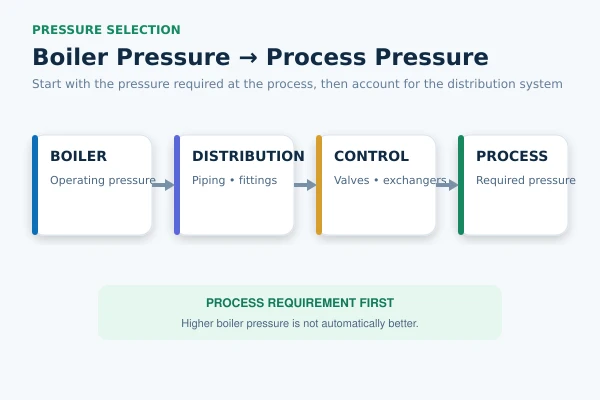
Boiler pressure should not be selected simply because a higher-pressure model appears more capable.
The required pressure should come from the process.
The boiler’s operating pressure and the pressure available at the steam-consuming equipment are not always identical.
Pressure can be lost through:
A buyer should therefore identify the pressure required at the actual process and allow the system designer to evaluate reasonable distribution losses and control requirements.
Unnecessarily high boiler pressure can increase equipment requirements and may create operating conditions that the process does not need.
Most process-heating applications use saturated steam, while some specialized industrial and power applications may require superheated steam.
| 因素 | Saturated Steam | Superheated Steam |
|---|---|---|
| 温度 | Related to saturation pressure | Above saturation temperature |
| Common role | 过程加热 | Specialized processes/power |
| Heat-transfer behavior | Strong for many heating duties | Application-dependent |
| System complexity | Generally simpler | 一般较高 |
| Selection basis | Process requirement | Specific engineering requirement |
A supplier should therefore know capacity, pressure and steam-temperature requirements before recommending a boiler configuration.
There is no universally best industrial boiler fuel.
Fuel selection is increasingly a site-specific economic and engineering decision.
Buyers should compare:
燃气蒸汽锅炉 remain widely applicable where natural gas or another suitable gaseous fuel is reliably available.
Potential advantages include:
But buyers should still investigate gas-price exposure, supply pressure, local emissions requirements and the long-term availability of the fuel.
Liquid-fuel systems may be useful where gas infrastructure is unavailable or where a site requires an independent or backup fuel supply.
The procurement scope may need to include:
A lower boiler purchase price should not be considered separately from the cost of the complete fuel system.
电蒸汽锅炉 eliminate combustion at the point of use and can provide precise load control.
然而, the boiler itself is only part of the decision.
Buyers should check:
The International Energy Agency notes that electric boilers are commercially available for industrial heat and steam, while electricity-to-gas price ratios and grid connection constraints can materially affect deployment.
This is why an electric boiler should be evaluated as part of the plant’s electrical system rather than as an isolated piece of equipment.
Biomass-fired steam boilers may be economically attractive where a consistent, suitable and competitively priced biomass fuel is locally available.
But “生物质” is not a complete fuel specification.
Buyers should provide data for:
The project may also require:
A cheap biomass fuel can become expensive if inconsistent quality reduces useful steam output or causes operating problems.
Fuel flexibility may be valuable where fuel prices fluctuate or where uninterrupted steam production is critical.
然而, flexibility also adds complexity.
Compare:
Fuel flexibility is valuable when it solves a real supply or operating risk—not simply because “more fuels” sounds better on a specification sheet.
The answer depends on the site.
| 因素 | 燃气锅炉 | 电锅炉 | 生物质锅炉 |
|---|---|---|---|
| Energy infrastructure | Gas supply | Electrical capacity | Biomass supply/storage |
| On-site combustion | 是的 | 不 | 是的 |
| Fuel handling | Relatively simple | Very simple | 更复杂 |
| Automation potential | 高的 | Very high | 高的 |
| 维护复杂性 | 缓和 | 一般较低 | 一般较高 |
| Local emissions equipment | 依赖市场 | No combustion system | Often more extensive |
| Energy-price exposure | Gas market | Electricity market | Biomass supply chain |
| Best fit | Broad industrial use | Favorable electrical economics | Reliable biomass availability |
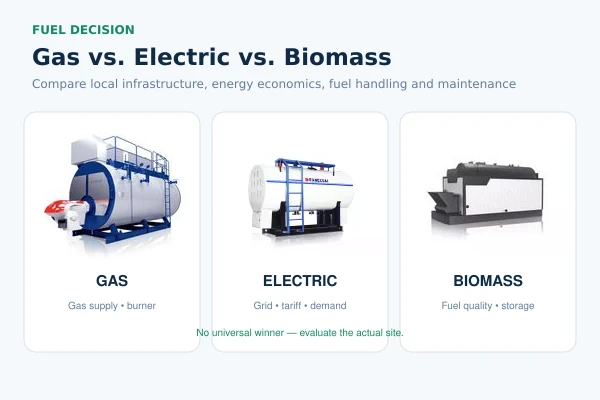
Instead of asking which fuel is universally cheapest, calculate the expected cost of useful steam under the plant’s actual conditions.
That requires actual energy prices, 营业时间, steam demand and realistic system efficiency.
Boiler construction is another important purchasing decision.
Neither design is automatically superior.
在火管锅炉中, hot combustion gases pass through tubes surrounded by water.
取决于项目, fire-tube designs can offer relatively straightforward operation and a compact solution for many industrial steam applications.
在水管锅炉中, water/steam flows through tubes heated externally by combustion gases.
Water-tube systems are frequently considered for applications involving higher capacities, pressures or demanding operating conditions, but the correct selection remains project-specific.
A detailed fire-tube vs. water-tube boiler comparison should consider:
| Selection Factor | Questions to Ask |
|---|---|
| 容量 | What is minimum, 正常和高峰需求? |
| 压力 | What process pressure is required? |
| Load changes | How quickly does steam demand vary? |
| 空间 | What boiler-room dimensions are available? |
| 水质 | What treatment system is available? |
| 维护 | What service capability exists locally? |
| 安装 | Are there transport or site restrictions? |
| Expansion | Is future steam-demand growth expected? |
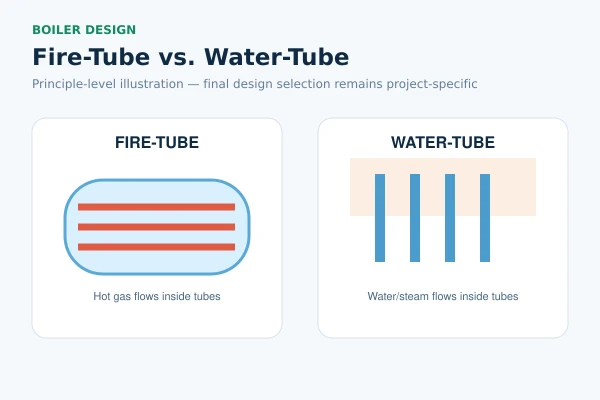
Boiler type should follow the process requirement, not the other way around.
“锅炉效率: 95%.”
By itself, that number tells a buyer surprisingly little.
A meaningful efficiency figure should state the conditions under which it was calculated or tested.
Ask:
A boiler operates inside a steam system.
Real annual fuel consumption can be affected by:
这 我们. Department of Energy’s steam-system resources identify system-level improvement opportunities including combustion optimization, 凝结水回流, blowdown control, efficient burners and waste-heat recovery.
This is an important procurement lesson.
The highest quoted efficiency is not automatically the lowest annual fuel cost.
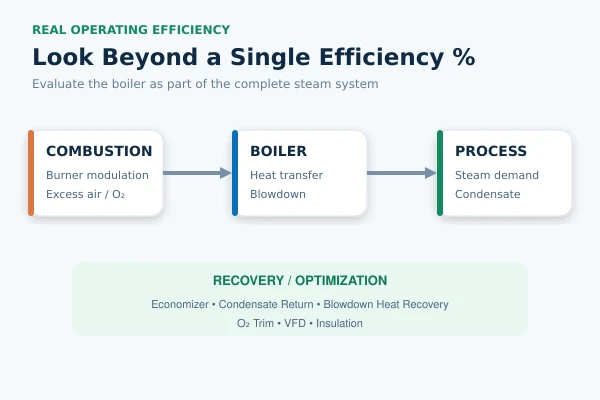
取决于项目, options may include:
Each option should be evaluated against actual operating conditions.
Feedwater is not a secondary issue.
Water conditions influence boiler reliability, 效率, maintenance and service life.
取决于系统, engineers may need to evaluate:
Poor water management can contribute to scale, 腐蚀, carryover and unnecessary blowdown.
Scale on heat-transfer surfaces can reduce effective heat transfer, while corrosion can create serious reliability problems.
The complete project may therefore require:
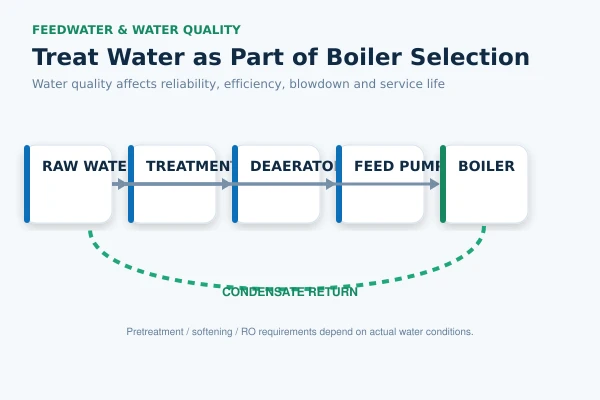
A boiler manufacturer should receive basic feedwater information before final equipment selection rather than discovering severe water-quality problems during commissioning.
A quotation for “one boiler” does not necessarily include a complete steam plant.
This is one of the easiest ways for two supplier quotations to appear similar while actually covering very different scopes.
取决于项目, auxiliary equipment may include:
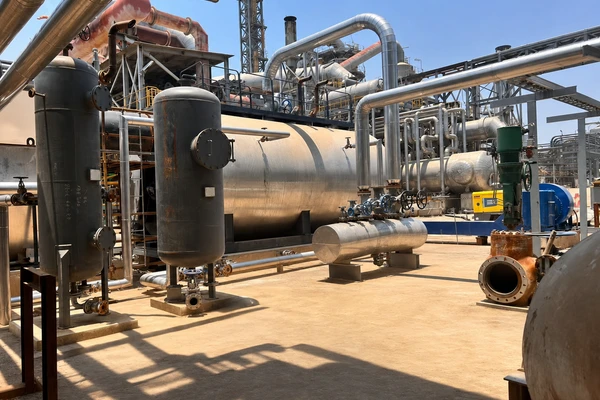
Buyers should request a clear list of inclusions and exclusions.
If Supplier A includes the boiler, 刻录机, 省煤器, pumps and controls while Supplier B quotes only the pressure vessel and basic burner, their prices are not directly comparable.
A PLC-controlled boiler is not automatically a “smart boiler.”
The procurement question should be:
What does the control system measure, record, communicate and optimize?
At minimum, industrial boiler automation may need to control or monitor:
More advanced systems may monitor:
Integration may extend to:
Sensors → PLC → HMI → SCADA → Data Storage → Remote Monitoring
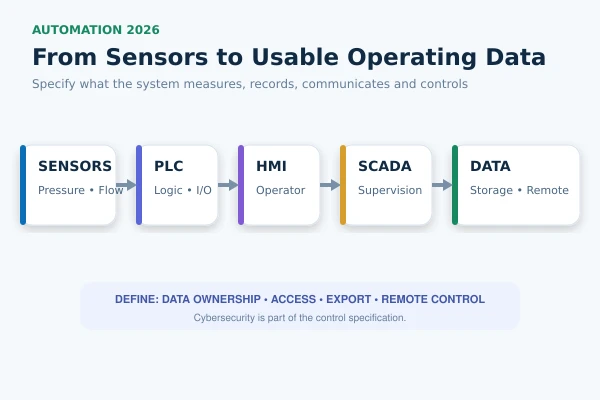
Before ordering remote monitoring, also define:
For connected industrial systems, cybersecurity should be part of the control specification. NIST SP 800-82 Rev. 3 provides guidance for operational technology security, including industrial control environments.
There is no single global emissions limit that applies to every industrial steam boiler.
Requirements may vary by:
例如, 这 我们. EPA’s industrial, commercial and institutional boiler rules illustrate how boiler requirements can depend on facility and fuel category.
For an export project, buyers should identify the applicable emissions requirement before final burner and emissions-control selection.
Potential regulated emissions can include:
The required solution may involve low-NOx burners, flue-gas recirculation, combustion controls, dust collection or other technologies depending on fuel and local requirements.
Certification also depends on destination and project scope.
Examples can include applicable requirements under the ASME Boiler and Pressure Vessel Code 或者, for relevant EU pressure equipment, 这 Pressure Equipment Directive.
Do not simply ask a supplier:
“Do you have CE/ASME?”
Instead ask:
Certification should be verified before production.
There is no reliable universal price for an industrial steam boiler.
Price depends on much more than nominal capacity.
Major cost drivers include:
This creates three different numbers:
Boiler Purchase Price ≠ Installed Project Cost ≠ Lifecycle Cost
A low equipment quotation can become expensive when important systems are excluded.
Instead of asking only:
“How much is a 10-ton steam boiler?”
ask:
“What is included in the complete 10 t/h steam system for my specified pressure, 燃料, feedwater, emissions requirements and operating profile?”
That question produces a much more useful quotation.
Total cost of ownership considers what the boiler will cost throughout an evaluation period—not only what it costs to purchase.
A practical model is:
Boiler TCO = Equipment + 燃料 + 电 + 水 + Chemicals + 维护 + 备件 + Emissions Compliance + 安装 + Downtime − Recoverable Energy Savings
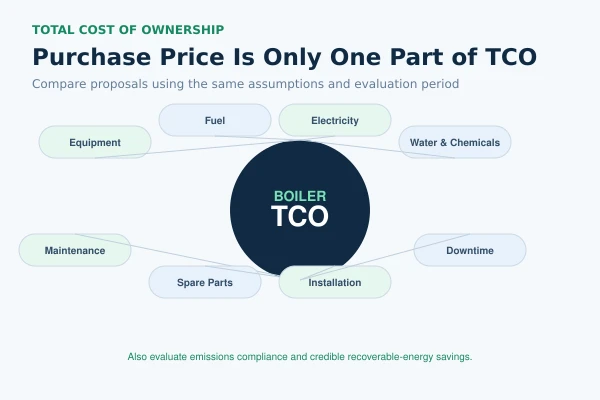
A five-, ten- or longer-year model can be used depending on the company’s investment process.
Include the boiler and all equipment necessary to achieve the defined scope.
For many steam plants, fuel becomes one of the largest lifecycle expenses.
Annual fuel calculations should use realistic steam demand and operating hours rather than assuming continuous operation at nameplate capacity.
Important inputs include:
Include electrical consumption from:
For electric boilers, electricity becomes the primary energy input and tariff structure becomes particularly important.
考虑:
Estimate:
Downtime is often underestimated.
In some manufacturing facilities, an hour without process steam can cost far more than a small difference in quoted boiler efficiency.
Critical processes should therefore evaluate:
When comparing industrial steam boiler suppliers, most buyers make a critical mistake: they compare only the quotation price instead of comparing the full lifecycle cost under identical operating assumptions.
To make a fair decision, all suppliers must be evaluated using the same technical and economic baseline:
Without this normalization, the comparison becomes meaningless.
Assumptions for this example:
| TCO Item | Supplier A (Basic System) | Supplier B (Optimized System) | Supplier C (High-Efficiency System) |
|---|---|---|---|
| Equipment cost | $180,000 | $210,000 | $260,000 |
| Auxiliaries (泵, 坦克, 控制) | $45,000 | $60,000 | $85,000 |
| 安装 & 调试 | $50,000 | $55,000 | $70,000 |
| Subtotal CAPEX | $275,000 | $325,000 | $415,000 |
| 年燃料费用 | $310,000 | $295,000 | $275,000 |
| 10-year fuel cost | $3,100,000 | $2,950,000 | $2,750,000 |
| Annual electricity | $18,000 | $16,000 | $15,000 |
| 10-year electricity | $180,000 | $160,000 | $150,000 |
| 水 & 化学品 | $25,000 | $22,000 | $20,000 |
| 10-year water/chemicals | $250,000 | $220,000 | $200,000 |
| 年度保养 | $20,000 | $18,000 | $16,000 |
| 10-year maintenance | $200,000 | $180,000 | $160,000 |
| Spare parts (10-年) | $60,000 | $55,000 | $50,000 |
| Emissions compliance cost | $30,000 | $25,000 | $20,000 |
| Estimated downtime cost | $120,000 | $80,000 | $50,000 |
| Heat recovery benefit | -$50,000 | -$90,000 | -$130,000 |
| 10-year total TCO | $4,165,000 | $3,925,000 | $3,665,000 |
Although Supplier C has the highest initial investment, it delivers the lowest total lifecycle cost due to:
同时, Supplier A appears attractive at purchase stage but becomes the most expensive option over 10 年 due to fuel inefficiency.
A correct TCO decision is not:
“Which boiler is cheapest?”
这是:
“Which boiler produces steam at the lowest cost per ton over its real operating life?”
在大多数工业案例中, fuel cost represents 70–85% of total lifecycle cost, meaning even a 2–3% efficiency difference can outweigh the entire equipment price difference within a few years.
Industrial boiler quotations are often misleading because different suppliers:
所以, the first step is not price comparison — it is scope normalization.
Before comparing prices, force all suppliers to use the same baseline:
If suppliers refuse to align assumptions, their quotations are not comparable.
A real industrial steam system includes more than the pressure vessel.
A proper comparison must include:
| Item | Supplier A | Supplier B | Supplier C |
|---|---|---|---|
| Boiler type | Fire-tube | Fire-tube | Water-tube |
| Rated efficiency | 90% | 92% | 94% |
| Part-load efficiency | Not specified | 缓和 | High stability |
| Burner turndown ratio | 1:3 | 1:5 | 1:8 |
| Economizer included | 不 | 是的 | 是的 (high efficiency type) |
| Condensate recovery system | 选修的 | Included | Included + optimized |
| 控制系统 | Basic PLC | 可编程逻辑控制器 + 人机界面 | 可编程逻辑控制器 + SCADA + remote monitoring |
| Emissions system | Standard burner | Low-NOx burner | Ultra-low NOx + FGR |
| 水处理 | Not included | Included | Fully integrated system |
| Installation scope | Equipment only | Partial installation | Full turnkey |
| Commissioning | Not included | Included | Full performance guarantee |
| 保修单 | 12 months | 18 months | 24 months + performance guarantee |
| Spare parts | Limited | Standard kit | Full 2-year critical kit |
| 文档 | Basic manual | Full technical package | Full + digital twin model |
Many low-price quotations exclude critical systems such as:
These exclusions often shift 20–40% of total project cost back to the buyer.
After normalization, the decision should follow this logic:
- Does the system meet process requirements?
- Does it minimize lifecycle cost (总拥有成本)?
- Does it reduce operational risk (downtime, instability)?
- Does it comply with emissions and certification rules?
- Is supplier support reliable for 10+ 年?
Only when all five answers are positive should price become the deciding factor.
A professional boiler procurement decision is not a price comparison exercise.
It is a system engineering optimization problem involving:
If you want, I can next upgrade this article further into a “lead-generation version” (SEO + CTA + product positioning for MakeBoiler) or convert it into a landing page structure for Google Ads traffic.
A professional industrial steam boiler quotation should clearly define the technical and commercial scope.
取决于项目, request:
清晰的报价可以减少项目后期的误解.
仅凭价格不足以评估锅炉供应商.
工业锅炉是预计运行多年的压力系统, 通常在蒸汽可用性至关重要的生产过程中.
从多个方面评估供应商.
供应商能否解释为什么特定容量, 压力, 燃烧器和辅助配置已选定?
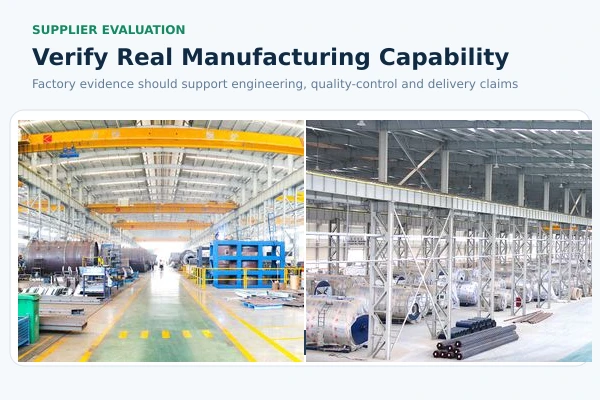
询问有关:
对于诸如以下的语句:
“高效率”
要求:
计算/测试依据 + 燃料 + 加载 + 给水温度.
为了:
“低氮氧化物”
要求:
保证价值 + 燃料 + 加载 + 参考条件 + 测试方法.
为了:
“智能锅炉”
要求:
PLC architecture + I/O list + monitored parameters + communication functions.
For export projects, also evaluate:
A good supplier should be able to explain what it will deliver, what the buyer must provide and where each party’s responsibility begins and ends.
A procurement team should investigate further when it sees any of the following.
A percentage alone is not enough.
The supplier should ask about normal and minimum load.
Variable demand affects burner and boiler operation.
询问燃料, 加载, reference oxygen and test basis.
A low price may reflect an incomplete scope.
Verify the manufacturer, equipment and applicability.
Water conditions affect boiler operation and life.
International projects need clear interface boundaries.
Critical spares should be identified before shipment.
Compare scope before comparing price.
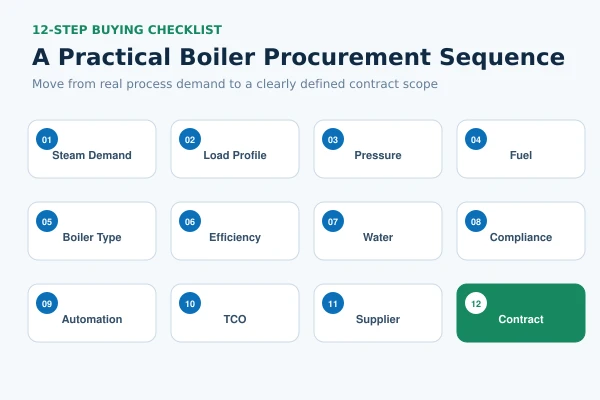
Use this process before placing an order.
Determine capacity, 压力, temperature and steam quality.
Identify minimum, 正常和高峰需求.
Include process requirements and distribution considerations.
Compare price, infrastructure, supply reliability and storage.
Evaluate fire-tube, water-tube or another configuration against actual requirements.
Use consistent test/calculation assumptions and examine part-load operation.
Define treatment, 脱气, condensate return and blowdown requirements.
Use requirements applicable to the installation market.
Specify measurements, PLC/HMI/SCADA integration, alarms and remote access.
Compare lifecycle operating costs—not just purchase price.
Review engineering, 制造业, 测试, documentation and service.
Clearly define inclusions, 排除, 安装, 调试, 训练, spare parts and warranty.
简而言之:
Steam Demand → Load Profile → Pressure → Fuel → Boiler Type → Efficiency → Water → Compliance → Automation → TCO → Supplier → Contract
To receive a useful engineering quotation, 准备以下信息.
Providing these parameters allows the engineering team to evaluate an actual boiler system instead of producing a generic price quotation.
The correct size depends on minimum, normal and peak steam demand rather than maximum production capacity alone. Buyers should build a steam-load profile that also considers daily operating hours, batch loads, seasonal changes and future production requirements.
Start by determining steam consumption from all relevant process equipment and identifying which loads operate simultaneously. Separate normal demand from short peak loads and include reasonable system requirements. 最终尺寸应通过工程热量和质量平衡来验证,而不是仅依赖于简单的经验法则.
在考虑蒸汽分布和控制要求后,锅炉应为该过程提供足够的压力. 压力越高并不一定越好. 首先定义过程所需的压力, 然后选择合适的锅炉运行和设计压力.
两者都不是普遍更好的. 电锅炉消除了使用点燃烧并提供精确控制, 但电价, 电网容量和需求费用会影响运营成本. 在天然气容易获得的地方,燃气锅炉可以提供有利的经济效益. Compare both using actual local energy prices and steam demand.
It can be in locations with reliable low-cost biomass, but fuel price alone is not enough. Biomass moisture, calorific value, 灰, 贮存, feeding, dust control and maintenance must also be included in the economic comparison.
Fire-tube boilers pass hot gases through tubes surrounded by water, while water-tube boilers circulate water/steam through tubes heated externally. The appropriate design depends on capacity, 压力, load response, 空间, water conditions and process requirements.
Compare suppliers using the same fuel basis, 锅炉负荷, feedwater temperature and test/calculation method. Also evaluate burner turndown, 烟囱温度, 过量空气, economizer configuration, 凝结水回收和排污,因为这些会影响实际运营成本.
取决于项目, 辅助系统可能包括燃烧器, 泵, 水处理, 除氧器, 省煤器, 烟囱, 燃油系统, 凝结水系统, 排污系统, 控制和排放设备. 始终确认报价包含和排除内容.
没有可靠的通用价格. 成本随容量而变化, 压力, 燃料, 锅炉设计, 刻录机, 控制, 热回收, 水处理, certification, 排放设备及辅助系统范围. 安装工程成本应与锅炉采购价格分开评估.
添加设备, 燃料, 电, 水, 化学品, 维护, 备件, 安装, 所选评估期内的排放合规性和预期停机时间. 在适当的情况下减去可信的回收能源节省. 使用相同的假设比较所有提案.
At minimum, provide capacity, 负载曲线, 工作压力, 蒸汽温度, 燃料, 营业时间, 给水条件, 凝结水回流, application, installation country, emissions requirements and certification requirements.
Compare engineering capability, manufacturing quality, 认证范围, documented efficiency and emissions performance, factory testing, 自动化, project experience, documentation, commissioning support, spare-parts availability and after-sales service—not only price.
The best industrial steam boiler in 2026 is not automatically the one with the highest capacity, highest quoted efficiency or lowest purchase price.
A successful boiler project begins with the production process.
Ask:
The strongest purchasing strategy is therefore:
Define capacity → build the load profile → define pressure → compare fuels → select the boiler type → evaluate real efficiency → confirm water and compliance requirements → define automation → calculate TCO → verify supplier evidence → confirm the complete project scope.
If you are preparing an industrial steam boiler project, start with five parameters:
蒸汽容量 + 工作压力 + 燃料 + 营业时间 + installation country
通过这些输入(最好是真实的蒸汽负荷曲线),锅炉制造商可以超越通用报价,开始设计与实际过程相匹配的系统.
需要帮助选择合适的工业蒸汽锅炉? 发送您的容量, 压力, 在 WhatsApp 上向我们发送燃料和安装国家/地区,以获得针对特定项目的锅炉推荐和报价. 在 WhatsApp 上获取锅炉报价 → +86-132-1322-2805。
免费锅炉报价
没有延迟, 得到 3 今日报价 比较最优惠的价格 安全可靠评论
本文内容?
If you like Fang Kuai, 请留言.


V查看我们客户的评论
"方快的蒸汽发生器很优秀. 它们非常易于使用并且需要最少的维护. 方快的客户服务也很出色. 他们反应灵敏,乐于助人. 蒸汽发生器的能源效率也非常出色, 这帮助我节省了能源费用. 强烈推荐方快的蒸汽发生器。"
玛丽亚
西班牙"方快的客户服务是一流的. 他们帮助我选择了满足我需求的完美锅炉,并在整个过程中提供了大力支持. 安装过程也很顺利,锅炉超出了我的预期. 非常易于使用和维护, 能源效率显着. 我向任何需要可靠高效供暖解决方案的人强烈推荐方快的产品。"
娟
墨西哥"方快的热水器太棒了. 升温快速高效, 而且水会长时间保持高温. 我们从来没有遇到过任何问题,它在我们的日常运营中取得了显着改善. 安装过程也很顺利,客服态度也很好. 强烈推荐方快的热水器。"
莎拉
加拿大"方快的热水器太棒了. 升温快速高效, 而且水会长时间保持高温. 我们从来没有遇到过任何问题,它在我们的日常运营中取得了显着改善. 安装过程也很顺利,客服态度也很好. 强烈推荐方快的热水器。"
莎拉
加拿大"我为我的工厂购买了一台方快蒸汽锅炉,它已经完美运行了几个月了. 材料的质量和锅炉的结构令人印象深刻. 它也非常节能, 这帮助我们节省了能源费用. 我向任何需要可靠高效供暖解决方案的人强烈推荐方快的产品。"
约翰
美国"方快的客户服务是一流的. 他们帮助我选择了满足我需求的完美锅炉,并在整个过程中提供了大力支持. 安装过程也很顺利,锅炉超出了我的预期. 非常易于使用和维护, 能源效率显着. 我向任何需要可靠高效供暖解决方案的人强烈推荐方快的产品。"
娟
墨西哥"方快的蒸汽发生器很优秀. 它们非常易于使用并且需要最少的维护. 方快的客户服务也很出色. 他们反应灵敏,乐于助人. 蒸汽发生器的能源效率也非常出色, 这帮助我节省了能源费用. 强烈推荐方快的蒸汽发生器。"
玛丽亚
西班牙"方快的辅助设备让我的锅炉系统更上一层楼. 设备质量卓越,价格非常合理. 该设备帮助提高了我的锅炉系统的效率和性能, 这导致显着的成本节约. 我向任何需要优质锅炉配件的人强烈推荐方快的辅助设备。"
马里克
英国"方快的客户服务是一流的. 他们帮助我选择了满足我需求的完美锅炉,并在整个过程中提供了大力支持. 安装过程也很顺利,锅炉超出了我的预期. 非常易于使用和维护, 能源效率显着. 我向任何需要可靠高效供暖解决方案的人强烈推荐方快的产品。"
娟
墨西哥