
Industrial boiler procurement in 2026 is increasingly influenced by lifecycle efficiency, emissions compliance, fuel flexibility, automation and operating cost—not simply the initial equipment price.
For industrial buyers, this changes the questions that need to be asked before a boiler is ordered.
A quoted efficiency figure is no longer enough without knowing the operating conditions behind it. An emissions promise has limited value unless it corresponds to the regulations at the installation site. A PLC-controlled boiler is not necessarily a “smart boiler” unless its sensors, data, alarms and remote-access functions support the plant’s actual operating strategy.
The wider industrial energy market is changing as well. The International Energy Agency (IEA) reports that industries relying heavily on low-temperature heat and steam account for a significant share of global industrial energy consumption. It also identifies energy efficiency and increasing electrification of industrial heat as important parts of the transition now taking place across multiple markets. IEA – Renewables for Industry
For buyers planning a new steam or hot-water project, five industrial boiler procurement trends deserve particular attention in 2026:
The result is a more engineering-driven procurement process.
Traditional boiler purchasing often started with three questions:
Those questions remain important, but they are no longer sufficient.
A better industrial boiler procurement process begins with the plant’s operating profile and ends with lifecycle performance.
Modern buyers increasingly need to evaluate:
This creates an important distinction.
A boiler should not be selected simply because it can produce the required maximum steam capacity. It should be selected because the complete boiler system can meet the plant’s real load profile efficiently, safely and reliably.
| Procurement Factor | Traditional Focus | 2026 Procurement Focus |
|---|---|---|
| 价格 | Initial equipment price | Total lifecycle cost |
| 容量 | Maximum t/h | 平均的, peak and minimum load |
| 效率 | Rated efficiency | Efficiency under actual conditions |
| 排放量 | General compliance | Installation-market requirements |
| 控制 | Basic PLC | 可编程逻辑控制器 + monitoring + data + diagnostics |
| 燃料 | Single available fuel | 成本, availability and flexibility |
| 维护 | Repair after failure | Preventive and predictive maintenance |
| Supplier | Equipment delivery | Engineering and lifecycle support |
This shift from equipment purchasing to performance purchasing is one of the most important industrial boiler procurement trends in 2026.
Industrial boiler efficiency has always mattered. What is changing is how sophisticated buyers evaluate it.
The first question should not be:
“What is the efficiency of this boiler?”
A more useful question is:
“Under what load, 燃料, 给水温度, excess-air level and test method was this efficiency measured?”
Two boilers with apparently similar efficiency ratings may perform very differently once installed.
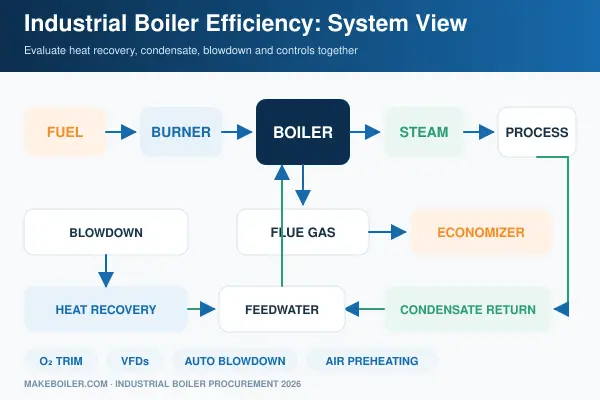
A boiler operates as part of a steam system rather than as an isolated piece of equipment.
Real fuel consumption can be affected by:
美国. Department of Energy’s steam-system guidance treats efficiency as a system-level issue and identifies measures such as combustion optimization, automatic blowdown control, 凝结水回流, short-cycling reduction and waste-heat recovery as potential improvement opportunities. 我们. 能源部 - 蒸汽系统
That is an important lesson for procurement teams: the highest number on a technical datasheet does not automatically produce the lowest operating cost.
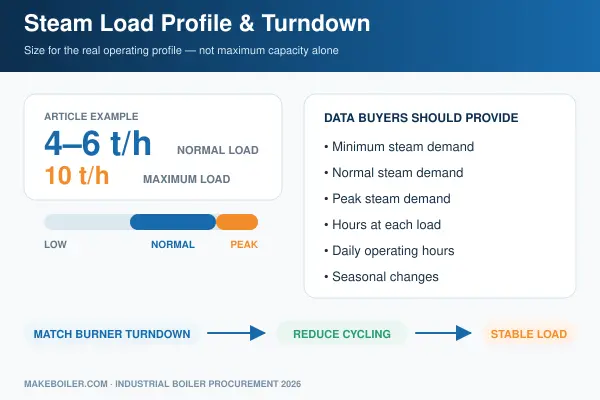
Consider a plant that needs a maximum of 10 t/h of steam.
Its normal production load, 然而, may only be 4–6 t/h, with short periods approaching 10 吨/小时.
If the boiler and burner cannot operate effectively at the lower load, the system may cycle repeatedly. Frequent starts and stops can affect pressure stability and increase avoidable operating losses.
为此原因, buyers should provide suppliers with a load profile whenever possible:
This provides much more useful sizing information than maximum capacity alone.
Depending on boiler type, fuel and application, an industrial steam system may benefit from technologies such as:
Not every technology is appropriate for every project. The correct combination depends on flue-gas conditions, process temperatures, 燃料, water chemistry and the expected operating profile.
A reliable comparison requires all suppliers to use comparable assumptions.
The following procurement table can help.
| 范围 | What the Buyer Should Request | 为什么它很重要 |
|---|---|---|
| Rated efficiency | Test method and operating conditions | Makes quotations comparable |
| Boiler load | Efficiency at relevant load points | Shows part-load performance |
| Fuel specification | LHV/HHV and fuel properties | Prevents inconsistent calculations |
| 给水温度 | Temperature used in calculation | Directly affects heat balance |
| Flue-gas temperature | Expected stack temperature | Helps identify heat loss |
| Flue-gas O₂ | Expected operating level | Indicates combustion conditions |
| Burner turndown | Minimum stable firing rate | Important for variable loads |
| Blowdown | Expected blowdown basis | Influences water and heat losses |
| 节能器 | Included or optional | Changes recovered heat |
| Auxiliary power | 粉丝, pumps and controls | Affects plant energy consumption |
A strong 工业锅炉报价 should make these assumptions visible rather than hiding them behind one efficiency percentage.
Industrial boiler emissions can no longer be treated as an issue to investigate only after the equipment has been ordered.
For international projects, the installation country—and sometimes the specific state, province or city—can significantly change the technical requirements.
一个常见的采购错误是询问:
“全球工业锅炉NOx标准是多少?”
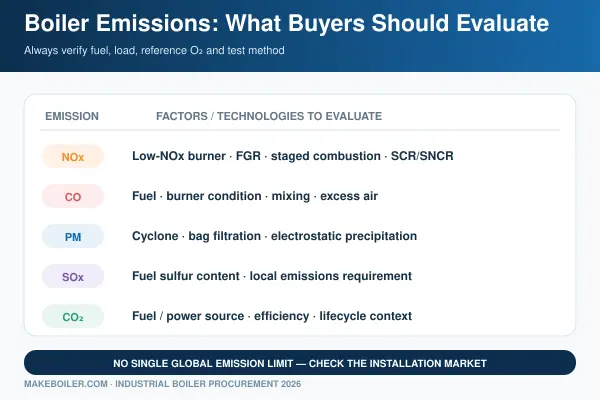
没有适用于所有工业锅炉的单一全球数字.
适用的限制可能取决于:
美国提供了一个有用的例子,说明为什么买家必须检查确切的监管类别. EPA 对工业的要求, 商业和机构锅炉区分设施和燃料类别. 一个区域源规则, 例如, 解决燃煤锅炉问题, 石油或生物质并涵盖汞等污染物, 颗粒物和一氧化碳; 根据该特定规则,纯燃气锅炉的处理方式有所不同. 其他要求也可能适用. 我们. EPA – 工业, 商业和机构锅炉
所以, an export buyer should identify the applicable local requirement before finalizing the burner, fuel system and emissions-control configuration.
NOx formation is strongly influenced by combustion conditions, particularly flame temperature and oxygen availability.
取决于应用, reduction strategies may include:
The correct solution depends on both the target emission level and the operating conditions.
High CO can indicate incomplete combustion or unsuitable burner settings.
Fuel characteristics, burner condition, mixing and excess air can all influence CO formation.
PM is particularly relevant to solid-fuel systems such as biomass and coal boilers.
The overall system may require:
Selection depends on fuel ash characteristics and local emission requirements.
SOx is strongly connected to fuel sulfur content. Fuel specification should therefore be part of both the emissions review and operating-cost analysis.
Carbon accounting is becoming more relevant to industrial energy planning, particularly for multinational companies and supply chains.
然而, a low on-site emission level should not automatically be interpreted as low lifecycle emissions. 例如, an electric boiler has no combustion emissions at the point of use, but the environmental impact of its electricity depends on the grid or power source.
| Technology | Primary Function | Typical Application | What to Verify |
|---|---|---|---|
| Low-NOx burner | Reduce NOx formation during combustion | Gas/oil systems | Test conditions and guaranteed value |
| Flue Gas Recirculation | Lower combustion temperature | Common in gas-fired applications | FGR ratio and operating range |
| O₂ Trim | Optimize fuel-air ratio | Variable-load systems | Sensor and control strategy |
| Staged Combustion | Control combustion zones | Application-dependent | Burner/furnace compatibility |
| SCR/SNCR | Post-combustion NOx reduction | Where stricter control is required | Reagent/catalyst and operating cost |
| Dust Collection | Reduce particulate emissions | Biomass/coal systems | Required collection performance |
An emissions guarantee should always state its basis.
Buyers should ask:
Without these conditions, two emission figures may not be directly comparable.
Industrial heat remains one of the most important energy uses in manufacturing.
IEA analysis published in late 2025 highlights growing interest in the electrification of industrial heat and steam, while emphasizing that energy efficiency should come first. The report also notes that electric boilers are already commercially available, although electricity-to-gas price ratios, grid capacity and connection lead times can limit adoption. IEA – Renewables for Industry
This means the question is not simply:
“Will electric boilers replace fuel-fired boilers?”
The more practical question is:
“Which heat source produces the best technical and economic result at this specific plant?”
Gas-fired boilers remain attractive where gas infrastructure is reliable and fuel economics are favorable.
Typical advantages include:
Buyers should still evaluate gas-price exposure, local emissions requirements and future operating strategy.
For projects evaluating this option, 看看我们的 gas-fired steam boiler information.
电锅炉 eliminate on-site combustion and can provide precise control and fast response.
They are particularly interesting where:
The main procurement question is often not the boiler itself but electrical infrastructure.
A buyer should confirm:
Biomass-fired steam boilers can be economically attractive where suitable fuel is abundant and consistently available.
然而, the boiler cannot be selected correctly without understanding the fuel.
Important biomass parameters include:
Fuel handling, 贮存, feeding, ash removal and dust control also become part of the boiler project.
A low biomass fuel price means little if poor fuel quality reduces useful output or creates excessive maintenance.
Fuel flexibility can reduce exposure to supply interruptions or price changes.
But additional flexibility also creates additional complexity.
When comparing a dual-fuel configuration, buyers should consider:
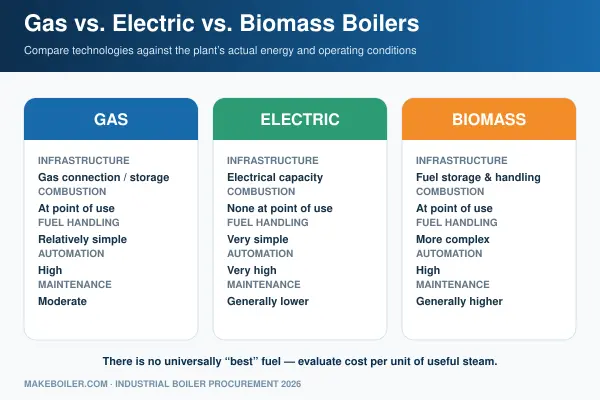
There is no universally “best” industrial boiler fuel.
The correct option depends on the local energy market and production process.
| 因素 | 燃气锅炉 | 电锅炉 | 生物质锅炉 |
|---|---|---|---|
| 燃料基础设施 | Gas connection/storage | Electrical capacity | 燃料储存 & 处理 |
| Point-of-use combustion | 是的 | 不 | 是的 |
| Fuel Handling | Relatively simple | Very simple | 更复杂 |
| 自动化 | 高的 | Very high | 高的 |
| Maintenance Complexity | 缓和 | 一般较低 | 一般较高 |
| Fuel-price Exposure | Gas market | Electricity market | Biomass supply chain |
| Part-load Control | Strong with correct burner | 强的 | System-dependent |
| Emissions Equipment | 依赖市场 | No combustion control | Often more extensive |
| 最佳应用 | Broad industrial use | Suitable power economics/clean operation | Reliable low-cost biomass supply |
Instead of asking suppliers which fuel is “best,” calculate the expected cost per unit of useful steam under the plant’s actual conditions.
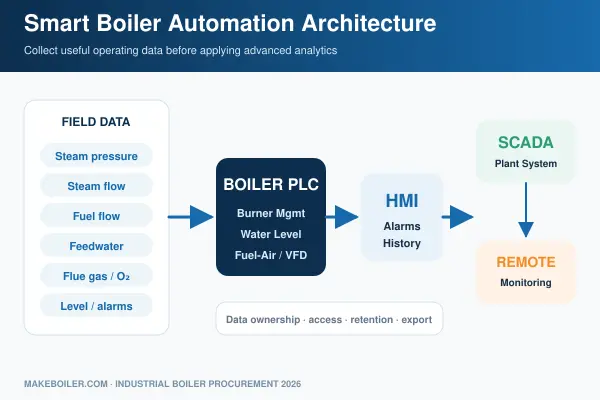
A PLC is now common in modern industrial boiler systems, but installing a PLC does not automatically make a boiler intelligent.
The important question is what the control system can measure, record and optimize.
A modern automation architecture may integrate:
下一阶段是使用运营数据来改进决策.
例如, 历史数据可以揭示:
这些信号可以支持基于状态的预测性维护.
工业自动化组织也越来越关注人工智能, 数字双胞胎, 预测性维护和实时优化, 同时强调数据质量的重要性, 可靠性和网络安全. International Society of Automation
The practical lesson for boiler buyers is straightforward: collect useful operating data before trying to apply advanced analytics.
| Data Point | Procurement Value |
|---|---|
| 蒸汽压力 | Monitor process stability |
| 蒸汽流量 | Measure real demand |
| Fuel flow | Track energy consumption |
| Feedwater flow | Support mass/energy balance |
| 给水温度 | Evaluate thermal conditions |
| Flue-gas temperature | Detect heat-loss changes |
| Stack O₂ | Monitor combustion |
| Water level | Essential operational/safety parameter |
| Blowdown | Track water and energy loss |
| Burner firing rate | Understand load behavior |
| Alarm history | Diagnose recurring faults |
| Operating hours | Plan maintenance |
Before ordering remote monitoring, buyers should also specify who owns the data, how long it is retained, who can access it and whether data can be exported.
Connecting a boiler control system to a plant network or remote service platform creates operational advantages—but also introduces another procurement question: who can access the system?
Remote access should be designed rather than improvised.
Buyers may need to consider:
A useful question to include in a tender is:
“If the supplier can remotely access the boiler PLC, who authorizes that connection, how is it secured, and can the plant disable remote access?”
Cybersecurity requirements should be agreed before commissioning, not discovered afterward.
The lowest boiler quotation is not necessarily the lowest-cost boiler.
For many industrial steam projects, fuel consumed during operation can become far more significant than the initial price difference between two boiler configurations.
A useful procurement model is:
10-Year Boiler TCO = Equipment + 燃料 + 电 + 水 + Chemicals + 维护 + 备件 + Emissions Compliance + Downtime + Installation − Recoverable Energy Savings
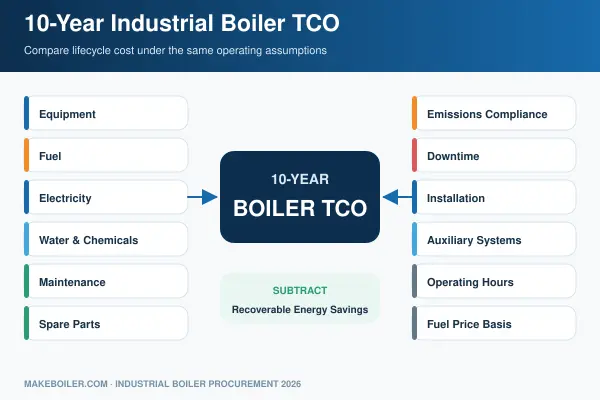
The precise model will vary by project, but the principle is valuable.
Include the boiler plus necessary auxiliary systems.
A quotation that excludes major auxiliary equipment can look artificially inexpensive.
Calculate from expected load rather than nameplate capacity alone.
使用:
考虑泵, 粉丝, 燃料处理, 水处理和排放控制设备——不仅仅是锅炉控制柜.
给水水质, 凝结水回收和排污策略会影响水和化学品的消耗.
比较预期:
适用于关键生产流程, 一小时没有蒸汽的成本可能超过锅炉效率的微小差异.
因此,采购讨论中应包括可靠性和冗余性.
制造商无法正确确定工业锅炉的尺寸 “我需要一个蒸汽锅炉” 或者 “I need 10 吨” alone.
For a useful engineering quotation, provide at least:
Providing this information early allows suppliers to compare configurations rather than simply quote equipment.
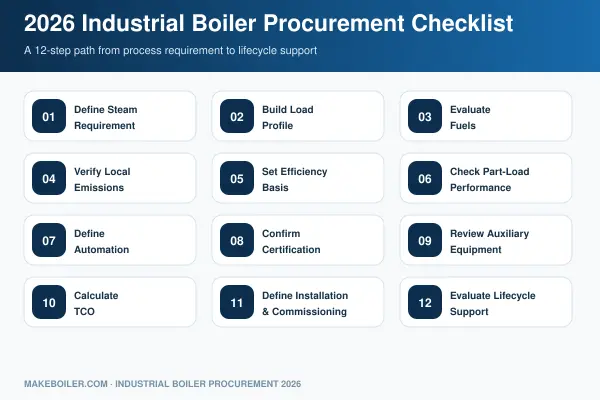
Determine capacity, 压力, temperature and steam-quality requirements.
Identify minimum, 正常和高峰需求.
Compare price, 可靠性, infrastructure, 存储和未来可用性.
获取实际安装位置的适用要求.
定义测试基础而不是简单地要求最高百分比.
根据工厂负荷情况检查燃烧器调节和调节.
指定所需的测量值, 警报, PLC/SCADA集成和远程监控.
美国机械工程师协会, CE 或其他认证仅应在检查适用于目的地和项目后指定.
证书范围还应与所提供的设备相匹配.
这可能包括:
Compare realistic annual operating costs under the same assumptions.
Specify what the supplier, local contractor and buyer are each responsible for.
Ask about training, 备件, remote support, documentation and service after commissioning.
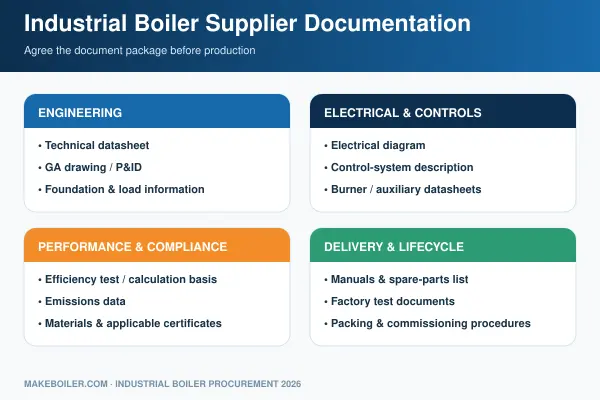
Documentation is an important part of international industrial boiler procurement.
Depending on project scope, buyers should request appropriate documents such as:
确切的文件包应在生产前商定.
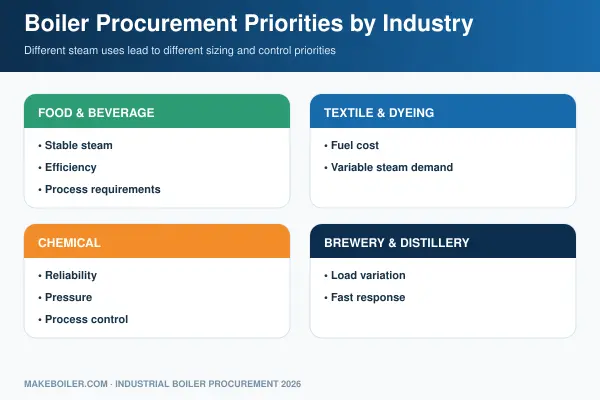
不同行业使用蒸汽的方式不同.
| 行业 | 典型采购优先级 |
|---|---|
| 食物 & 饮料 | 蒸汽稳定, 效率和流程要求 |
| 纺织品 & 染色 | 燃料成本和可变的蒸汽需求 |
| 化学 | 可靠性, 压力和过程控制 |
| 药物 | 蒸汽质量, 控制和记录 |
| 啤酒厂 & 酒厂 | 负载变化和快速响应 |
| 纸浆 & 纸 | 连续蒸汽需求量大 |
| 建筑/供暖 | 季节性效率和调制 |
| 制造业 | 可靠性, 自动化和运营成本 |
因此,工业不仅仅是一个营销类别. 影响尺码, 控制策略和辅助系统设计.
如果报价包含以下任何内容,采购团队应进一步调查:
没有计算基础的百分比很难比较.
询问燃料, 加载, 参考条件及测试方法.
供应商应了解负载情况.
确认是哪个厂家, 证书实际涵盖的设备和压力元件.
确定包含和排除的内容.
水化学影响可靠性, 效率和锅炉寿命.
国际项目需要明确的责任边界.
Remote installations should consider critical spares before shipment.
Ask exactly what parameters are measured, stored and accessible.
Compare scope before comparing price.
One of the simplest ways to improve boiler purchasing decisions is to replace marketing claims with evidence.
| Supplier Claim | Evidence the Buyer Should Request |
|---|---|
| “高效率” | Test basis, load and operating conditions |
| “低氮氧化物” | 保证价值, reference conditions and test basis |
| “Smart control” | I/O list, control narrative and monitoring functions |
| “运营成本低” | Calculation assumptions and TCO model |
| “Certified” | Certificate, scope and equipment applicability |
| “维护方便” | Maintenance schedule and spare-parts list |
| “Global service” | Actual service scope and responsibility |
| “Fast installation” | 项目进度和接口要求 |
这种证据优先的方法使竞争的工业锅炉提案更容易比较并降低采购风险.
当前的一些发展可能会在未来十年继续影响工业锅炉项目.
锅炉房优化将越来越多地考虑燃烧器, 锅炉, 水系统, 热回收, 凝结水和工艺需求一起.
电锅炉和其他工业供热技术可能会在电价上涨的情况下获得更多关注, 电网容量和碳目标使商业案例具有吸引力.
这并不意味着燃烧锅炉消失. 这意味着买家有更多的技术可供比较.
蒸汽流量, 燃油流, 温度, 与排放相关的参数和警报越来越多地成为工厂综合能源管理系统的一部分.
随着有用数据变得更容易收集,从固定维护间隔到基于条件的决策的转变可能会继续下去.
尤其对于海外项目, 训练, 远程故障排除, 备件规划和调试支持可能成为更重要的选择标准.
方向已明确: 工业锅炉采购不再是购买一个压力容器,而是更多地选择一个完整的能源, 控制和生命周期支持系统.
最重要的趋势之一是从初始购买价格转向生命周期性能. 买家越来越需要比较真实的运营效率, 负载灵活性, 燃油成本, 排放要求, 自动化, 维护和技术支持. 如果初始价格较高的锅炉能够更好地匹配工厂的实际蒸汽需求和运行条件,则总成本可能会较低.
没有适合每个工业锅炉项目的单一效率数字. 效率取决于锅炉设计, 燃料, 加载, 给水温度, 燃烧条件和热回收设备. 买家应要求供应商提供效率测试或计算依据,并使用相同的运营假设比较所有提案.
Compare efficiency using the same fuel basis, 锅炉负荷, feedwater temperature and calculation or test method. Also evaluate burner turndown, flue-gas temperature, O₂ level, economizer configuration, condensate recovery and blowdown. These factors can influence actual annual fuel consumption even when two boilers have similar rated efficiencies.
Depending on the fuel and local regulations, relevant emissions may include NOx, CO, 颗粒物, SOx and other regulated pollutants. Requirements vary significantly by country and jurisdiction, so buyers should confirm the applicable local permit or standard before selecting the burner and emissions-control system.
A low-NOx industrial boiler uses combustion or emissions-control technologies designed to reduce nitrogen oxide formation or release. Possible measures include low-NOx burners, staged combustion, flue-gas recirculation and, for certain applications, post-combustion treatment. The actual guaranteed NOx level should always state the fuel, load and reference test conditions.
Not universally. Electric boilers eliminate on-site combustion and offer strong controllability, but economics depend heavily on electricity prices, demand charges and available electrical infrastructure. Gas-fired boilers may remain more economical in markets with favorable gas pricing. The correct comparison should use cost per unit of useful steam under the plant’s actual load.
At minimum, automation should safely control critical boiler functions such as burner operation, pressure and water level. More advanced systems may monitor steam flow, 燃油消耗, flue-gas temperature, O₂, feedwater, alarms and operating history. The correct level of automation depends on process criticality and plant integration requirements.
Include equipment, 燃料, 电, 水, 化学品, 维护, 备件, emissions compliance, installation and expected downtime over the evaluation period. Subtract credible energy savings or recovered heat where appropriate. Use the same production and fuel-price assumptions when comparing different boiler proposals.
A supplier should know the required steam capacity, 最小/正常/峰值负载, 压力, 温度, 燃料, operating schedule, 给水条件, 凝结水回流, installation location, emissions requirements and process application. A real load profile is especially valuable because maximum capacity alone does not describe how the boiler will operate.
Compare more than price. Evaluate engineering capability, manufacturing quality, 认证范围, documented performance, 自动化, project references, spare-parts availability, commissioning support and after-sales service. Require each supplier to explain efficiency, emissions and operating-cost claims under clearly defined conditions.
The best industrial boiler in 2026 is not automatically the boiler with the highest quoted efficiency or the lowest purchase price.
A successful project begins with the plant itself.
How much steam is actually required? How does demand change during the day? Which fuels are locally available? What emissions rules apply? How reliable is the electrical infrastructure? How important is remote monitoring? What happens if the boiler stops production? 谁来调试和维护设备?
回答这些问题为更好的工业锅炉采购决策奠定了基础.
因此,最强有力的采购策略是基于证据的策略:
定义负载 → 验证当地要求 → 比较燃料选项 → 评估实际效率 → 定义自动化 → 计算 TCO → 验证供应商证据 → 计划安装和生命周期支持.
如果你是 规划工业蒸汽项目, 首先准备以下五个参数:
蒸汽容量, 工作压力, 燃料, 每日运行时间和安装国家/地区.
有了这些输入, 工程团队可以超越通用报价,开始评估与实际流程相匹配的锅炉配置.
免费锅炉报价
没有延迟, 得到 3 今日报价 比较最优惠的价格 安全可靠评论
本文内容?
If you like Fang Kuai, 请留言.



V查看我们客户的评论
"方快的热水锅炉质量让我印象深刻. 它经久耐用,超出了我的预期. 安装过程也很顺利,客服态度也很好. 热水锅炉操作维护非常方便, 能源效率显着. 强烈推荐方快的热水器。"
杰克
澳大利亚"方快的辅助设备让我的锅炉系统更上一层楼. 设备质量卓越,价格非常合理. 该设备帮助提高了我的锅炉系统的效率和性能, 这导致显着的成本节约. 我向任何需要优质锅炉配件的人强烈推荐方快的辅助设备。"
马里克
英国"方快的蒸汽锅炉非常适合我的食品加工业务. 它满足我们的所有要求并且非常可靠. 材料的质量和锅炉的构造非常出色. 它也非常容易操作和维护, 这帮助我们节省了维护时间和金钱. 我向任何需要可靠供暖解决方案的人强烈推荐方快的蒸汽锅炉。"
杰森
巴西"我为我的工厂购买了一台方快蒸汽锅炉,它已经完美运行了几个月了. 材料的质量和锅炉的结构令人印象深刻. 它也非常节能, 这帮助我们节省了能源费用. 我向任何需要可靠高效供暖解决方案的人强烈推荐方快的产品。"
约翰
美国"方快导热油锅炉操作维护非常方便. 它帮助我们节省了维护时间和金钱, 这导致显着的成本节约. 材料的质量和锅炉的构造非常出色. 它也非常节能, 这帮助我们节省了能源费用. 强烈推荐方快的导热油锅炉 ."
艾伦
巴西"方快的蒸汽发生器非常适合我的小生意. 它非常易于使用,需要最少的维护. 它也非常节能, 这帮助我节省了能源费用. 方快的客服也很好. 他们反应灵敏,乐于助人. 强烈推荐方快的蒸汽发生器。"
艾哈迈德
埃及"方快的蒸汽锅炉非常适合我的食品加工业务. 它满足我们的所有要求并且非常可靠. 材料的质量和锅炉的构造非常出色. 它也非常容易操作和维护, 这帮助我们节省了维护时间和金钱. 我向任何需要可靠供暖解决方案的人强烈推荐方快的蒸汽锅炉。"
杰森
巴西"我们化工厂一直在使用方快导热油锅炉多年,从未让我们失望过. 锅炉非常耐用,可以承受恶劣的条件. 它也非常容易操作和维护, 这帮助我们节省了维护时间和金钱. 方快的导热油锅炉是一流的,我强烈推荐给任何需要可靠供暖解决方案的人。"
张
中国"方快的热水锅炉质量让我印象深刻. 它经久耐用,超出了我的预期. 安装过程也很顺利,客服态度也很好. 热水锅炉操作维护非常方便, 能源效率显着. 强烈推荐方快的热水器。"
杰克
澳大利亚