
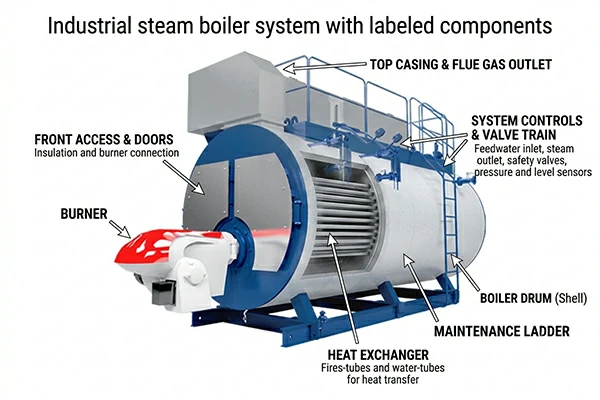
A steam boiler is not just a simple heating device. It is a complete thermal energy system composed of multiple components that work together to convert fuel energy into usable steam.
The main 蒸汽锅炉 components include the burner, 燃烧室, 热交换器, boiler drum, water circulation system, 及控制系统. Each component has a specific function, and the performance of the entire boiler depends on how efficiently these parts operate together.
For industrial users, understanding steam boiler components is important when selecting equipment, 提高能源效率, reducing maintenance costs, and ensuring safe operation.
在本指南中, we will explain the function of each major steam boiler component, how they work together, and why these parts are critical for reliable steam generation.
章节概述: This section introduces the main parts of a steam boiler and explains how different components work together to convert fuel energy into usable steam.
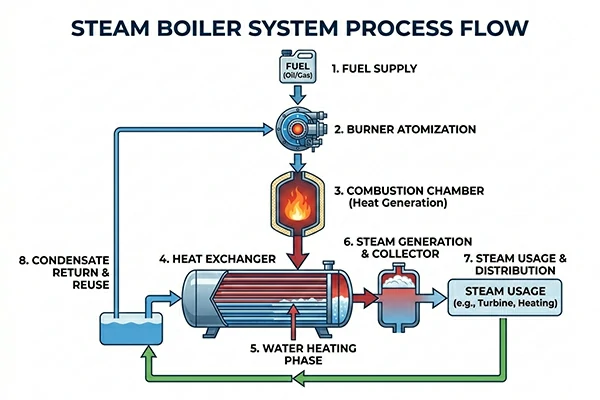
A steam boiler is not a single machine but a complete system consisting of several important mechanical and control components. Although boiler designs vary depending on fuel type, 容量, 和应用, most industrial steam boilers include the following basic parts:
| Steam Boiler Component | Main Function |
|---|---|
| 刻录机 | Produces heat energy by burning fuel such as natural gas, 油, 生物质, 或煤. |
| 燃烧室 | Provides space for fuel combustion and generates high-temperature gases. |
| 热交换器 | Transfers heat from combustion gases to water for steam generation. |
| 锅炉汽包 | Stores water and separates steam from water mixture. |
| 水循环系统 | Maintains continuous water flow through heating surfaces. |
| Steam Outlet System | Delivers generated steam to industrial equipment or heating systems. |
| 控制系统 | Monitors pressure, 温度, 水位, and combustion conditions. |
| 安全设备 | Protect the boiler from abnormal pressure, 过热, and operating risks. |
Each component has a specific purpose. The failure or poor performance of one part can affect the efficiency, 安全, and service life of the entire steam boiler system.
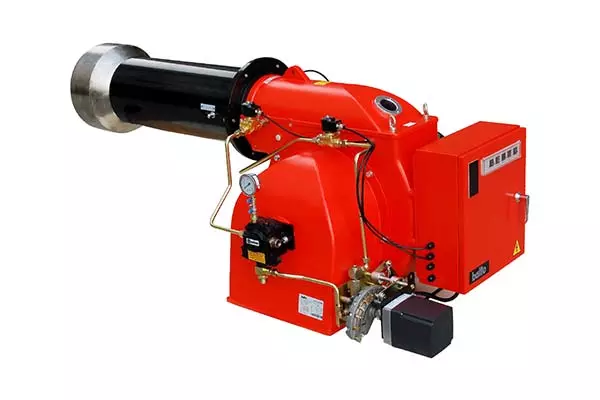
章节概述: 这 刻录机 is the component responsible for creating the heat source required for steam production. Its design directly influences fuel efficiency, 排放量, and boiler performance.
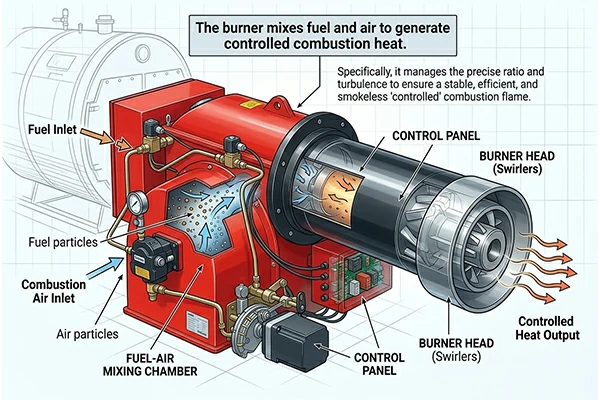
这 steam boiler burner is often considered the heart of a combustion boiler because it controls the process of converting fuel energy into thermal energy.
During operation, the burner mixes fuel and air in the correct ratio, creates a stable flame, and releases heat inside the combustion chamber. The generated heat is then transferred to water through the boiler heating surfaces.
Industrial steam boiler burners can operate with different fuel types, 包括:
A high-quality burner helps the boiler achieve:
The working process of a burner usually includes four main steps:
Fuel is transported from the storage system to the burner through dedicated fuel pipelines. The supply system controls the amount of fuel entering the combustion process.
The burner combines fuel with combustion air at an optimized ratio. Proper air-fuel mixing ensures complete combustion and reduces unnecessary energy loss.
The ignition system creates a controlled flame inside the combustion chamber. Modern burners usually include automatic ignition and flame monitoring systems to improve safety.
燃烧过程中, chemical energy stored in the fuel is converted into thermal energy. This heat is then transferred through the boiler heating surfaces to produce steam.
Modern industrial burners often use automatic modulation technology. Instead of operating only at full capacity, the burner can adjust flame intensity according to steam demand, reducing fuel consumption and improving efficiency.
章节概述: The combustion chamber provides the environment where fuel burns and converts chemical energy into high-temperature heat required for steam generation.
这 燃烧室, also known as the furnace or firebox, is the area where fuel combustion takes place. It is one of the most important sections inside a steam boiler because the quality of combustion directly affects efficiency and emissions.
Inside the combustion chamber, the burner produces a high-temperature flame. The released heat is absorbed by the surrounding boiler heating surfaces and transferred to the water system.
A well-designed combustion chamber should provide:
The temperature inside industrial boiler combustion chambers can reach extremely high levels. 所以, the chamber is usually constructed with heat-resistant materials and insulation layers to reduce heat loss and protect external structures.
The design of the combustion chamber directly affects boiler operation. Poor combustion conditions may lead to:
为此原因, industrial boiler manufacturers carefully optimize combustion chamber size, 形状, and heat distribution according to different fuels and operating requirements.
章节概述: This section explains how the heat exchanger transfers thermal energy from combustion gases to water and why it is one of the most important components affecting steam boiler efficiency.
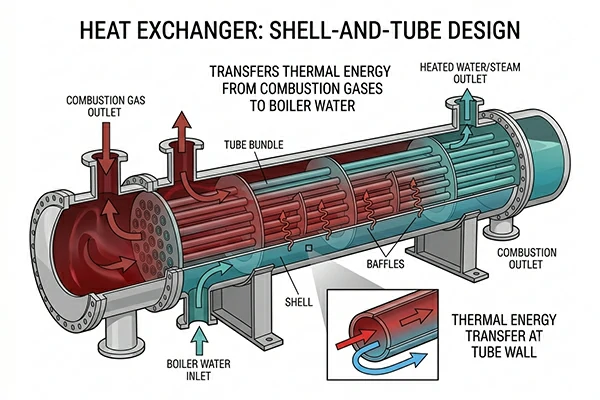
这 steam boiler heat exchanger is a critical component responsible for transferring heat from hot combustion gases to water without allowing the two fluids to directly mix.
The efficiency of a steam boiler largely depends on how effectively the heat exchanger captures and transfers thermal energy. A well-designed heat exchanger can reduce fuel consumption, improve steam production capacity, and lower operating costs.
锅炉运行期间:
Different steam boiler designs use different heat exchanger structures. The two most common designs are fire-tube boilers and water-tube boilers.
在火管锅炉中, 热燃烧气体流过被水包围的管道.
The tube walls act as heat transfer surfaces, allowing heat from the gases to transfer into the surrounding water.
Main advantages of fire-tube boiler heat exchangers:
Fire-tube boilers are commonly used in:
在水管锅炉中, water flows inside tubes while hot combustion gases surround the outside of the tubes.
This design allows water to absorb heat faster and enables the boiler to operate at higher pressures and temperatures.
Main advantages of water-tube boiler heat exchangers:
Water-tube boilers are widely used in:
| 特征 | 火管锅炉 | 水管锅炉 |
|---|---|---|
| Heat Transfer Method | Hot gases flow inside tubes while water surrounds them. | Water flows inside tubes while hot gases heat the outside surface. |
| Pressure Capability | Low to medium pressure applications. | High-pressure industrial applications. |
| Steam Generation Speed | Moderate steam production speed. | Fast steam generation. |
| 维护 | Simple maintenance and easier inspection. | Requires professional maintenance and water treatment. |
| 典型应用 | Commercial heating and small factories. | Power generation and heavy industries. |
章节概述: The boiler drum stores water, separates steam from water mixture, and maintains stable steam generation during operation.
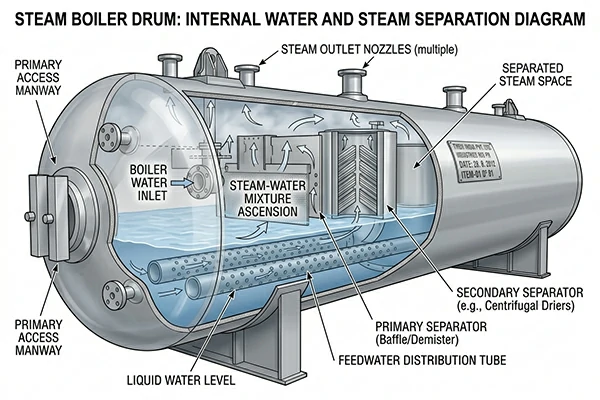
这 boiler drum is a pressure vessel that plays a key role in maintaining steam quality and system stability.
In many industrial steam boilers, the drum performs two important functions:
During the steam generation process:
A properly designed boiler drum improves:
High-quality steam should contain as little moisture as possible. Excess water carried with steam can cause problems such as:
所以, the boiler drum must provide sufficient space and separation performance to produce reliable steam output.
章节概述: The water circulation system ensures continuous movement of water through heated areas, allowing the boiler to maintain stable steam production.
The water circulation system is another essential part of industrial steam boilers. Its main purpose is to move water continuously through heating surfaces so that heat can be transferred efficiently.
Without proper water circulation, some areas of the boiler may become overheated, reducing efficiency and increasing the risk of equipment damage.
Natural circulation uses the difference in density between hot water and cooler water to create movement inside the boiler.
优点:
Natural circulation is commonly used in traditional industrial boiler systems.
Forced circulation uses pumps to control water movement inside the boiler system.
优点:
Forced circulation systems are commonly applied in:
章节概述: The control system monitors and adjusts boiler operating conditions to improve efficiency, 安全, and automation.
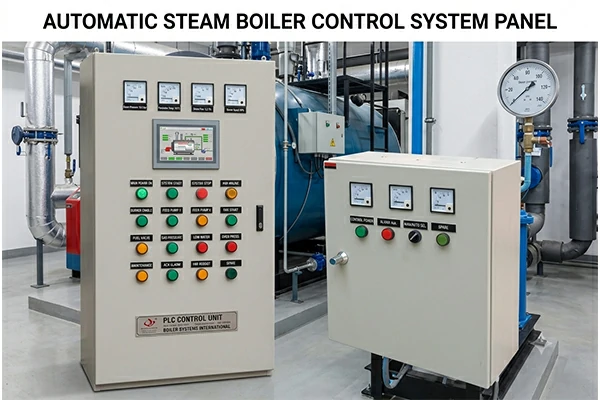
这 steam boiler control system is the intelligent management center of a modern boiler. It continuously monitors important operating parameters and automatically adjusts the equipment according to steam demand.
Typical parameters controlled by the system include:
A modern boiler control system usually contains the following components:
| Control Component | Main Function |
|---|---|
| Pressure Controller | Maintains stable steam pressure during operation. |
| Water Level Controller | Prevents low-water operation and protects boiler safety. |
| Temperature Sensor | Monitors temperature changes inside the boiler system. |
| Fuel Control Valve | Adjusts fuel supply according to steam demand. |
| PLC Control System | Provides automatic monitoring and intelligent operation. |
Advanced control systems provide several benefits:
章节概述:
This section explains the essential safety components installed in steam boilers to control pressure, prevent equipment failure, and ensure safe long-term operation.
Steam boilers operate under high temperature and pressure conditions, which means safety protection is one of the most important aspects of boiler design.
Modern steam boiler systems are equipped with multiple safety devices that continuously monitor operating conditions and automatically respond when abnormal situations occur.
A reliable safety system not only protects the boiler equipment but also reduces operational risks, improves system stability, and extends the service life of key components.
The pressure relief valve is one of the most critical safety devices installed on a steam boiler. Its main function is to automatically release excess pressure when the internal boiler pressure exceeds the designed safety limit.
During normal operation, the pressure relief valve remains closed and allows the boiler to maintain stable working pressure. 然而, if the control system fails or steam pressure rises unexpectedly, the valve opens automatically to discharge steam and prevent dangerous overpressure conditions.
Regular inspection and testing of pressure relief valves are necessary because a malfunctioning valve can seriously affect boiler safety.
A low water cut-off device protects steam boilers from operating without sufficient water. Maintaining the correct water level inside the boiler is essential because water absorbs heat from the combustion process.
If the water level drops too low, the heating surface may become overheated, causing damage to boiler tubes, deformation of metal components, or even serious equipment failure.
When the water level falls below the safe limit, the low water cut-off system automatically stops the burner operation until the water level returns to normal.
The control system works as the “脑” of a modern steam boiler. It monitors important operating parameters including pressure, 温度, 水位, 燃料供应, and combustion conditions.
Advanced boiler control systems use sensors and automation technology to adjust burner output according to steam demand. This helps maintain stable steam production while reducing unnecessary fuel consumption.
| Control Function | Purpose | 好处 |
|---|---|---|
| Pressure Monitoring | Maintains safe steam pressure levels | Prevents overpressure operation |
| Water Level Control | Keeps proper boiler water volume | Protects heating surfaces from damage |
| Fuel Control | Adjusts combustion according to demand | Improves energy efficiency |
| Automatic Shutdown | Stops operation during abnormal conditions | Improves operator safety |
Water quality has a direct impact on steam boiler performance and operating life. Untreated water contains minerals such as calcium and magnesium, which can form scale deposits inside boiler tubes and heat transfer surfaces.
Scale buildup reduces heat transfer efficiency and forces the boiler to consume more fuel to produce the same amount of steam. 严重时, excessive scale can cause overheating and damage to pressure components.
A complete water treatment system usually includes filtration, water softening, chemical treatment, and continuous monitoring to maintain suitable boiler water quality.
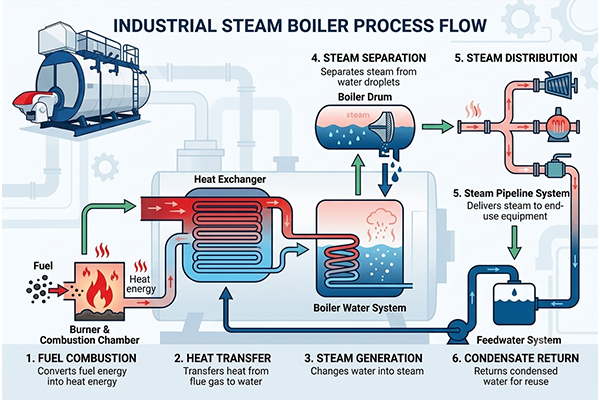
章节概述:
This section explains how different steam boiler components work together as a complete system to convert fuel energy into usable steam for industrial heating and processing applications.
A steam boiler is not a single independent device. It is a complete thermal system where multiple components, 包括燃烧器, 燃烧室, 热交换器, boiler drum, 控制系统, and steam pipelines, work together to generate and deliver steam efficiently.
Understanding how these components interact helps operators improve boiler efficiency, 减少燃油消耗, and maintain safe and stable operation.
The steam generation process inside an industrial boiler follows a continuous closed-loop cycle. Each component performs a specific function, and the entire system works together to transform fuel energy into high-temperature steam.
The process begins inside the burner. The burner mixes fuel, 例如天然气, 油, 生物质, or other energy sources, with air and creates a controlled combustion process.
燃烧过程中, chemical energy stored in the fuel is converted into thermal energy, producing high-temperature flue gases that provide the heat required for steam production.
A properly designed burner ensures stable combustion, improves fuel utilization, and helps reduce unnecessary emissions.
燃料 + Air → Combustion → High Temperature Heat Energy
After combustion, high-temperature gases flow through the heat exchanger area where thermal energy is transferred to the boiler water.
The heat exchanger acts as the connection point between the combustion system and the water system. It allows heat to move efficiently while preventing combustion gases from mixing with the water or steam.
Different boiler designs use different heat transfer methods. 例如, in fire-tube boilers, 热气体通过被水包围的管道, while in water-tube boilers, water flows inside tubes heated by external combustion gases.
As water continuously absorbs heat from the heat exchanger, its temperature gradually increases until it reaches the boiling point.
When sufficient thermal energy is absorbed, the water changes from liquid form into steam. The generated steam contains a large amount of usable thermal energy, making it suitable for industrial processes, 供暖系统, 和发电.
The quality and quantity of steam produced depend on several factors, 包括:
After steam is generated, the mixture of water and steam enters the boiler drum. The boiler drum plays an important role in separating steam from remaining water particles.
The separated steam collects at the upper section of the drum, while water returns to the circulation system for further heating.
Effective steam separation improves steam quality and prevents excessive moisture from entering downstream equipment.
Once high-quality steam is collected, it leaves the boiler through the main steam outlet and travels through the steam distribution pipeline.
The steam can then be delivered to different applications, 包括:
A well-designed steam distribution system with proper insulation helps reduce heat loss and improves overall energy efficiency.
After steam releases its heat energy during the industrial process, it gradually cools and changes back into liquid water, known as condensate.
Instead of being discharged, the condensate is collected and returned to the boiler feedwater system for reuse.
The condensate return process provides several benefits:
| Process Stage | Main Component Involved | 功能 |
|---|---|---|
| 1. 燃料燃烧 | 刻录机 & 燃烧室 | Converts fuel energy into heat energy |
| 2. 传播热量 | 热交换器 | Transfers heat from flue gas to water |
| 3. 蒸汽发生 | Boiler Water System | Changes water into steam |
| 4. Steam Separation | 锅炉汽包 | Separates steam from water droplets |
| 5. 蒸汽分配 | Steam Pipeline System | Delivers steam to end-use equipment |
| 6. Condensate Return | Feedwater System | Returns condensed water for reuse |
The performance of a steam boiler depends on how efficiently all components work together. A high-quality burner cannot achieve maximum efficiency if the heat exchanger is poorly maintained. 相似地, an efficient boiler drum and control system cannot compensate for improper combustion conditions.
为此原因, industrial users should consider the entire boiler system rather than focusing only on individual components when selecting, upgrading, or maintaining a steam boiler.
A properly designed and maintained steam boiler system can provide reliable thermal energy, 降低运营成本, and stable performance for many years.
章节概述:
This section introduces practical methods to improve steam boiler efficiency, 减少燃油消耗, and lower long-term operating costs.
Improving steam boiler efficiency is not only about selecting a high-efficiency boiler model. Daily operation, 维护实践, 燃油质量, and system optimization all influence the overall energy performance.
For industrial facilities, even a small improvement in boiler efficiency can create significant savings because boilers often operate continuously throughout the year.
An economizer is a heat recovery device installed in the boiler exhaust system. It captures heat from hot flue gases and uses this recovered energy to preheat boiler feedwater.
By recovering waste heat that would normally escape through the chimney, an economizer can reduce fuel consumption and improve overall boiler efficiency.
The combustion process directly affects boiler efficiency. Too much air increases heat loss through exhaust gases, while insufficient air can cause incomplete combustion and increased emissions.
Modern burners equipped with automatic combustion control systems can adjust the fuel-air ratio to maintain efficient combustion under different load conditions.
Regular maintenance is essential for maintaining steam boiler performance. Common maintenance tasks include cleaning heat transfer surfaces, checking burner operation, inspecting safety valves, and testing control systems.
A well-maintained boiler not only consumes less fuel but also reduces unexpected downtime and extends equipment lifespan.
Many energy losses occur after steam leaves the boiler. Poor insulation, steam leakage, and inefficient condensate recovery systems can significantly reduce overall system efficiency.
Improving steam pipelines, repairing leaks, and recovering condensate water can help facilities maximize the energy value of generated steam.
章节概述:
This section explains where steam boilers are commonly used and why different industries rely on steam as an efficient heat transfer medium.
Steam boilers are widely used because steam can transfer large amounts of thermal energy quickly and efficiently. From manufacturing processes to heating systems, steam remains an important energy source in many industries.
| 行业 | Steam Boiler Applications |
|---|---|
| 食品加工 | 烹饪, 消毒, 打扫, and production heating |
| 医药行业 | 消毒, clean steam production, and process heating |
| 纺织工业 | 染色, 烘干, and fabric processing |
| 化学工业 | Reaction heating and temperature control |
| 发电 | Driving steam turbines for electricity production |
| 医院和商业建筑 | 加热, hot water supply, 和灭菌 |
章节概述:
This section provides key factors to consider when selecting a steam boiler for industrial or commercial applications.
Choosing the correct steam boiler requires more than simply comparing prices. The right boiler should match your steam demand, 燃料供应情况, operating environment, and future expansion plans.
The first step is calculating the required steam output. Boiler capacity is usually measured by tons per hour (TPH), kilograms per hour (公斤/小时), or boiler horsepower.
Selecting a boiler that is too small may result in insufficient steam supply, while an oversized boiler can increase investment costs and reduce operating efficiency.
The choice of fuel has a major impact on operating costs. Common steam boiler fuels include natural gas, 柴油, 生物质, 煤炭, and electricity.
| 汽油种类 | 主要优点 | Suitable Applications |
|---|---|---|
| 天然气 | Clean combustion and high efficiency | Industrial and commercial heating |
| 生物质 | Renewable fuel and lower carbon emissions | Factories with biomass resources |
| 煤炭 | Lower fuel cost in some regions | Large-scale industrial production |
| 电 | Clean operation and easy installation | Small-scale applications |
章节概述:
This section provides a practical steam boiler maintenance checklist to help operators improve reliability, prevent unexpected failures, and extend boiler service life.
Regular maintenance is one of the most important factors affecting steam boiler performance. Even a high-quality boiler system may experience efficiency losses, increased fuel consumption, or safety risks if inspections and maintenance are ignored.
A proper maintenance program should include daily monitoring, regular cleaning, safety inspections, and professional servicing according to the manufacturer’s recommendations.
Daily inspection allows operators to identify potential problems before they develop into major equipment failures. Operators should monitor important operating parameters and check whether the boiler is running under normal conditions.
| Inspection Item | What to Check | Purpose |
|---|---|---|
| 蒸汽压力 | Check whether pressure remains within the designed range | Ensure safe and stable operation |
| Water Level | Confirm proper water level inside the boiler drum | Prevent overheating caused by low water conditions |
| Burner Operation | Check flame condition and combustion stability | Maintain efficient fuel combustion |
| Leaks and Noise | Inspect pipelines, 阀门, and boiler body | Detect abnormal conditions early |
During long-term operation, deposits may accumulate inside boiler components. Scale, 煤烟, and corrosion products can reduce heat transfer efficiency and increase energy consumption.
Regular cleaning should include inspection of heat exchanger surfaces, combustion chambers, boiler tubes, and water circulation systems.
For industrial steam boilers operating continuously, professional inspection is usually recommended at scheduled intervals to ensure all pressure components remain safe and reliable.
Water treatment is a key part of steam boiler maintenance. Poor water quality can lead to scale formation, 腐蚀, and reduced boiler efficiency.
A proper water management program normally includes water softening, chemical treatment, dissolved oxygen control, and regular testing of water parameters.
Maintaining proper water quality helps protect boiler tubes, improve heat transfer efficiency, and reduce maintenance costs.
章节概述:
This section summarizes the major advantages and limitations of steam boiler systems to help users understand whether steam technology fits their application.
Steam boilers have been widely used for more than a century because of their reliability, flexibility, and ability to deliver large amounts of thermal energy. 然而, like any industrial equipment, steam boilers also have certain limitations that should be considered before installation.
章节概述:
This FAQ section answers common questions about steam boiler operation, 效率, 应用, and maintenance to help users better understand steam boiler systems.
A steam boiler is designed to convert water into steam by using thermal energy. The generated steam can be used for industrial heating, 发电, 消毒, manufacturing processes, 和商业供暖系统.
A steam boiler generates steam by burning fuel or using electricity to create heat. The heat is transferred to water through heat transfer surfaces, causing the water to reach its boiling point and transform into steam.
The main difference is the flow direction of water and hot gases. 在火管锅炉中, 热燃烧气体流过被水包围的管道. 在水管锅炉中, water flows inside tubes heated by external combustion gases.
Fire-tube boilers are generally suitable for low and medium-pressure applications, while water-tube boilers are preferred for high-pressure and large-capacity industrial applications.
The service life of a steam boiler depends on boiler quality, 工作条件, 维护实践, and water treatment. 通过适当的维护, many industrial steam boilers can operate reliably for 20 到 35 years or longer.
Steam boiler efficiency can be improved by installing economizers, maintaining proper combustion, 改善绝缘性, reducing steam leakage, optimizing water treatment, and performing regular maintenance.
章节概述:
This section summarizes the key points of steam boiler technology and explains why selecting the right system is important for long-term efficiency and reliability.
Steam boilers remain one of the most important thermal energy solutions used in industrial, 商业的, and power generation applications. Their ability to produce reliable and high-quality steam makes them essential for industries that require continuous heating and processing capabilities.
Understanding how steam boilers work, the function of each component, different boiler types, 维护要求, and efficiency improvement methods can help businesses make better decisions when purchasing or upgrading a boiler system.
The best steam boiler solution depends on several factors, including required steam capacity, 燃料供应情况, operating environment, energy costs, and future production requirements.
If you are planning to install a new steam boiler system or replace an existing unit, choosing an experienced boiler manufacturer can help ensure better performance, 降低运营成本, 和长期可靠性.
Our professional boiler engineers can help you select the most suitable steam boiler based on your required capacity, 汽油种类, 工作压力, and application requirements.
For technical consultation, customized boiler solutions, and quotation support, 请联系我们:
免费锅炉报价
没有延迟, 得到 3 今日报价 比较最优惠的价格 安全可靠评论
本文内容?
If you like Fang Kuai, 请留言.


V查看我们客户的评论
"方快的热水锅炉质量让我印象深刻. 它经久耐用,超出了我的预期. 安装过程也很顺利,客服态度也很好. 热水锅炉操作维护非常方便, 能源效率显着. 强烈推荐方快的热水器。"
杰克
澳大利亚"方快的客户服务是一流的. 他们帮助我选择了满足我需求的完美锅炉,并在整个过程中提供了大力支持. 安装过程也很顺利,锅炉超出了我的预期. 非常易于使用和维护, 能源效率显着. 我向任何需要可靠高效供暖解决方案的人强烈推荐方快的产品。"
娟
墨西哥"方快导热油锅炉操作维护非常方便. 它帮助我们节省了维护时间和金钱, 这导致显着的成本节约. 材料的质量和锅炉的构造非常出色. 它也非常节能, 这帮助我们节省了能源费用. 强烈推荐方快的导热油锅炉 ."
艾伦
巴西"方快的蒸汽发生器很优秀. 它们非常易于使用并且需要最少的维护. 方快的客户服务也很出色. 他们反应灵敏,乐于助人. 蒸汽发生器的能源效率也非常出色, 这帮助我节省了能源费用. 强烈推荐方快的蒸汽发生器。"
玛丽亚
西班牙"我为我的工厂购买了一台方快蒸汽锅炉,它已经完美运行了几个月了. 材料的质量和锅炉的结构令人印象深刻. 它也非常节能, 这帮助我们节省了能源费用. 我向任何需要可靠高效供暖解决方案的人强烈推荐方快的产品。"
约翰
美国"方快的辅助设备让我的锅炉系统更上一层楼. 设备质量卓越,价格非常合理. 该设备帮助提高了我的锅炉系统的效率和性能, 这导致显着的成本节约. 我向任何需要优质锅炉配件的人强烈推荐方快的辅助设备。"
马里克
英国"方快的热水锅炉质量让我印象深刻. 它经久耐用,超出了我的预期. 安装过程也很顺利,客服态度也很好. 热水锅炉操作维护非常方便, 能源效率显着. 强烈推荐方快的热水器。"
杰克
澳大利亚"方快的蒸汽发生器非常适合我的小生意. 它非常易于使用,需要最少的维护. 它也非常节能, 这帮助我节省了能源费用. 方快的客服也很好. 他们反应灵敏,乐于助人. 强烈推荐方快的蒸汽发生器。"
艾哈迈德
埃及"方快的辅助设备让我的锅炉系统更上一层楼. 设备质量卓越,价格非常合理. 该设备帮助提高了我的锅炉系统的效率和性能, 这导致显着的成本节约. 我向任何需要优质锅炉配件的人强烈推荐方快的辅助设备。"
马里克
英国