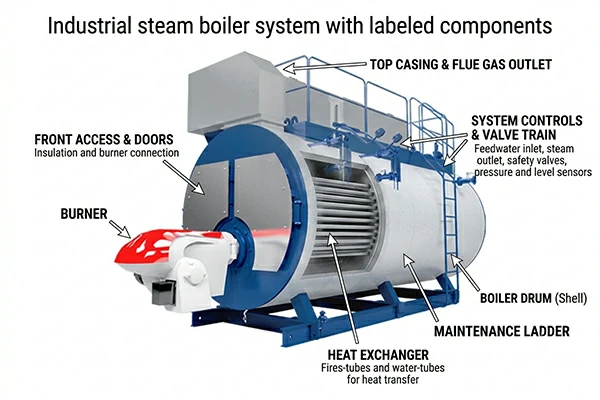
A steam boiler is not just a simple heating device. It is a complete thermal energy system composed of multiple components that work together to convert fuel energy into usable steam.
The main Паровой котел components include the burner, камера сгорания, теплообменник, boiler drum, water circulation system, и система управления. Each component has a specific function, and the performance of the entire boiler depends on how efficiently these parts operate together.
For industrial users, understanding steam boiler components is important when selecting equipment, Повышение энергоэффективности, reducing maintenance costs, and ensuring safe operation.
В этом руководстве, we will explain the function of each major steam boiler component, how they work together, and why these parts are critical for reliable steam generation.
Обзор раздела: This section introduces the main parts of a steam boiler and explains how different components work together to convert fuel energy into usable steam.
A steam boiler is not a single machine but a complete system consisting of several important mechanical and control components. Although boiler designs vary depending on fuel type, емкость, и приложение, most industrial steam boilers include the following basic parts:
| Steam Boiler Component | Основная функция |
|---|---|
| Горелка | Produces heat energy by burning fuel such as natural gas, масло, биомасса, или уголь. |
| Камера сгорания | Provides space for fuel combustion and generates high-temperature gases. |
| Теплообменник | Переносит тепло от дымовых газов в воду для выработки пара.. |
| Котельный барабан | Хранит воду и отделяет пар от водной смеси.. |
| Система циркуляции воды | Обеспечивает непрерывный поток воды через нагревательные поверхности.. |
| Система выпуска пара | Доставляет образующийся пар к промышленному оборудованию или системам отопления.. |
| Система контроля | Контролирует давление, температура, уровень воды, и условия горения. |
| Устройства безопасности | Защитите котел от аномального давления, перегрев, и операционные риски. |
Каждый компонент имеет определенное назначение. Отказ или плохая работа одной детали может повлиять на эффективность., безопасность, и срок службы всей паровой котельной системы.
Обзор раздела: The горелка компонент, отвечающий за создание источника тепла, необходимого для производства пара. Его конструкция напрямую влияет на топливную экономичность., выбросы, и производительность котла.
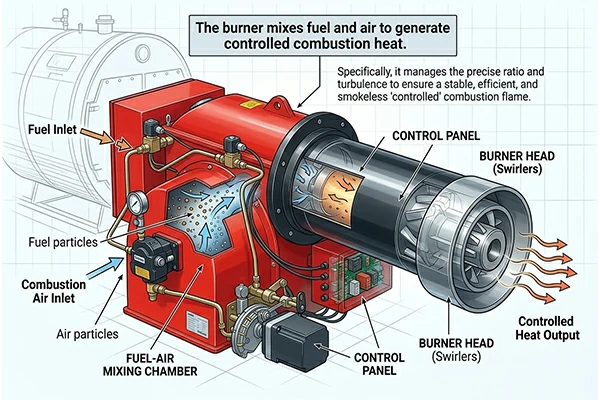
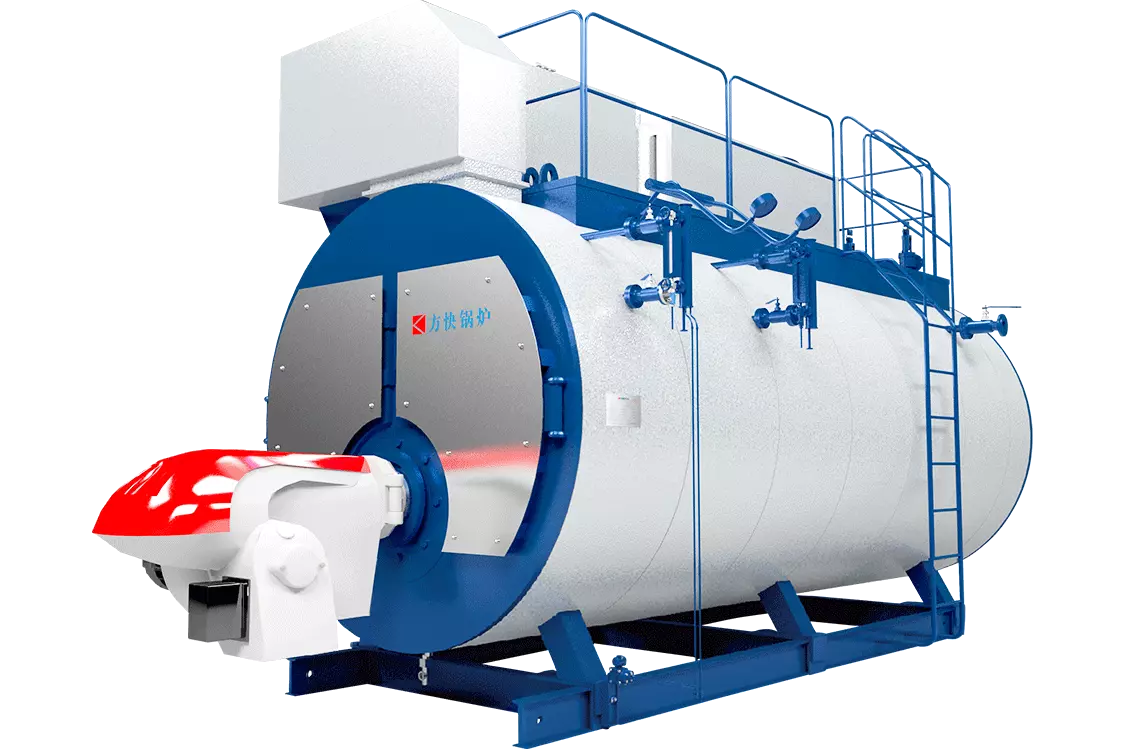
The горелка парового котла is often considered the heart of a combustion boiler because it controls the process of converting fuel energy into thermal energy.
During operation, the burner mixes fuel and air in the correct ratio, creates a stable flame, and releases heat inside the combustion chamber. The generated heat is then transferred to water through the boiler heating surfaces.
Industrial steam boiler burners can operate with different fuel types, включая:
A high-quality burner helps the boiler achieve:
The working process of a burner usually includes four main steps:
Fuel is transported from the storage system to the burner through dedicated fuel pipelines. The supply system controls the amount of fuel entering the combustion process.
The burner combines fuel with combustion air at an optimized ratio. Proper air-fuel mixing ensures complete combustion and reduces unnecessary energy loss.
The ignition system creates a controlled flame inside the combustion chamber. Modern burners usually include automatic ignition and flame monitoring systems to improve safety.
Во время горения, chemical energy stored in the fuel is converted into thermal energy. This heat is then transferred through the boiler heating surfaces to produce steam.
Modern industrial burners often use automatic modulation technology. Instead of operating only at full capacity, the burner can adjust flame intensity according to steam demand, reducing fuel consumption and improving efficiency.
Обзор раздела: The combustion chamber provides the environment where fuel burns and converts chemical energy into high-temperature heat required for steam generation.
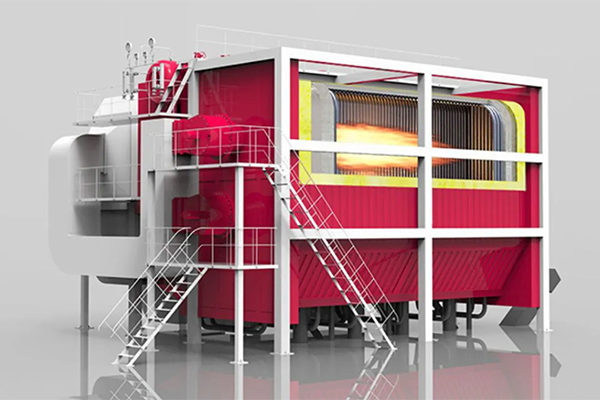
The камера сгорания, also known as the furnace or firebox, is the area where fuel combustion takes place. It is one of the most important sections inside a steam boiler because the quality of combustion directly affects efficiency and emissions.
Inside the combustion chamber, the burner produces a high-temperature flame. The released heat is absorbed by the surrounding boiler heating surfaces and transferred to the water system.
A well-designed combustion chamber should provide:
Температура внутри камер сгорания промышленных котлов может достигать чрезвычайно высоких значений.. Поэтому, камера обычно изготавливается из термостойких материалов и изоляционных слоев для уменьшения теплопотерь и защиты внешних конструкций..
Конструкция камеры сгорания напрямую влияет на работу котла.. Плохие условия горения могут привести к:
По этой причине, производители промышленных котлов тщательно оптимизируют размер камеры сгорания, форма, и распределение тепла в соответствии с различными видами топлива и эксплуатационными требованиями.
Обзор раздела: This section explains how the heat exchanger transfers thermal energy from combustion gases to water and why it is one of the most important components affecting steam boiler efficiency.
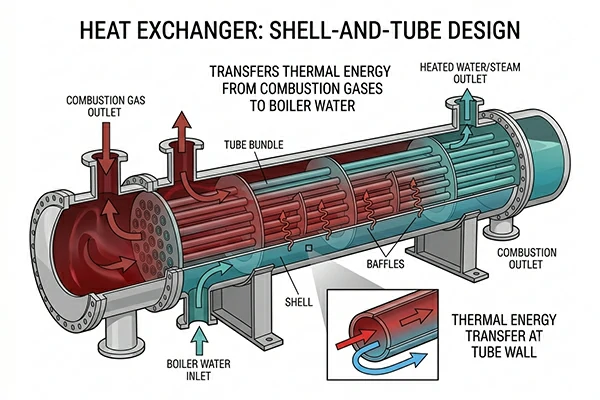
The steam boiler heat exchanger is a critical component responsible for transferring heat from hot combustion gases to water without allowing the two fluids to directly mix.
The efficiency of a steam boiler largely depends on how effectively the heat exchanger captures and transfers thermal energy. A well-designed heat exchanger can reduce fuel consumption, improve steam production capacity, and lower operating costs.
Во время работы котла:
Different steam boiler designs use different heat exchanger structures. The two most common designs are fire-tube boilers and water-tube boilers.
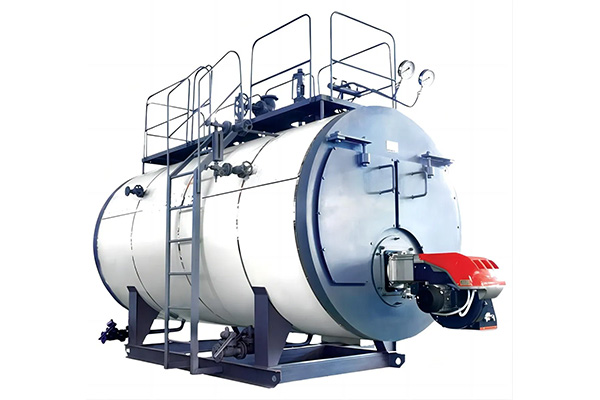
В жаротрубном котле, горячие дымовые газы текут по трубкам, окруженным водой.
The tube walls act as heat transfer surfaces, allowing heat from the gases to transfer into the surrounding water.
Main advantages of fire-tube boiler heat exchangers:
Fire-tube boilers are commonly used in:
В водотрубном котле, water flows inside tubes while hot combustion gases surround the outside of the tubes.
This design allows water to absorb heat faster and enables the boiler to operate at higher pressures and temperatures.
Main advantages of water-tube boiler heat exchangers:
Водотрубные котлы широко используются в:
| Особенность | Жаротрубный котел | Водотрубный котел |
|---|---|---|
| Метод теплопередачи | Горячие газы текут внутри трубок, а вода окружает их.. | Вода течет внутри труб, а горячие газы нагревают внешнюю поверхность.. |
| Способность давления | Приложения с низким и средним давлением. | Промышленное применение высокого давления. |
| Скорость генерации пара | Умеренная скорость производства пара. | Быстрое производство пара. |
| Обслуживание | Простое обслуживание и упрощенный осмотр. | Требует профессионального ухода и очистки воды.. |
| Типичные применения | Коммерческое отопление и небольшие заводы. | Энергетика и тяжелая промышленность. |
Обзор раздела: Барабан котла хранит воду, отделяет пар от водной смеси, и поддерживает стабильное парообразование во время работы.
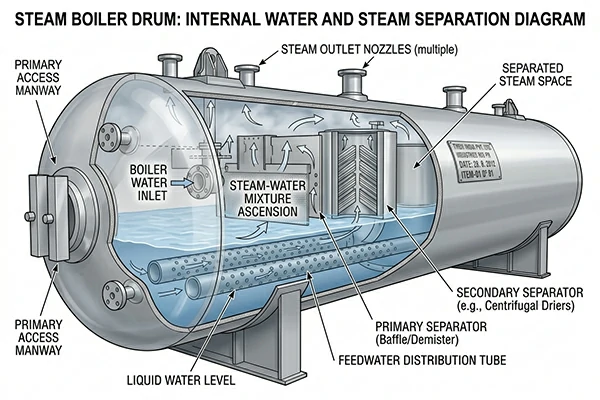
The boiler drum представляет собой сосуд под давлением, который играет ключевую роль в поддержании качества пара и стабильности системы..
Во многих промышленных паровых котлах, барабан выполняет две важные функции:
В процессе генерации пара:
Правильно спроектированный барабан котла улучшает:
Качественный пар должен содержать как можно меньше влаги.. Excess water carried with steam can cause problems such as:
Поэтому, the boiler drum must provide sufficient space and separation performance to produce reliable steam output.
Обзор раздела: The water circulation system ensures continuous movement of water through heated areas, allowing the boiler to maintain stable steam production.
The water circulation system is another essential part of industrial steam boilers. Its main purpose is to move water continuously through heating surfaces so that heat can be transferred efficiently.
Without proper water circulation, some areas of the boiler may become overheated, reducing efficiency and increasing the risk of equipment damage.
Natural circulation uses the difference in density between hot water and cooler water to create movement inside the boiler.
Преимущества:
Natural circulation is commonly used in traditional industrial boiler systems.
Forced circulation uses pumps to control water movement inside the boiler system.
Преимущества:
Forced circulation systems are commonly applied in:
Обзор раздела: The control system monitors and adjusts boiler operating conditions to improve efficiency, безопасность, and automation.
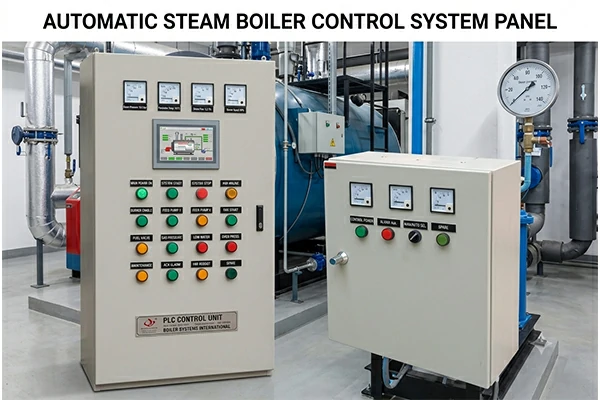
The steam boiler control system is the intelligent management center of a modern boiler. It continuously monitors important operating parameters and automatically adjusts the equipment according to steam demand.
Typical parameters controlled by the system include:
A modern boiler control system usually contains the following components:
| Control Component | Основная функция |
|---|---|
| Pressure Controller | Maintains stable steam pressure during operation. |
| Water Level Controller | Prevents low-water operation and protects boiler safety. |
| Temperature Sensor | Monitors temperature changes inside the boiler system. |
| Fuel Control Valve | Adjusts fuel supply according to steam demand. |
| PLC Control System | Provides automatic monitoring and intelligent operation. |
Advanced control systems provide several benefits:
Обзор раздела:
This section explains the essential safety components installed in steam boilers to control pressure, prevent equipment failure, and ensure safe long-term operation.
Steam boilers operate under high temperature and pressure conditions, which means safety protection is one of the most important aspects of boiler design.
Modern steam boiler systems are equipped with multiple safety devices that continuously monitor operating conditions and automatically respond when abnormal situations occur.
A reliable safety system not only protects the boiler equipment but also reduces operational risks, improves system stability, and extends the service life of key components.
The pressure relief valve is one of the most critical safety devices installed on a steam boiler. Its main function is to automatically release excess pressure when the internal boiler pressure exceeds the designed safety limit.
During normal operation, the pressure relief valve remains closed and allows the boiler to maintain stable working pressure. Однако, if the control system fails or steam pressure rises unexpectedly, the valve opens automatically to discharge steam and prevent dangerous overpressure conditions.
Regular inspection and testing of pressure relief valves are necessary because a malfunctioning valve can seriously affect boiler safety.
A low water cut-off device protects steam boilers from operating without sufficient water. Maintaining the correct water level inside the boiler is essential because water absorbs heat from the combustion process.
If the water level drops too low, the heating surface may become overheated, causing damage to boiler tubes, deformation of metal components, or even serious equipment failure.
When the water level falls below the safe limit, the low water cut-off system automatically stops the burner operation until the water level returns to normal.
The control system works as the “мозг” of a modern steam boiler. It monitors important operating parameters including pressure, температура, уровень воды, подача топлива, и условия горения.
Advanced boiler control systems use sensors and automation technology to adjust burner output according to steam demand. This helps maintain stable steam production while reducing unnecessary fuel consumption.
| Control Function | Purpose | Преимущества |
|---|---|---|
| Pressure Monitoring | Maintains safe steam pressure levels | Prevents overpressure operation |
| Water Level Control | Keeps proper boiler water volume | Protects heating surfaces from damage |
| Fuel Control | Adjusts combustion according to demand | Improves energy efficiency |
| Automatic Shutdown | Stops operation during abnormal conditions | Improves operator safety |
Water quality has a direct impact on steam boiler performance and operating life. Untreated water contains minerals such as calcium and magnesium, which can form scale deposits inside boiler tubes and heat transfer surfaces.
Scale buildup reduces heat transfer efficiency and forces the boiler to consume more fuel to produce the same amount of steam. В тяжелых случаях, excessive scale can cause overheating and damage to pressure components.
A complete water treatment system usually includes filtration, water softening, chemical treatment, and continuous monitoring to maintain suitable boiler water quality.
Обзор раздела:
This section explains how different steam boiler components work together as a complete system to convert fuel energy into usable steam for industrial heating and processing applications.
A steam boiler is not a single independent device. It is a complete thermal system where multiple components, включая горелку, камера сгорания, теплообменник, boiler drum, система управления, and steam pipelines, work together to generate and deliver steam efficiently.
Understanding how these components interact helps operators improve boiler efficiency, снизить расход топлива, and maintain safe and stable operation.
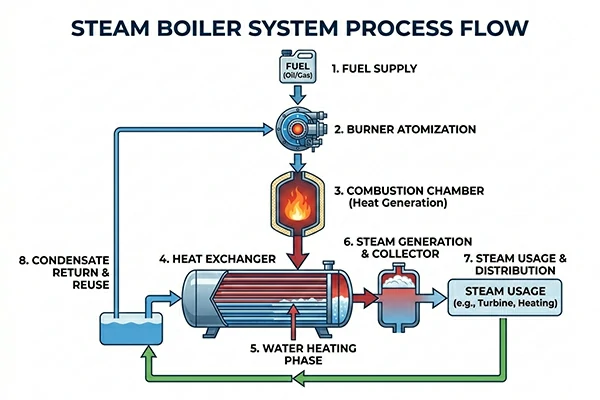
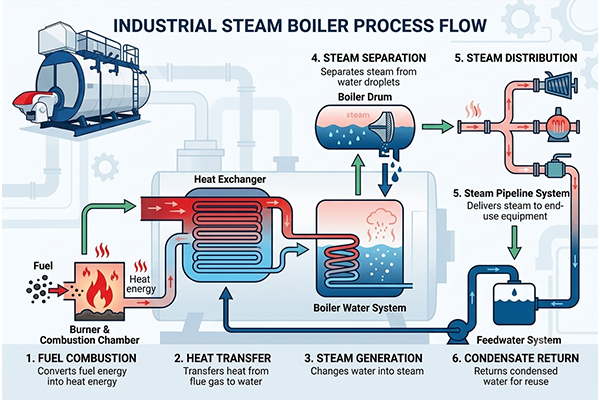
The steam generation process inside an industrial boiler follows a continuous closed-loop cycle. Each component performs a specific function, and the entire system works together to transform fuel energy into high-temperature steam.
The process begins inside the burner. The burner mixes fuel, например, природный газ, масло, биомасса, or other energy sources, with air and creates a controlled combustion process.
Во время горения, chemical energy stored in the fuel is converted into thermal energy, producing high-temperature flue gases that provide the heat required for steam production.
A properly designed burner ensures stable combustion, improves fuel utilization, and helps reduce unnecessary emissions.
Топливо + Air → Combustion → High Temperature Heat Energy
After combustion, high-temperature gases flow through the heat exchanger area where thermal energy is transferred to the boiler water.
The heat exchanger acts as the connection point between the combustion system and the water system. It allows heat to move efficiently while preventing combustion gases from mixing with the water or steam.
Different boiler designs use different heat transfer methods. Например, in fire-tube boilers, Горячие газы проходят через трубки, окруженные водой, while in water-tube boilers, water flows inside tubes heated by external combustion gases.
As water continuously absorbs heat from the heat exchanger, its temperature gradually increases until it reaches the boiling point.
When sufficient thermal energy is absorbed, the water changes from liquid form into steam. The generated steam contains a large amount of usable thermal energy, making it suitable for industrial processes, системы отопления, и производство электроэнергии.
The quality and quantity of steam produced depend on several factors, включая:
After steam is generated, the mixture of water and steam enters the boiler drum. The boiler drum plays an important role in separating steam from remaining water particles.
The separated steam collects at the upper section of the drum, while water returns to the circulation system for further heating.
Effective steam separation improves steam quality and prevents excessive moisture from entering downstream equipment.
Once high-quality steam is collected, it leaves the boiler through the main steam outlet and travels through the steam distribution pipeline.
The steam can then be delivered to different applications, включая:
A well-designed steam distribution system with proper insulation helps reduce heat loss and improves overall energy efficiency.
After steam releases its heat energy during the industrial process, it gradually cools and changes back into liquid water, known as condensate.
Instead of being discharged, the condensate is collected and returned to the boiler feedwater system for reuse.
The condensate return process provides several benefits:
| Process Stage | Main Component Involved | Функция |
|---|---|---|
| 1. Сгорание топлива | Горелка & Камера сгорания | Преобразует энергию топлива в тепловую энергию |
| 2. Теплопередача | Теплообменник | Переносит тепло от дымовых газов к воде |
| 3. Генерация пара | Система котловой воды | Превращает воду в пар |
| 4. Сепарация пара | Котельный барабан | Отделяет пар от капель воды. |
| 5. Распределение пара | Система паропроводов | Подает пар к конечному оборудованию |
| 6. Возврат конденсата | Система питательной воды | Возвращает конденсат для повторного использования |
Производительность парового котла зависит от того, насколько эффективно работают все компоненты вместе.. Качественная горелка не сможет достичь максимальной эффективности, если теплообменник будет плохо обслуживаться.. Сходным образом, эффективный барабан котла и система управления не могут компенсировать неправильные условия горения.
По этой причине, Промышленные пользователи должны учитывать всю котельную систему, а не сосредотачиваться только на отдельных компонентах при выборе., модернизация, или обслуживание парового котла.
A properly designed and maintained steam boiler system can provide reliable thermal energy, Снижение эксплуатационных расходов, and stable performance for many years.
Обзор раздела:
This section introduces practical methods to improve steam boiler efficiency, снизить расход топлива, and lower long-term operating costs.
Improving steam boiler efficiency is not only about selecting a high-efficiency boiler model. Daily operation, практика технического обслуживания, качество топлива, and system optimization all influence the overall energy performance.
For industrial facilities, even a small improvement in boiler efficiency can create significant savings because boilers often operate continuously throughout the year.
An economizer is a heat recovery device installed in the boiler exhaust system. It captures heat from hot flue gases and uses this recovered energy to preheat boiler feedwater.
By recovering waste heat that would normally escape through the chimney, an economizer can reduce fuel consumption and improve overall boiler efficiency.
The combustion process directly affects boiler efficiency. Too much air increases heat loss through exhaust gases, while insufficient air can cause incomplete combustion and increased emissions.
Modern burners equipped with automatic combustion control systems can adjust the fuel-air ratio to maintain efficient combustion under different load conditions.
Regular maintenance is essential for maintaining steam boiler performance. Common maintenance tasks include cleaning heat transfer surfaces, checking burner operation, inspecting safety valves, and testing control systems.
A well-maintained boiler not only consumes less fuel but also reduces unexpected downtime and extends equipment lifespan.
Many energy losses occur after steam leaves the boiler. Poor insulation, steam leakage, and inefficient condensate recovery systems can significantly reduce overall system efficiency.
Improving steam pipelines, repairing leaks, and recovering condensate water can help facilities maximize the energy value of generated steam.
Обзор раздела:
This section explains where steam boilers are commonly used and why different industries rely on steam as an efficient heat transfer medium.
Steam boilers are widely used because steam can transfer large amounts of thermal energy quickly and efficiently. From manufacturing processes to heating systems, steam remains an important energy source in many industries.
| Промышленность | Steam Boiler Applications |
|---|---|
| Переработка пищевых продуктов | Кулинария, стерилизация, уборка, and production heating |
| Фармацевтическая промышленность | Стерилизация, clean steam production, and process heating |
| Текстильная промышленность | Окрашивание, сушка, and fabric processing |
| Химическая индустрия | Reaction heating and temperature control |
| Выработка энергии | Driving steam turbines for electricity production |
| Больницы и коммерческие здания | Обогрев, hot water supply, и стерилизация |
Обзор раздела:
This section provides key factors to consider when selecting a steam boiler for industrial or commercial applications.
Choosing the correct steam boiler requires more than simply comparing prices. The right boiler should match your steam demand, наличие топлива, operating environment, and future expansion plans.

The first step is calculating the required steam output. Boiler capacity is usually measured by tons per hour (ТПХ), kilograms per hour (кг/ч), or boiler horsepower.
Выбор слишком маленького котла может привести к недостаточной подаче пара., в то время как котел слишком большого размера может увеличить инвестиционные затраты и снизить эффективность работы..
Выбор топлива оказывает большое влияние на эксплуатационные расходы.. Обычное топливо для паровых котлов включает природный газ., дизельное топливо, биомасса, уголь, и электричество.
| Тип топлива | Основные преимущества | Подходящие приложения |
|---|---|---|
| Натуральный газ | Чистое сгорание и высокая эффективность | Промышленное и коммерческое отопление |
| Биомасса | Возобновляемое топливо и снижение выбросов углекислого газа | Заводы с ресурсами биомассы |
| Уголь | Снижение стоимости топлива в некоторых регионах | Крупномасштабное промышленное производство |
| Электричество | Чистая работа и простая установка | Малые приложения |
Обзор раздела:
В этом разделе представлен практический контрольный список по техническому обслуживанию парового котла, который поможет операторам повысить надежность., предотвратить неожиданные сбои, и продлить срок службы котла.
Регулярное техническое обслуживание является одним из наиболее важных факторов, влияющих на производительность парового котла.. Даже качественная котельная система может испытывать потери эффективности., повышенный расход топлива, или риски для безопасности, если проверки и техническое обслуживание игнорируются.
Правильная программа технического обслуживания должна включать ежедневный мониторинг., регулярная уборка, проверки безопасности, и профессиональное обслуживание согласно рекомендациям производителя..
Ежедневный осмотр позволяет операторам выявлять потенциальные проблемы до того, как они перерастут в серьезные неисправности оборудования.. Операторы должны следить за важными рабочими параметрами и проверять, работает ли котел в нормальных условиях..
| Объект проверки | Что проверить | Purpose |
|---|---|---|
| Давление пара | Проверьте, остается ли давление в пределах расчетного диапазона. | Обеспечить безопасную и стабильную работу |
| Уровень воды | Убедитесь, что уровень воды внутри барабана котла правильный. | Предотвратите перегрев, вызванный низким уровнем воды. |
| Работа горелки | Проверьте состояние пламени и стабильность горения. | Поддержание эффективного сгорания топлива |
| Утечки и шум | Осмотр трубопроводов, клапаны, и корпус котла | Обнаружение аномальных условий на ранней стадии |
При длительной эксплуатации, отложения могут накапливаться внутри компонентов котла. Шкала, сажа, и продукты коррозии могут снизить эффективность теплопередачи и увеличить потребление энергии..
Регулярная чистка должна включать осмотр поверхностей теплообменника., камеры сгорания, котельные трубы, и системы циркуляции воды.
Для промышленных паровых котлов, работающих непрерывно, профессиональный осмотр обычно рекомендуется проводить через определенные промежутки времени, чтобы гарантировать, что все компоненты давления остаются безопасными и надежными..
Водоподготовка – ключевая часть обслуживания парового котла. Плохое качество воды может привести к образованию накипи., коррозия, и снижение эффективности котла.
Правильная программа управления водными ресурсами обычно включает умягчение воды., chemical treatment, контроль растворенного кислорода, и регулярное тестирование параметров воды.
Поддержание надлежащего качества воды помогает защитить трубы котла., повысить эффективность теплопередачи, и сократить расходы на техническое обслуживание.
Обзор раздела:
В этом разделе обобщены основные преимущества и ограничения систем паровых котлов, чтобы помочь пользователям понять, соответствует ли паровая технология их применению..
Паровые котлы широко используются уже более века из-за своей надежности., гибкость, и способность доставлять большие объемы тепловой энергии. Однако, как любое промышленное оборудование, паровые котлы также имеют определенные ограничения, которые следует учитывать перед установкой.
Обзор раздела:
В этом разделе часто задаваемых вопросов содержатся ответы на распространенные вопросы по эксплуатации парового котла., эффективность, Приложения, и техническое обслуживание, чтобы помочь пользователям лучше понять системы паровых котлов..
Паровой котел предназначен для преобразования воды в пар с использованием тепловой энергии.. Образующийся пар можно использовать для промышленного отопления., выработка энергии, стерилизация, производственные процессы, и коммерческих систем отопления.
Паровой котел генерирует пар путем сжигания топлива или использования электричества для создания тепла.. Тепло передается воде через поверхности теплопередачи., заставляя воду достигать точки кипения и превращаться в пар.
Основное отличие заключается в направлении потока воды и горячих газов.. В жаротрубном котле, горячие дымовые газы текут по трубкам, окруженным водой. В водотрубном котле, water flows inside tubes heated by external combustion gases.
Жаротрубные котлы обычно подходят для систем низкого и среднего давления., в то время как водотрубные котлы предпочтительны для промышленного применения высокого давления и большой мощности..
Срок службы парового котла зависит от качества котла., условия эксплуатации, практика технического обслуживания, и очистка воды. При правильном обслуживании, многие промышленные паровые котлы могут надежно работать в течение 20 к 35 лет или дольше.
КПД парового котла можно повысить установкой экономайзеров., поддержание правильного сгорания, улучшение изоляции, уменьшение утечки пара, оптимизация очистки воды, и проведение регулярного технического обслуживания.
Обзор раздела:
В этом разделе обобщаются ключевые моменты технологии паровых котлов и объясняется, почему выбор правильной системы важен для долгосрочной эффективности и надежности..
Паровые котлы остаются одним из наиболее важных решений в области тепловой энергии, используемых в промышленности., коммерческий, и приложения для производства электроэнергии. Их способность производить надежный и высококачественный пар делает их незаменимыми для отраслей, где требуются возможности непрерывного нагрева и обработки..
Понимание принципа работы паровых котлов, функция каждого компонента, разные типы котлов, требования к техническому обслуживанию, и методы повышения эффективности могут помочь предприятиям принимать более обоснованные решения при покупке или модернизации котельной системы..
Лучшее решение для парового котла зависит от нескольких факторов., включая необходимую паропроизводительность, наличие топлива, operating environment, затраты на электроэнергию, и будущие производственные требования.
Если вы планируете установить новую паровую котельную систему или заменить существующую установку, выбор опытного производителя котла может помочь обеспечить лучшую производительность., Снижение эксплуатационных расходов, и долгосрочная надежность.
Наши профессиональные инженеры по котлам помогут вам выбрать наиболее подходящий паровой котел в зависимости от требуемой мощности., тип топлива, рабочее давление, и требования к приложению.
Для технической консультации, индивидуальные решения для котлов, и поддержка котировок, пожалуйста, свяжитесь с нами:
БЕСПЛАТНЫЕ ЦЕНЫ НА БОЙЛЕР
Без задержки, получать 3 котировки сегодня Сравните лучшие цены Безопасный и надежныйОБЗОРЫ
ЧТО В ЭТОЙ СТАТЬЕ?
Какой тип топлива лучше всего подходит для паровых котлов, чтобы сбалансировать затраты, Эффективность, и выбросы?
Лучшие практики, чтобы максимизировать эффективность котла на угле
Руководство по ценам на котлы на отработанном масле (2026): Расходы, ROI & Hidden Fees
Цены на масляные котлы:Сколько стоит установка масляного котла?

Если вам нравится Фанг Куай, пожалуйста, оставьте свое сообщение.


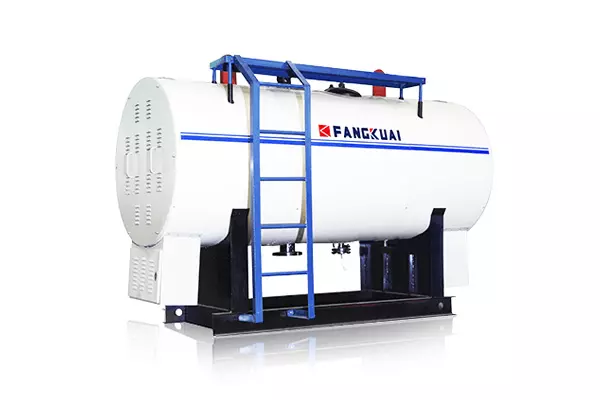
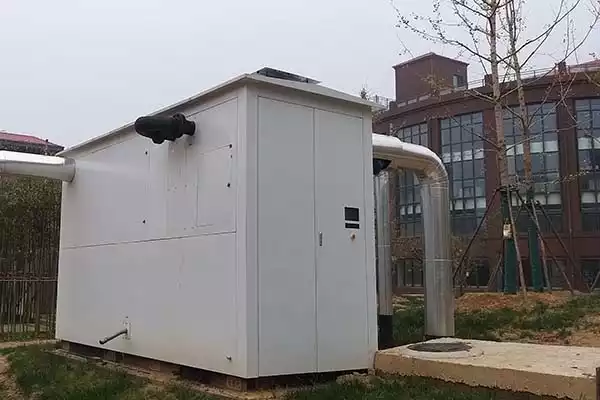
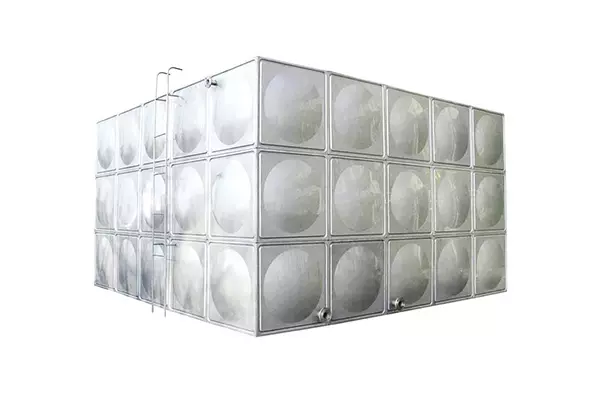

Впросмотреть отзывы наших клиентов
"Вспомогательное оборудование Fangkuai сделало мою котельную еще лучше. Качество оборудования исключительное, а цены очень разумные. Оборудование помогло повысить эффективность и производительность моей котельной установки., что привело к значительной экономии средств. Я настоятельно рекомендую вспомогательное оборудование Fangkuai всем, кто нуждается в высококачественных принадлежностях для котлов."
Марик
Великобритания"Я купил паровой котел Fangkuai для своей фабрики, и он работает безупречно уже несколько месяцев.. Качество материалов и конструкция котла впечатляют. Он также очень энергоэффективен, что помогло нам сэкономить деньги на наших счетах за электроэнергию. Я настоятельно рекомендую продукцию Fangkuai всем, кто нуждается в надежных и эффективных решениях для отопления."
Джон
США"Термомасляный котел от Fangkuai очень прост в эксплуатации и обслуживании.. Это помогло нам сэкономить время и деньги на обслуживании, что привело к значительной экономии средств. Качество материалов и конструкция котла исключительны.. Он также очень энергоэффективен, что помогло нам сэкономить деньги на наших счетах за электроэнергию. Я настоятельно рекомендую термомасляный котел Fangkuai. ."
Аллен
Бразилия"Я купил паровой котел Fangkuai для своей фабрики, и он работает безупречно уже несколько месяцев.. Качество материалов и конструкция котла впечатляют. Он также очень энергоэффективен, что помогло нам сэкономить деньги на наших счетах за электроэнергию. Я настоятельно рекомендую продукцию Fangkuai всем, кто нуждается в надежных и эффективных решениях для отопления."
Джон
США"Парогенераторы Fangkuai превосходны.. Они очень просты в использовании и требуют минимального обслуживания.. Обслуживание клиентов в Fangkuai также исключительное.. Они очень отзывчивы и всегда готовы помочь. Энергоэффективность парогенераторов также замечательна., который помог мне сэкономить деньги на счетах за электроэнергию. Я настоятельно рекомендую парогенераторы Fangkuai."
Мария
Испания"Парогенератор от Fangkuai идеально подходит для моего малого бизнеса.. Он очень прост в использовании и требует минимального обслуживания. Он также очень энергоэффективен, который помог мне сэкономить деньги на счетах за электроэнергию. Обслуживание клиентов в Fangkuai также отличное.. Они очень отзывчивы и всегда готовы помочь. Я настоятельно рекомендую парогенераторы Fangkuai."
Ахмед
Египет"Мы уже много лет используем термомасляный котел Fangkuai на нашем химическом заводе, и он нас ни разу не подвел.. Котел очень прочный и выдерживает суровые условия.. Он также очень прост в эксплуатации и обслуживании, что помогло нам сэкономить время и деньги на обслуживании. Термомасляные котлы Fangkuai являются первоклассными, и я настоятельно рекомендую их всем, кто нуждается в надежных решениях для отопления."
Чанг
Китай"Я купил паровой котел Fangkuai для своей фабрики, и он работает безупречно уже несколько месяцев.. Качество материалов и конструкция котла впечатляют. Он также очень энергоэффективен, что помогло нам сэкономить деньги на наших счетах за электроэнергию. Я настоятельно рекомендую продукцию Fangkuai всем, кто нуждается в надежных и эффективных решениях для отопления."
Джон
США"Я очень впечатлен качеством водогрейного котла Fangkuai.. Он построен на века и превзошел мои ожидания. Процесс установки также был очень гладким, и обслуживание клиентов было превосходным.. Водогрейный котел очень прост в эксплуатации и обслуживании., и энергоэффективность замечательная. Я очень рекомендую водогрейные котлы Fangkuai."
Джек
Австралия