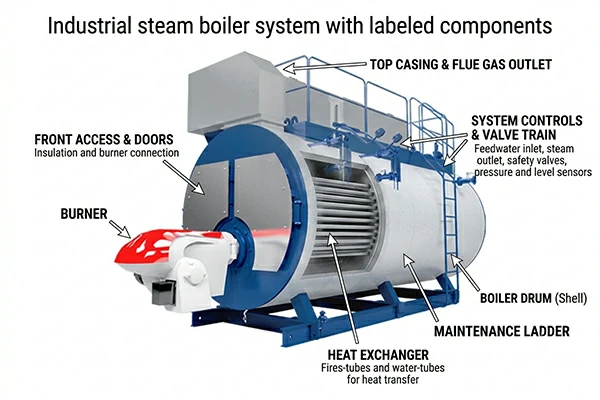
A steam boiler is not just a simple heating device. It is a complete thermal energy system composed of multiple components that work together to convert fuel energy into usable steam.
The main паровий котел components include the burner, камера згоряння, теплообмінник, boiler drum, water circulation system, і система контролю. Each component has a specific function, and the performance of the entire boiler depends on how efficiently these parts operate together.
For industrial users, understanding steam boiler components is important when selecting equipment, підвищення енергоефективності, reducing maintenance costs, and ensuring safe operation.
У цьому посібнику, ми пояснимо функцію кожного основного компонента парового котла, як вони працюють разом, і чому ці частини є критично важливими для надійного виробництва пари.
Огляд розділу: У цьому розділі представлено основні частини парового котла та пояснено, як різні компоненти працюють разом, щоб перетворити паливну енергію на придатну пару.
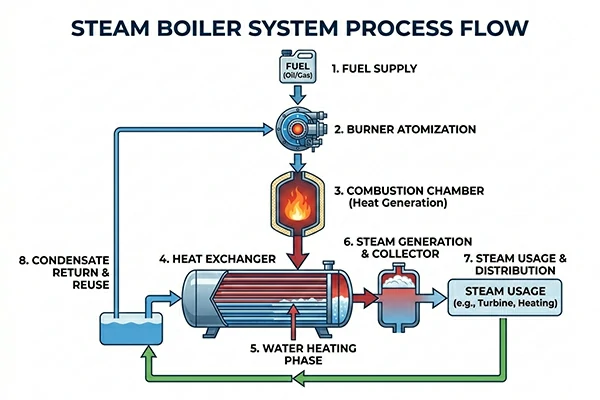
Паровий котел - це не окрема машина, а повна система, що складається з кількох важливих механічних і контрольних компонентів. Хоча конструкції котлів відрізняються в залежності від типу палива, потужність, і застосування, більшість промислових парових котлів включають наступні основні частини:
| Компонент парового котла | Основна функція |
|---|---|
| Пальник | Виробляє теплову енергію, спалюючи паливо, наприклад природний газ, масло, біомаса, або вугілля. |
| Камера згоряння | Забезпечує простір для спалювання палива та генерує високотемпературні гази. |
| Теплообмінник | Передає тепло від газів згоряння воді для утворення пари. |
| Барабан котла | Зберігає воду та відокремлює пару від водяної суміші. |
| Система циркуляції води | Підтримує постійний потік води через поверхні нагріву. |
| Система випуску пари | Подає вироблену пару до промислового обладнання або систем опалення. |
| Система контролю | Стежить за тиском, температура, рівень води, та умови горіння. |
| Запобіжні пристрої | Захистіть котел від надмірного тиску, перегрів, та операційні ризики. |
Кожен компонент має певне призначення. Відмова або погана робота однієї частини може вплинути на ефективність, безпеки, і термін служби всієї системи парового котла.
Огляд розділу: The пальник є компонентом, відповідальним за створення джерела тепла, необхідного для виробництва пари. Його конструкція безпосередньо впливає на економію палива, викиди, і продуктивність котла.
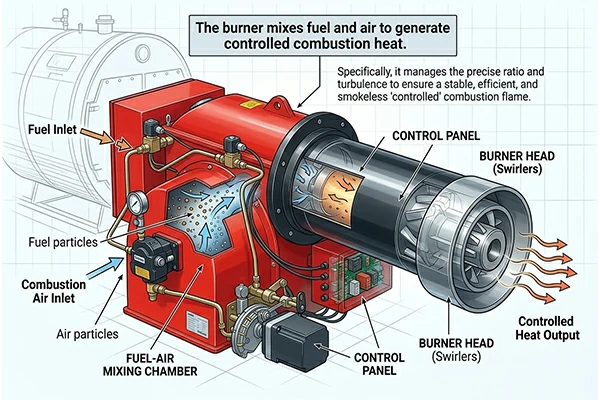
The пальник парового котла часто вважається серцем котла, оскільки він контролює процес перетворення енергії палива в теплову енергію.
Під час експлуатації, пальник змішує паливо і повітря в правильному співвідношенні, створює стійке полум'я, і виділяє тепло всередині камери згоряння. Вироблене тепло потім передається воді через поверхні нагріву котла.
Пальники промислових парових котлів можуть працювати на різних видах палива, в тому числі:
Якісний пальник допомагає котлу досягти:
Робочий процес пальника зазвичай складається з чотирьох основних етапів:
Паливо транспортується від системи зберігання до пальника через спеціальні паливопроводи. Система подачі контролює кількість палива, що надходить у процес згоряння.
Пальник поєднує паливо з повітрям для горіння в оптимізованому співвідношенні. Правильне змішування повітря та палива забезпечує повне згоряння та зменшує непотрібні втрати енергії.
Система запалювання створює контрольоване полум'я всередині камери згоряння. Сучасні пальники зазвичай оснащені системами автоматичного запалювання та моніторингу полум’я для підвищення безпеки.
Під час горіння, хімічна енергія, накопичена в паливі, перетворюється на теплову. Потім це тепло передається через поверхні нагріву котла для виробництва пари.
Сучасні промислові пальники часто використовують технологію автоматичної модуляції. Замість того, щоб працювати лише на повну потужність, пальник може регулювати інтенсивність полум'я відповідно до потреби в парі, зниження витрати палива та підвищення ефективності.
Огляд розділу: Камера згоряння забезпечує середовище, де горить паливо та перетворює хімічну енергію у високотемпературне тепло, необхідне для виробництва пари.
The камера згоряння, також відомий як піч або топка, це зона, де відбувається спалювання палива. Це одна з найважливіших частин парового котла, тому що якість згоряння безпосередньо впливає на ефективність і викиди..
Всередині камери згоряння, пальник створює полум'я високої температури. Вивільнене тепло поглинається навколишніми поверхнями нагріву котла і передається в систему водопостачання.
Добре спроектована камера згоряння повинна забезпечувати:
The temperature inside industrial boiler combustion chambers can reach extremely high levels. тому, the chamber is usually constructed with heat-resistant materials and insulation layers to reduce heat loss and protect external structures.
The design of the combustion chamber directly affects boiler operation. Poor combustion conditions may lead to:
З цієї причини, industrial boiler manufacturers carefully optimize combustion chamber size, форму, and heat distribution according to different fuels and operating requirements.
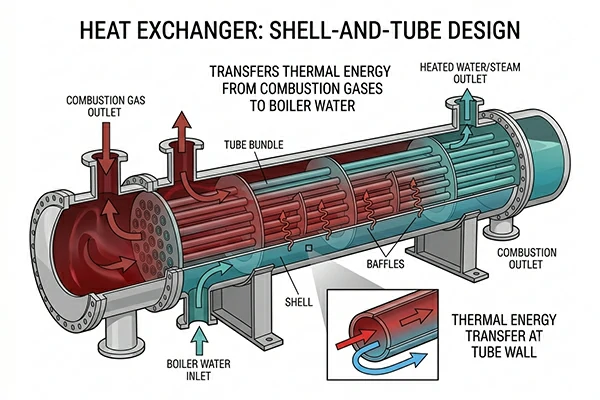
Огляд розділу: У цьому розділі пояснюється, як теплообмінник передає теплову енергію від газів, що утворюються при згоранні, до води, і чому він є одним із найважливіших компонентів, що впливає на ефективність парового котла..
The теплообмінник парового котла є критичним компонентом, відповідальним за передачу тепла від гарячих газів згоряння до води, не дозволяючи двом рідинам безпосередньо змішуватися.
Ефективність парового котла багато в чому залежить від того, наскільки теплообмінник вловлює і передає теплову енергію.. Добре сконструйований теплообмінник може зменшити споживання палива, покращити потужність виробництва пари, і нижчі експлуатаційні витрати.
Під час роботи котла:
Different steam boiler designs use different heat exchanger structures. The two most common designs are fire-tube boilers and water-tube boilers.
У жаротрубному котлі, hot combustion gases flow through tubes surrounded by water.
The tube walls act as heat transfer surfaces, allowing heat from the gases to transfer into the surrounding water.
Main advantages of fire-tube boiler heat exchangers:
Fire-tube boilers are commonly used in:
У водотрубному котлі, water flows inside tubes while hot combustion gases surround the outside of the tubes.
This design allows water to absorb heat faster and enables the boiler to operate at higher pressures and temperatures.
Main advantages of water-tube boiler heat exchangers:
Water-tube boilers are widely used in:
| Особливість | Вогнетрубний котел | Водотрубний котел |
|---|---|---|
| Heat Transfer Method | Hot gases flow inside tubes while water surrounds them. | Water flows inside tubes while hot gases heat the outside surface. |
| Pressure Capability | Low to medium pressure applications. | High-pressure industrial applications. |
| Steam Generation Speed | Moderate steam production speed. | Fast steam generation. |
| Технічне обслуговування | Simple maintenance and easier inspection. | Requires professional maintenance and water treatment. |
| Типові програми | Commercial heating and small factories. | Power generation and heavy industries. |
Огляд розділу: The boiler drum stores water, separates steam from water mixture, and maintains stable steam generation during operation.
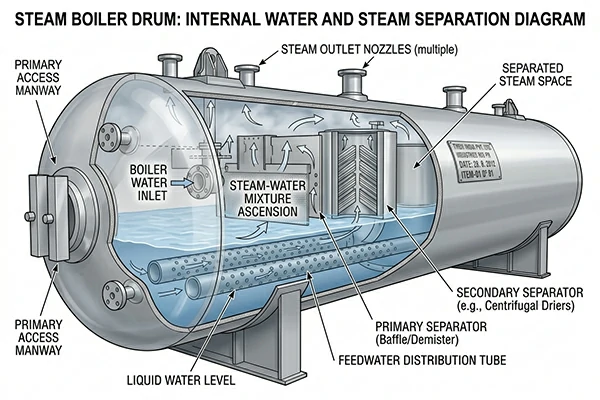
The boiler drum is a pressure vessel that plays a key role in maintaining steam quality and system stability.
In many industrial steam boilers, the drum performs two important functions:
During the steam generation process:
A properly designed boiler drum improves:
High-quality steam should contain as little moisture as possible. Excess water carried with steam can cause problems such as:
тому, the boiler drum must provide sufficient space and separation performance to produce reliable steam output.
Огляд розділу: The water circulation system ensures continuous movement of water through heated areas, allowing the boiler to maintain stable steam production.
The water circulation system is another essential part of industrial steam boilers. Its main purpose is to move water continuously through heating surfaces so that heat can be transferred efficiently.
Without proper water circulation, some areas of the boiler may become overheated, reducing efficiency and increasing the risk of equipment damage.
Natural circulation uses the difference in density between hot water and cooler water to create movement inside the boiler.
Переваги:
Natural circulation is commonly used in traditional industrial boiler systems.
Forced circulation uses pumps to control water movement inside the boiler system.
Переваги:
Forced circulation systems are commonly applied in:
Огляд розділу: The control system monitors and adjusts boiler operating conditions to improve efficiency, безпеки, and automation.
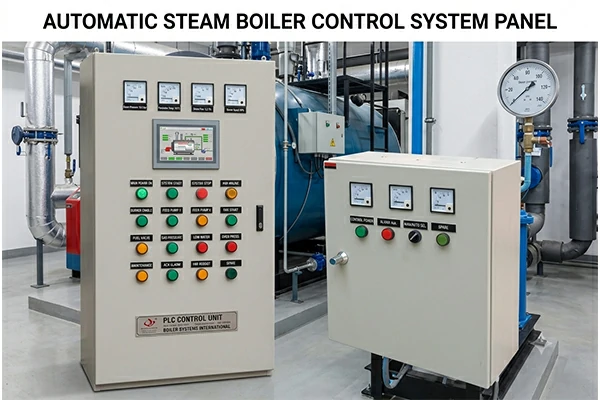
The steam boiler control system is the intelligent management center of a modern boiler. It continuously monitors important operating parameters and automatically adjusts the equipment according to steam demand.
Typical parameters controlled by the system include:
A modern boiler control system usually contains the following components:
| Control Component | Основна функція |
|---|---|
| Pressure Controller | Maintains stable steam pressure during operation. |
| Water Level Controller | Prevents low-water operation and protects boiler safety. |
| Temperature Sensor | Monitors temperature changes inside the boiler system. |
| Fuel Control Valve | Adjusts fuel supply according to steam demand. |
| PLC Control System | Provides automatic monitoring and intelligent operation. |
Advanced control systems provide several benefits:
Огляд розділу:
This section explains the essential safety components installed in steam boilers to control pressure, prevent equipment failure, and ensure safe long-term operation.
Steam boilers operate under high temperature and pressure conditions, which means safety protection is one of the most important aspects of boiler design.
Modern steam boiler systems are equipped with multiple safety devices that continuously monitor operating conditions and automatically respond when abnormal situations occur.
A reliable safety system not only protects the boiler equipment but also reduces operational risks, improves system stability, and extends the service life of key components.
The pressure relief valve is one of the most critical safety devices installed on a steam boiler. Its main function is to automatically release excess pressure when the internal boiler pressure exceeds the designed safety limit.
During normal operation, the pressure relief valve remains closed and allows the boiler to maintain stable working pressure. Проте, if the control system fails or steam pressure rises unexpectedly, the valve opens automatically to discharge steam and prevent dangerous overpressure conditions.
Необхідні регулярні перевірки та випробування запобіжних клапанів, оскільки несправний клапан може серйозно вплинути на безпеку котла.
Пристрій відсікання низького рівня води захищає парові котли від роботи без достатньої кількості води. Важливо підтримувати належний рівень води всередині котла, оскільки вода поглинає тепло в процесі згоряння.
Якщо рівень води падає занадто низько, поверхня нагріву може перегрітися, спричинення пошкодження труб котла, деформація металевих деталей, або навіть серйозна несправність обладнання.
Коли рівень води падає нижче безпечної межі, система відсікання низького рівня води автоматично зупиняє роботу пальника, поки рівень води не повернеться до нормального.
Система управління працює як “мозок” сучасного парового котла. It monitors important operating parameters including pressure, температура, рівень води, подача палива, та умови горіння.
Advanced boiler control systems use sensors and automation technology to adjust burner output according to steam demand. This helps maintain stable steam production while reducing unnecessary fuel consumption.
| Control Function | Purpose | Переваги |
|---|---|---|
| Pressure Monitoring | Maintains safe steam pressure levels | Prevents overpressure operation |
| Water Level Control | Keeps proper boiler water volume | Protects heating surfaces from damage |
| Fuel Control | Adjusts combustion according to demand | Improves energy efficiency |
| Automatic Shutdown | Stops operation during abnormal conditions | Improves operator safety |
Water quality has a direct impact on steam boiler performance and operating life. Untreated water contains minerals such as calcium and magnesium, які можуть утворювати відкладення накипу всередині труб котла та поверхонь теплопередачі.
Утворення накипу знижує ефективність теплопередачі та змушує котел споживати більше палива для виробництва тієї ж кількості пари. У важких випадках, надмірний накип може спричинити перегрів і пошкодження компонентів, що працюють під тиском.
Повна система очищення води зазвичай включає фільтрацію, пом'якшення води, хімічна обробка, і постійний моніторинг для підтримки належної якості котлової води.
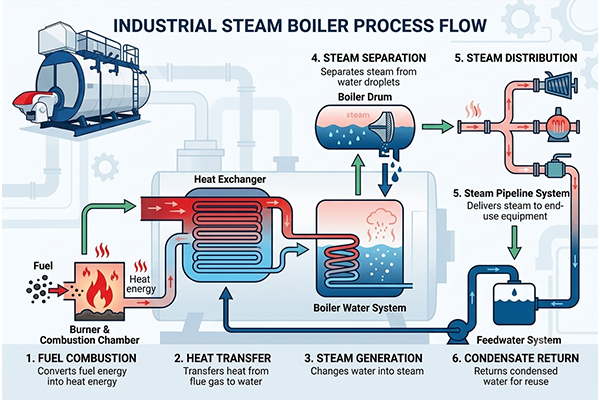
Огляд розділу:
У цьому розділі пояснюється, як різні компоненти парового котла працюють разом як повна система для перетворення енергії палива в пару, придатну для промислового опалення та обробки..
Паровий котел не є окремим самостійним пристроєм. Це повна теплова система, що складається з кількох компонентів, включаючи пальник, камера згоряння, теплообмінник, boiler drum, система контролю, and steam pipelines, work together to generate and deliver steam efficiently.
Understanding how these components interact helps operators improve boiler efficiency, зменшити витрату палива, and maintain safe and stable operation.
The steam generation process inside an industrial boiler follows a continuous closed-loop cycle. Each component performs a specific function, and the entire system works together to transform fuel energy into high-temperature steam.
The process begins inside the burner. The burner mixes fuel, наприклад природний газ, масло, біомаса, or other energy sources, with air and creates a controlled combustion process.
Під час горіння, хімічна енергія, накопичена в паливі, перетворюється на теплову, producing high-temperature flue gases that provide the heat required for steam production.
A properly designed burner ensures stable combustion, improves fuel utilization, and helps reduce unnecessary emissions.
паливо + Повітря → Горіння → Високотемпературна теплова енергія
Після спалювання, високотемпературні гази протікають через зону теплообмінника, де теплова енергія передається котловій воді.
Теплообмінник діє як точка з’єднання між системою спалювання та системою водопостачання. Це дозволяє теплу ефективно переміщатися, одночасно запобігаючи змішуванню газів згоряння з водою чи парою.
У різних конструкціях котлів використовуються різні способи передачі тепла. Наприклад, в жаротрубних котлах, гарячі гази проходять через труби, оточені водою, при цьому у водотрубних котлах, вода тече всередині труб, нагрітих газами зовнішнього горіння.
Оскільки вода постійно поглинає тепло від теплообмінника, його температура поступово підвищується, поки не досягне точки кипіння.
Коли поглинається достатня кількість теплової енергії, the water changes from liquid form into steam. The generated steam contains a large amount of usable thermal energy, making it suitable for industrial processes, системи опалення, і виробництво електроенергії.
The quality and quantity of steam produced depend on several factors, в тому числі:
After steam is generated, the mixture of water and steam enters the boiler drum. The boiler drum plays an important role in separating steam from remaining water particles.
The separated steam collects at the upper section of the drum, while water returns to the circulation system for further heating.
Effective steam separation improves steam quality and prevents excessive moisture from entering downstream equipment.
Once high-quality steam is collected, it leaves the boiler through the main steam outlet and travels through the steam distribution pipeline.
The steam can then be delivered to different applications, в тому числі:
A well-designed steam distribution system with proper insulation helps reduce heat loss and improves overall energy efficiency.
After steam releases its heat energy during the industrial process, it gradually cools and changes back into liquid water, known as condensate.
Instead of being discharged, the condensate is collected and returned to the boiler feedwater system for reuse.
The condensate return process provides several benefits:
| Process Stage | Main Component Involved | функція |
|---|---|---|
| 1. Спалювання палива | Пальник & Камера згоряння | Converts fuel energy into heat energy |
| 2. Теплопередача | Теплообмінник | Transfers heat from flue gas to water |
| 3. Генерація пари | Boiler Water System | Changes water into steam |
| 4. Steam Separation | Барабан котла | Separates steam from water droplets |
| 5. Розповсюдження Steam | Steam Pipeline System | Delivers steam to end-use equipment |
| 6. Condensate Return | Feedwater System | Returns condensed water for reuse |
The performance of a steam boiler depends on how efficiently all components work together. A high-quality burner cannot achieve maximum efficiency if the heat exchanger is poorly maintained. Аналогічно, an efficient boiler drum and control system cannot compensate for improper combustion conditions.
З цієї причини, industrial users should consider the entire boiler system rather than focusing only on individual components when selecting, upgrading, or maintaining a steam boiler.
A properly designed and maintained steam boiler system can provide reliable thermal energy, менші експлуатаційні витрати, and stable performance for many years.
Огляд розділу:
This section introduces practical methods to improve steam boiler efficiency, зменшити витрату палива, and lower long-term operating costs.
Improving steam boiler efficiency is not only about selecting a high-efficiency boiler model. Daily operation, методи обслуговування, якість палива, and system optimization all influence the overall energy performance.
For industrial facilities, even a small improvement in boiler efficiency can create significant savings because boilers often operate continuously throughout the year.
An economizer is a heat recovery device installed in the boiler exhaust system. It captures heat from hot flue gases and uses this recovered energy to preheat boiler feedwater.
By recovering waste heat that would normally escape through the chimney, an economizer can reduce fuel consumption and improve overall boiler efficiency.
The combustion process directly affects boiler efficiency. Too much air increases heat loss through exhaust gases, while insufficient air can cause incomplete combustion and increased emissions.
Modern burners equipped with automatic combustion control systems can adjust the fuel-air ratio to maintain efficient combustion under different load conditions.
Regular maintenance is essential for maintaining steam boiler performance. Common maintenance tasks include cleaning heat transfer surfaces, checking burner operation, inspecting safety valves, and testing control systems.
A well-maintained boiler not only consumes less fuel but also reduces unexpected downtime and extends equipment lifespan.
Many energy losses occur after steam leaves the boiler. Poor insulation, steam leakage, and inefficient condensate recovery systems can significantly reduce overall system efficiency.
Improving steam pipelines, repairing leaks, and recovering condensate water can help facilities maximize the energy value of generated steam.
Огляд розділу:
This section explains where steam boilers are commonly used and why different industries rely on steam as an efficient heat transfer medium.
Steam boilers are widely used because steam can transfer large amounts of thermal energy quickly and efficiently. From manufacturing processes to heating systems, steam remains an important energy source in many industries.
| Промисловість | Steam Boiler Applications |
|---|---|
| Приготування їжі | Кулінарія, стерилізація, очищення, and production heating |
| Фармацевтична промисловість | Стерилізація, clean steam production, and process heating |
| Текстильна промисловість | Фарбування, сушіння, and fabric processing |
| Хімічна промисловість | Reaction heating and temperature control |
| Вироблення енергії | Driving steam turbines for electricity production |
| Лікарні та комерційні будівлі | Опалення, hot water supply, і стерилізація |
Огляд розділу:
This section provides key factors to consider when selecting a steam boiler for industrial or commercial applications.
Choosing the correct steam boiler requires more than simply comparing prices. The right boiler should match your steam demand, наявність палива, operating environment, and future expansion plans.

The first step is calculating the required steam output. Boiler capacity is usually measured by tons per hour (TPH), kilograms per hour (кг/год), or boiler horsepower.
Selecting a boiler that is too small may result in insufficient steam supply, while an oversized boiler can increase investment costs and reduce operating efficiency.
The choice of fuel has a major impact on operating costs. Common steam boiler fuels include natural gas, diesel oil, біомаса, вугілля, and electricity.
| Тип палива | Основні переваги | Suitable Applications |
|---|---|---|
| Природний газ | Clean combustion and high efficiency | Industrial and commercial heating |
| Біомаса | Renewable fuel and lower carbon emissions | Factories with biomass resources |
| вугілля | Lower fuel cost in some regions | Large-scale industrial production |
| Електрика | Clean operation and easy installation | Small-scale applications |
Огляд розділу:
This section provides a practical steam boiler maintenance checklist to help operators improve reliability, prevent unexpected failures, and extend boiler service life.
Regular maintenance is one of the most important factors affecting steam boiler performance. Even a high-quality boiler system may experience efficiency losses, increased fuel consumption, or safety risks if inspections and maintenance are ignored.
A proper maintenance program should include daily monitoring, regular cleaning, safety inspections, and professional servicing according to the manufacturer’s recommendations.
Daily inspection allows operators to identify potential problems before they develop into major equipment failures. Operators should monitor important operating parameters and check whether the boiler is running under normal conditions.
| Inspection Item | What to Check | Purpose |
|---|---|---|
| Тиск пари | Check whether pressure remains within the designed range | Ensure safe and stable operation |
| Water Level | Confirm proper water level inside the boiler drum | Prevent overheating caused by low water conditions |
| Burner Operation | Check flame condition and combustion stability | Maintain efficient fuel combustion |
| Leaks and Noise | Inspect pipelines, клапани, and boiler body | Detect abnormal conditions early |
During long-term operation, deposits may accumulate inside boiler components. Scale, сажа, and corrosion products can reduce heat transfer efficiency and increase energy consumption.
Regular cleaning should include inspection of heat exchanger surfaces, combustion chambers, boiler tubes, and water circulation systems.
For industrial steam boilers operating continuously, professional inspection is usually recommended at scheduled intervals to ensure all pressure components remain safe and reliable.
Water treatment is a key part of steam boiler maintenance. Poor water quality can lead to scale formation, корозія, and reduced boiler efficiency.
A proper water management program normally includes water softening, хімічна обробка, dissolved oxygen control, and regular testing of water parameters.
Maintaining proper water quality helps protect boiler tubes, improve heat transfer efficiency, and reduce maintenance costs.
Огляд розділу:
This section summarizes the major advantages and limitations of steam boiler systems to help users understand whether steam technology fits their application.
Steam boilers have been widely used for more than a century because of their reliability, flexibility, and ability to deliver large amounts of thermal energy. Проте, like any industrial equipment, steam boilers also have certain limitations that should be considered before installation.
Огляд розділу:
This FAQ section answers common questions about steam boiler operation, ефективність, програми, and maintenance to help users better understand steam boiler systems.
A steam boiler is designed to convert water into steam by using thermal energy. The generated steam can be used for industrial heating, Генерація живлення, стерилізація, manufacturing processes, і комерційні системи опалення.
A steam boiler generates steam by burning fuel or using electricity to create heat. The heat is transferred to water through heat transfer surfaces, causing the water to reach its boiling point and transform into steam.
The main difference is the flow direction of water and hot gases. У жаротрубному котлі, hot combustion gases flow through tubes surrounded by water. У водотрубному котлі, вода тече всередині труб, нагрітих газами зовнішнього горіння.
Fire-tube boilers are generally suitable for low and medium-pressure applications, while water-tube boilers are preferred for high-pressure and large-capacity industrial applications.
The service life of a steam boiler depends on boiler quality, умови експлуатації, методи обслуговування, and water treatment. При належному обслуговуванні, many industrial steam boilers can operate reliably for 20 до 35 years or longer.
Steam boiler efficiency can be improved by installing economizers, maintaining proper combustion, поліпшення ізоляції, reducing steam leakage, optimizing water treatment, and performing regular maintenance.
Огляд розділу:
This section summarizes the key points of steam boiler technology and explains why selecting the right system is important for long-term efficiency and reliability.
Steam boilers remain one of the most important thermal energy solutions used in industrial, комерційний, and power generation applications. Their ability to produce reliable and high-quality steam makes them essential for industries that require continuous heating and processing capabilities.
Understanding how steam boilers work, the function of each component, different boiler types, вимоги до обслуговування, and efficiency improvement methods can help businesses make better decisions when purchasing or upgrading a boiler system.
The best steam boiler solution depends on several factors, including required steam capacity, наявність палива, operating environment, energy costs, and future production requirements.
If you are planning to install a new steam boiler system or replace an existing unit, choosing an experienced boiler manufacturer can help ensure better performance, менші експлуатаційні витрати, і довгострокову надійність.
Our professional boiler engineers can help you select the most suitable steam boiler based on your required capacity, Тип палива, робочий тиск, and application requirements.
For technical consultation, customized boiler solutions, and quotation support, будь ласка, зв'яжіться з нами:
БЕЗКОШТОВНІ КОТЛИ
Жодної затримки, отримати 3 цитати сьогодні Порівняйте за найкращими цінами Безпечний і надійнийВІДГУКИ
ЩО В ЦІЙ СТАТТІ?

Якщо вам подобається Fang Kuai, будь ласка, залиште своє повідомлення.




Вiew Відгуки нашого Замовника
"Парогенератори Fangkuai чудові. Вони дуже прості у використанні та вимагають мінімального обслуговування. Обслуговування клієнтів у Fangkuai також виняткове. Вони дуже чуйні і завжди готові допомогти. Енергоефективність парогенераторів також чудова, що допомогло мені заощадити гроші на рахунках за електроенергію. Я дуже рекомендую парогенератори Fangkuai."
Марія
Іспанія"Паровий котел від Fangkuai ідеально підходить для мого харчового підприємства. Він відповідає всім нашим вимогам і є дуже надійним. Якість матеріалів і конструкції котла виняткові. Він також дуже простий в експлуатації та обслуговуванні, що допомогло нам заощадити час і гроші на технічне обслуговування. Я настійно рекомендую парові котли Fangkuai усім, хто потребує надійних рішень для опалення."
Json
Бразилія"Я придбав паровий котел Fangkuai для своєї фабрики, і він працює бездоганно вже кілька місяців. Якість матеріалів і конструкції котла вражають. Це також дуже енергоефективно, що допомогло нам заощадити гроші на наших рахунках за електроенергію. Я настійно рекомендую продукцію Fangkuai усім, хто потребує надійних та ефективних рішень для опалення."
Джон
США"Ми роками використовуємо термальний масляний котел Fangkuai для нашого хімічного заводу, і він ніколи не підводив нас. Котел дуже міцний і може витримувати суворі умови. Він також дуже простий в експлуатації та обслуговуванні, що допомогло нам заощадити час і гроші на технічне обслуговування. Термомасляні котли Fangkuai є першокласними, і я настійно рекомендую їх усім, хто потребує надійних рішень для опалення."
Чанг
Китай"Парогенератор від Fangkuai ідеально підходить для мого малого бізнесу. Він дуже простий у використанні та вимагає мінімального обслуговування. Це також дуже енергоефективно, що допомогло мені заощадити гроші на рахунках за електроенергію. Обслуговування клієнтів у Fangkuai також чудове. Вони дуже чуйні і завжди готові допомогти. Я дуже рекомендую парогенератори Fangkuai."
Ахмед
Єгипет"Паровий котел від Fangkuai ідеально підходить для мого харчового підприємства. Він відповідає всім нашим вимогам і є дуже надійним. Якість матеріалів і конструкції котла виняткові. Він також дуже простий в експлуатації та обслуговуванні, що допомогло нам заощадити час і гроші на технічне обслуговування. Я настійно рекомендую парові котли Fangkuai усім, хто потребує надійних рішень для опалення."
Json
Бразилія"Термомасляний котел від Fangkuai дуже простий в експлуатації та обслуговуванні. Це допомогло нам заощадити час і гроші на технічне обслуговування, що призвело до значної економії коштів. Якість матеріалів і конструкції котла виняткові. Це також дуже енергоефективно, що допомогло нам заощадити гроші на наших рахунках за електроенергію. Я настійно рекомендую термальний масляний котел Fangkuai ."
Аллен
Бразилія"Обслуговування клієнтів у Fangkuai є першокласним. Вони допомогли мені вибрати ідеальний котел для моїх потреб і надали чудову підтримку протягом усього процесу. Процес встановлення також пройшов легко, і котел перевершив мої очікування. Він дуже простий у використанні та обслуговуванні, і енергоефективність чудова. Я настійно рекомендую продукцію Fangkuai усім, хто потребує надійних та ефективних рішень для опалення."
Хуан
Мексика"Паровий котел від Fangkuai ідеально підходить для мого харчового підприємства. Він відповідає всім нашим вимогам і є дуже надійним. Якість матеріалів і конструкції котла виняткові. Він також дуже простий в експлуатації та обслуговуванні, що допомогло нам заощадити час і гроші на технічне обслуговування. Я настійно рекомендую парові котли Fangkuai усім, хто потребує надійних рішень для опалення."
Json
Бразилія