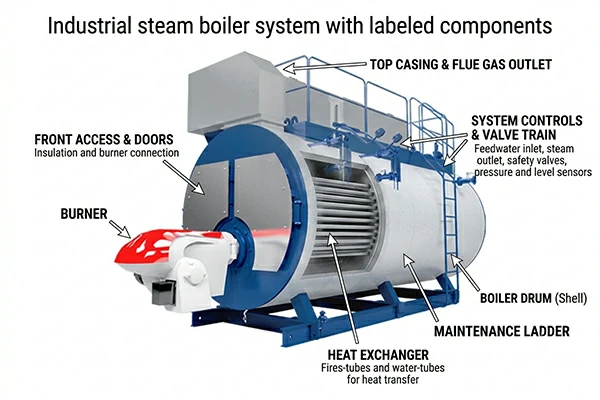
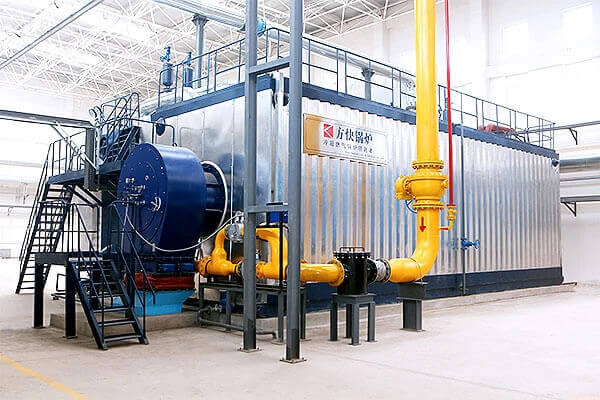
A steam boiler is not just a simple heating device. It is a complete thermal energy system composed of multiple components that work together to convert fuel energy into usable steam.
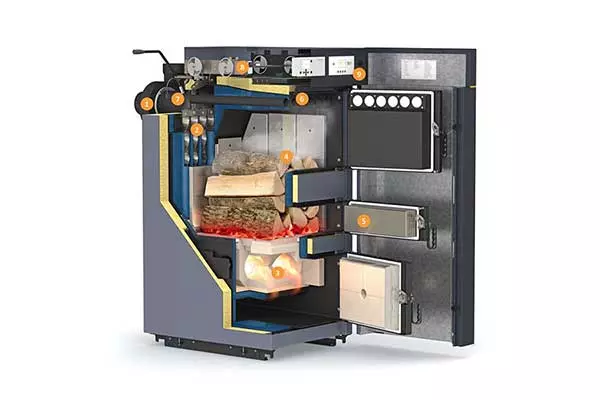
The main Dampfkessel components include the burner, Brennkammer, Wärmetauscher, boiler drum, water circulation system, und Steuerungssystem. Each component has a specific function, and the performance of the entire boiler depends on how efficiently these parts operate together.
For industrial users, understanding steam boiler components is important when selecting equipment, Verbesserung der Energieeffizienz, reducing maintenance costs, and ensuring safe operation.
In diesem Ratgeber, we will explain the function of each major steam boiler component, how they work together, and why these parts are critical for reliable steam generation.
Abschnittsübersicht: This section introduces the main parts of a steam boiler and explains how different components work together to convert fuel energy into usable steam.
A steam boiler is not a single machine but a complete system consisting of several important mechanical and control components. Although boiler designs vary depending on fuel type, Kapazität, und Anwendung, most industrial steam boilers include the following basic parts:
| Steam Boiler Component | Hauptfunktion |
|---|---|
| Brenner | Produces heat energy by burning fuel such as natural gas, Öl, Biomasse, oder Kohle. |
| Brennkammer | Provides space for fuel combustion and generates high-temperature gases. |
| Wärmetauscher | Transfers heat from combustion gases to water for steam generation. |
| Kesseltrommel | Stores water and separates steam from water mixture. |
| Wasserzirkulationssystem | Maintains continuous water flow through heating surfaces. |
| Steam Outlet System | Delivers generated steam to industrial equipment or heating systems. |
| Steuerungssystem | Monitors pressure, Temperatur, Wasserstand, and combustion conditions. |
| Sicherheitsvorrichtungen | Protect the boiler from abnormal pressure, Überhitzung, and operating risks. |
Each component has a specific purpose. The failure or poor performance of one part can affect the efficiency, Sicherheit, and service life of the entire steam boiler system.
Abschnittsübersicht: Der Brenner is the component responsible for creating the heat source required for steam production. Its design directly influences fuel efficiency, Emissionen, and boiler performance.
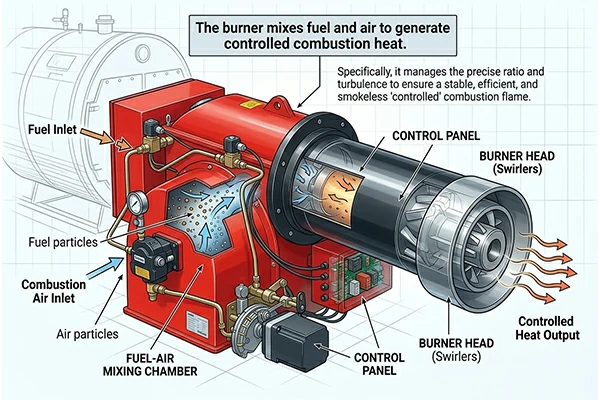
Der steam boiler burner is often considered the heart of a combustion boiler because it controls the process of converting fuel energy into thermal energy.
During operation, the burner mixes fuel and air in the correct ratio, creates a stable flame, and releases heat inside the combustion chamber. The generated heat is then transferred to water through the boiler heating surfaces.
Industrial steam boiler burners can operate with different fuel types, einschließlich:
A high-quality burner helps the boiler achieve:
The working process of a burner usually includes four main steps:
Fuel is transported from the storage system to the burner through dedicated fuel pipelines. The supply system controls the amount of fuel entering the combustion process.
The burner combines fuel with combustion air at an optimized ratio. Proper air-fuel mixing ensures complete combustion and reduces unnecessary energy loss.
The ignition system creates a controlled flame inside the combustion chamber. Modern burners usually include automatic ignition and flame monitoring systems to improve safety.
Während der Verbrennung, chemical energy stored in the fuel is converted into thermal energy. This heat is then transferred through the boiler heating surfaces to produce steam.
Modern industrial burners often use automatic modulation technology. Instead of operating only at full capacity, the burner can adjust flame intensity according to steam demand, reducing fuel consumption and improving efficiency.
Abschnittsübersicht: The combustion chamber provides the environment where fuel burns and converts chemical energy into high-temperature heat required for steam generation.
Der Brennkammer, also known as the furnace or firebox, is the area where fuel combustion takes place. It is one of the most important sections inside a steam boiler because the quality of combustion directly affects efficiency and emissions.
Inside the combustion chamber, the burner produces a high-temperature flame. The released heat is absorbed by the surrounding boiler heating surfaces and transferred to the water system.
A well-designed combustion chamber should provide:
The temperature inside industrial boiler combustion chambers can reach extremely high levels. Deshalb, the chamber is usually constructed with heat-resistant materials and insulation layers to reduce heat loss and protect external structures.
The design of the combustion chamber directly affects boiler operation. Poor combustion conditions may lead to:
Aus diesem Grund, industrial boiler manufacturers carefully optimize combustion chamber size, Form, and heat distribution according to different fuels and operating requirements.
Abschnittsübersicht: This section explains how the heat exchanger transfers thermal energy from combustion gases to water and why it is one of the most important components affecting steam boiler efficiency.
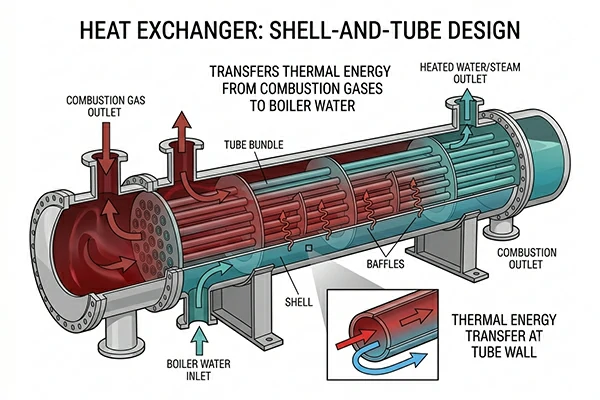
Der steam boiler heat exchanger is a critical component responsible for transferring heat from hot combustion gases to water without allowing the two fluids to directly mix.
The efficiency of a steam boiler largely depends on how effectively the heat exchanger captures and transfers thermal energy. A well-designed heat exchanger can reduce fuel consumption, improve steam production capacity, and lower operating costs.
Während des Kesselbetriebs:
Different steam boiler designs use different heat exchanger structures. The two most common designs are fire-tube boilers and water-tube boilers.
In einem Feuerrohrkessel, hot combustion gases flow through tubes surrounded by water.
The tube walls act as heat transfer surfaces, allowing heat from the gases to transfer into the surrounding water.
Main advantages of fire-tube boiler heat exchangers:
Fire-tube boilers are commonly used in:
In einem Wasserrohrkessel, water flows inside tubes while hot combustion gases surround the outside of the tubes.
This design allows water to absorb heat faster and enables the boiler to operate at higher pressures and temperatures.
Main advantages of water-tube boiler heat exchangers:
Water-tube boilers are widely used in:
| Besonderheit | Feuerrohrkessel | Wasserrohrkessel |
|---|---|---|
| Heat Transfer Method | Hot gases flow inside tubes while water surrounds them. | Water flows inside tubes while hot gases heat the outside surface. |
| Pressure Capability | Low to medium pressure applications. | High-pressure industrial applications. |
| Steam Generation Speed | Moderate steam production speed. | Fast steam generation. |
| Wartung | Simple maintenance and easier inspection. | Requires professional maintenance and water treatment. |
| Typische Anwendungen | Commercial heating and small factories. | Power generation and heavy industries. |
Abschnittsübersicht: The boiler drum stores water, separates steam from water mixture, and maintains stable steam generation during operation.
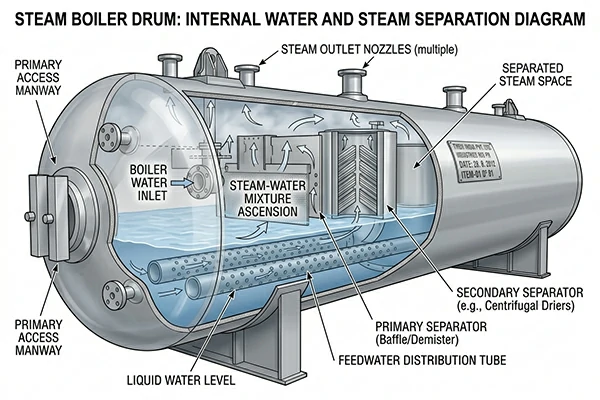
Der boiler drum is a pressure vessel that plays a key role in maintaining steam quality and system stability.
In many industrial steam boilers, the drum performs two important functions:
During the steam generation process:
A properly designed boiler drum improves:
High-quality steam should contain as little moisture as possible. Excess water carried with steam can cause problems such as:
Deshalb, the boiler drum must provide sufficient space and separation performance to produce reliable steam output.
Abschnittsübersicht: The water circulation system ensures continuous movement of water through heated areas, allowing the boiler to maintain stable steam production.
The water circulation system is another essential part of industrial steam boilers. Its main purpose is to move water continuously through heating surfaces so that heat can be transferred efficiently.
Without proper water circulation, some areas of the boiler may become overheated, reducing efficiency and increasing the risk of equipment damage.
Natural circulation uses the difference in density between hot water and cooler water to create movement inside the boiler.
Vorteile:
Natural circulation is commonly used in traditional industrial boiler systems.
Forced circulation uses pumps to control water movement inside the boiler system.
Vorteile:
Forced circulation systems are commonly applied in:
Abschnittsübersicht: The control system monitors and adjusts boiler operating conditions to improve efficiency, Sicherheit, and automation.
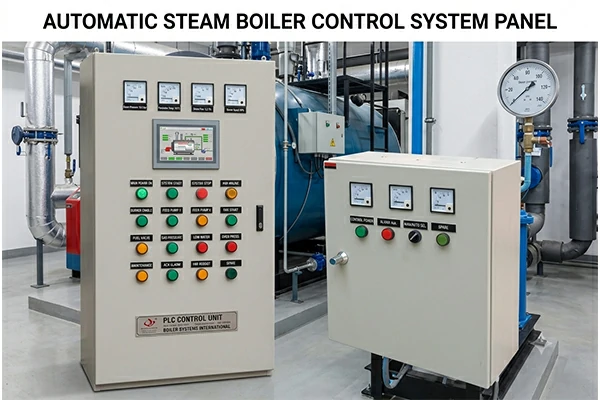
Der steam boiler control system is the intelligent management center of a modern boiler. It continuously monitors important operating parameters and automatically adjusts the equipment according to steam demand.
Typical parameters controlled by the system include:
A modern boiler control system usually contains the following components:
| Control Component | Hauptfunktion |
|---|---|
| Pressure Controller | Maintains stable steam pressure during operation. |
| Water Level Controller | Prevents low-water operation and protects boiler safety. |
| Temperature Sensor | Monitors temperature changes inside the boiler system. |
| Fuel Control Valve | Adjusts fuel supply according to steam demand. |
| PLC Control System | Provides automatic monitoring and intelligent operation. |
Advanced control systems provide several benefits:
Abschnittsübersicht:
This section explains the essential safety components installed in steam boilers to control pressure, prevent equipment failure, and ensure safe long-term operation.
Steam boilers operate under high temperature and pressure conditions, which means safety protection is one of the most important aspects of boiler design.
Modern steam boiler systems are equipped with multiple safety devices that continuously monitor operating conditions and automatically respond when abnormal situations occur.
A reliable safety system not only protects the boiler equipment but also reduces operational risks, improves system stability, and extends the service life of key components.
The pressure relief valve is one of the most critical safety devices installed on a steam boiler. Its main function is to automatically release excess pressure when the internal boiler pressure exceeds the designed safety limit.
During normal operation, the pressure relief valve remains closed and allows the boiler to maintain stable working pressure. Jedoch, if the control system fails or steam pressure rises unexpectedly, the valve opens automatically to discharge steam and prevent dangerous overpressure conditions.
Regular inspection and testing of pressure relief valves are necessary because a malfunctioning valve can seriously affect boiler safety.
A low water cut-off device protects steam boilers from operating without sufficient water. Maintaining the correct water level inside the boiler is essential because water absorbs heat from the combustion process.
If the water level drops too low, the heating surface may become overheated, causing damage to boiler tubes, deformation of metal components, or even serious equipment failure.
When the water level falls below the safe limit, the low water cut-off system automatically stops the burner operation until the water level returns to normal.
The control system works as the “Gehirn” of a modern steam boiler. It monitors important operating parameters including pressure, Temperatur, Wasserstand, Kraftstoffversorgung, and combustion conditions.
Advanced boiler control systems use sensors and automation technology to adjust burner output according to steam demand. This helps maintain stable steam production while reducing unnecessary fuel consumption.
| Control Function | Purpose | Vorteile |
|---|---|---|
| Pressure Monitoring | Maintains safe steam pressure levels | Prevents overpressure operation |
| Water Level Control | Keeps proper boiler water volume | Protects heating surfaces from damage |
| Fuel Control | Adjusts combustion according to demand | Improves energy efficiency |
| Automatic Shutdown | Stops operation during abnormal conditions | Improves operator safety |
Water quality has a direct impact on steam boiler performance and operating life. Untreated water contains minerals such as calcium and magnesium, which can form scale deposits inside boiler tubes and heat transfer surfaces.
Scale buildup reduces heat transfer efficiency and forces the boiler to consume more fuel to produce the same amount of steam. In schweren Fällen, excessive scale can cause overheating and damage to pressure components.
A complete water treatment system usually includes filtration, water softening, chemical treatment, and continuous monitoring to maintain suitable boiler water quality.
Abschnittsübersicht:
This section explains how different steam boiler components work together as a complete system to convert fuel energy into usable steam for industrial heating and processing applications.
A steam boiler is not a single independent device. It is a complete thermal system where multiple components, inklusive Brenner, Brennkammer, Wärmetauscher, boiler drum, Steuerungssystem, and steam pipelines, work together to generate and deliver steam efficiently.
Understanding how these components interact helps operators improve boiler efficiency, den Kraftstoffverbrauch reduzieren, and maintain safe and stable operation.
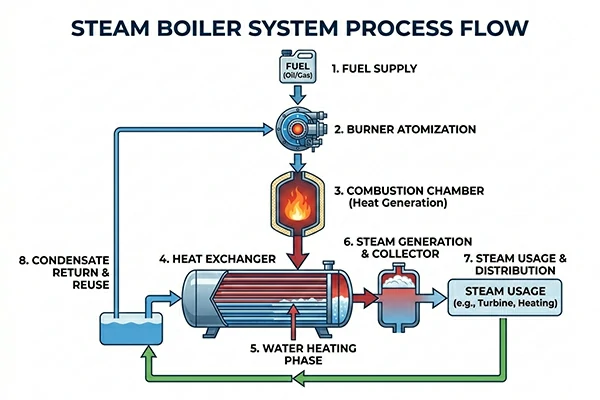
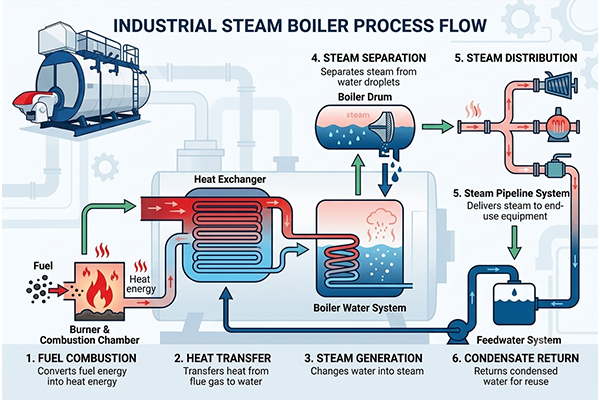
The steam generation process inside an industrial boiler follows a continuous closed-loop cycle. Each component performs a specific function, and the entire system works together to transform fuel energy into high-temperature steam.
The process begins inside the burner. The burner mixes fuel, wie Erdgas, Öl, Biomasse, or other energy sources, with air and creates a controlled combustion process.
Während der Verbrennung, chemical energy stored in the fuel is converted into thermal energy, producing high-temperature flue gases that provide the heat required for steam production.
A properly designed burner ensures stable combustion, improves fuel utilization, and helps reduce unnecessary emissions.
Kraftstoff + Air → Combustion → High Temperature Heat Energy
After combustion, high-temperature gases flow through the heat exchanger area where thermal energy is transferred to the boiler water.
The heat exchanger acts as the connection point between the combustion system and the water system. It allows heat to move efficiently while preventing combustion gases from mixing with the water or steam.
Different boiler designs use different heat transfer methods. Zum Beispiel, in fire-tube boilers, Heiße Gase laufen durch Röhrchen, die von Wasser umgeben sind, while in water-tube boilers, water flows inside tubes heated by external combustion gases.
As water continuously absorbs heat from the heat exchanger, its temperature gradually increases until it reaches the boiling point.
When sufficient thermal energy is absorbed, the water changes from liquid form into steam. The generated steam contains a large amount of usable thermal energy, making it suitable for industrial processes, Heizsysteme, und Stromerzeugung.
The quality and quantity of steam produced depend on several factors, einschließlich:
After steam is generated, the mixture of water and steam enters the boiler drum. The boiler drum plays an important role in separating steam from remaining water particles.
The separated steam collects at the upper section of the drum, while water returns to the circulation system for further heating.
Effective steam separation improves steam quality and prevents excessive moisture from entering downstream equipment.
Once high-quality steam is collected, it leaves the boiler through the main steam outlet and travels through the steam distribution pipeline.
The steam can then be delivered to different applications, einschließlich:
A well-designed steam distribution system with proper insulation helps reduce heat loss and improves overall energy efficiency.
After steam releases its heat energy during the industrial process, it gradually cools and changes back into liquid water, known as condensate.
Instead of being discharged, the condensate is collected and returned to the boiler feedwater system for reuse.
The condensate return process provides several benefits:
| Process Stage | Main Component Involved | Funktion |
|---|---|---|
| 1. Kraftstoffverbrennung | Brenner & Brennkammer | Converts fuel energy into heat energy |
| 2. Wärmeübertragung | Wärmetauscher | Transfers heat from flue gas to water |
| 3. Dampferzeugung | Boiler Water System | Changes water into steam |
| 4. Steam Separation | Kesseltrommel | Separates steam from water droplets |
| 5. Steam-Verteilung | Steam Pipeline System | Delivers steam to end-use equipment |
| 6. Condensate Return | Feedwater System | Returns condensed water for reuse |
The performance of a steam boiler depends on how efficiently all components work together. A high-quality burner cannot achieve maximum efficiency if the heat exchanger is poorly maintained. Ähnlich, an efficient boiler drum and control system cannot compensate for improper combustion conditions.
Aus diesem Grund, industrial users should consider the entire boiler system rather than focusing only on individual components when selecting, upgrading, or maintaining a steam boiler.
A properly designed and maintained steam boiler system can provide reliable thermal energy, geringere Betriebskosten, and stable performance for many years.
Abschnittsübersicht:
This section introduces practical methods to improve steam boiler efficiency, den Kraftstoffverbrauch reduzieren, and lower long-term operating costs.
Improving steam boiler efficiency is not only about selecting a high-efficiency boiler model. Daily operation, Wartungspraktiken, Kraftstoffqualität, and system optimization all influence the overall energy performance.
For industrial facilities, even a small improvement in boiler efficiency can create significant savings because boilers often operate continuously throughout the year.
An economizer is a heat recovery device installed in the boiler exhaust system. It captures heat from hot flue gases and uses this recovered energy to preheat boiler feedwater.
By recovering waste heat that would normally escape through the chimney, an economizer can reduce fuel consumption and improve overall boiler efficiency.
The combustion process directly affects boiler efficiency. Too much air increases heat loss through exhaust gases, while insufficient air can cause incomplete combustion and increased emissions.
Modern burners equipped with automatic combustion control systems can adjust the fuel-air ratio to maintain efficient combustion under different load conditions.
Regular maintenance is essential for maintaining steam boiler performance. Common maintenance tasks include cleaning heat transfer surfaces, checking burner operation, inspecting safety valves, and testing control systems.
A well-maintained boiler not only consumes less fuel but also reduces unexpected downtime and extends equipment lifespan.
Many energy losses occur after steam leaves the boiler. Poor insulation, steam leakage, and inefficient condensate recovery systems can significantly reduce overall system efficiency.
Improving steam pipelines, repairing leaks, and recovering condensate water can help facilities maximize the energy value of generated steam.
Abschnittsübersicht:
This section explains where steam boilers are commonly used and why different industries rely on steam as an efficient heat transfer medium.
Steam boilers are widely used because steam can transfer large amounts of thermal energy quickly and efficiently. From manufacturing processes to heating systems, steam remains an important energy source in many industries.
| Industrie | Steam Boiler Applications |
|---|---|
| Lebensmittelverarbeitung | Kochen, Sterilisation, Reinigung, and production heating |
| Pharmazeutische Industrie | Sterilisation, clean steam production, and process heating |
| Textilindustrie | Färberei, Trocknen, and fabric processing |
| Chemieindustrie | Reaction heating and temperature control |
| Energieerzeugung | Driving steam turbines for electricity production |
| Krankenhäuser und Gewerbebauten | Heizung, hot water supply, und Sterilisation |
Abschnittsübersicht:
This section provides key factors to consider when selecting a steam boiler for industrial or commercial applications.
Choosing the correct steam boiler requires more than simply comparing prices. The right boiler should match your steam demand, Kraftstoffverfügbarkeit, operating environment, and future expansion plans.
The first step is calculating the required steam output. Boiler capacity is usually measured by tons per hour (TPH), kilograms per hour (kg/h), or boiler horsepower.
Selecting a boiler that is too small may result in insufficient steam supply, while an oversized boiler can increase investment costs and reduce operating efficiency.
The choice of fuel has a major impact on operating costs. Common steam boiler fuels include natural gas, Dieselöl, Biomasse, Kohle, and electricity.
| Treibstoffart | Hauptvorteile | Suitable Applications |
|---|---|---|
| Erdgas | Clean combustion and high efficiency | Industrial and commercial heating |
| Biomasse | Renewable fuel and lower carbon emissions | Factories with biomass resources |
| Kohle | Lower fuel cost in some regions | Large-scale industrial production |
| Strom | Clean operation and easy installation | Small-scale applications |
Abschnittsübersicht:
This section provides a practical steam boiler maintenance checklist to help operators improve reliability, prevent unexpected failures, and extend boiler service life.
Regular maintenance is one of the most important factors affecting steam boiler performance. Even a high-quality boiler system may experience efficiency losses, increased fuel consumption, or safety risks if inspections and maintenance are ignored.
A proper maintenance program should include daily monitoring, regular cleaning, safety inspections, and professional servicing according to the manufacturer’s recommendations.
Daily inspection allows operators to identify potential problems before they develop into major equipment failures. Operators should monitor important operating parameters and check whether the boiler is running under normal conditions.
| Inspection Item | What to Check | Purpose |
|---|---|---|
| Dampfdruck | Check whether pressure remains within the designed range | Ensure safe and stable operation |
| Water Level | Confirm proper water level inside the boiler drum | Prevent overheating caused by low water conditions |
| Burner Operation | Check flame condition and combustion stability | Maintain efficient fuel combustion |
| Leaks and Noise | Inspect pipelines, Ventile, and boiler body | Detect abnormal conditions early |
During long-term operation, deposits may accumulate inside boiler components. Scale, Ruß, and corrosion products can reduce heat transfer efficiency and increase energy consumption.
Regular cleaning should include inspection of heat exchanger surfaces, combustion chambers, boiler tubes, and water circulation systems.
For industrial steam boilers operating continuously, professional inspection is usually recommended at scheduled intervals to ensure all pressure components remain safe and reliable.
Water treatment is a key part of steam boiler maintenance. Poor water quality can lead to scale formation, Korrosion, and reduced boiler efficiency.
A proper water management program normally includes water softening, chemical treatment, dissolved oxygen control, and regular testing of water parameters.
Maintaining proper water quality helps protect boiler tubes, improve heat transfer efficiency, and reduce maintenance costs.
Abschnittsübersicht:
This section summarizes the major advantages and limitations of steam boiler systems to help users understand whether steam technology fits their application.
Steam boilers have been widely used for more than a century because of their reliability, flexibility, and ability to deliver large amounts of thermal energy. Jedoch, like any industrial equipment, steam boilers also have certain limitations that should be considered before installation.
Abschnittsübersicht:
This FAQ section answers common questions about steam boiler operation, Effizienz, Anwendungen, and maintenance to help users better understand steam boiler systems.
A steam boiler is designed to convert water into steam by using thermal energy. The generated steam can be used for industrial heating, Energieerzeugung, Sterilisation, manufacturing processes, und gewerbliche Heizsysteme.
Ein Dampfkessel erzeugt Dampf, indem er Brennstoff verbrennt oder Strom zur Wärmeerzeugung nutzt. Die Wärme wird über Wärmeübertragungsflächen an Wasser übertragen, Dadurch erreicht das Wasser seinen Siedepunkt und verwandelt sich in Dampf.
Der Hauptunterschied besteht in der Strömungsrichtung von Wasser und heißen Gasen. In einem Feuerrohrkessel, hot combustion gases flow through tubes surrounded by water. In einem Wasserrohrkessel, water flows inside tubes heated by external combustion gases.
Flammrohrkessel sind grundsätzlich für Nieder- und Mitteldruckanwendungen geeignet, während Wasserrohrkessel für industrielle Hochdruck- und Großraumanwendungen bevorzugt werden.
Die Lebensdauer eines Dampfkessels hängt von der Kesselqualität ab, Betriebsbedingungen, Wartungspraktiken, und Wasseraufbereitung. Bei richtiger Wartung, Viele Industriedampfkessel können zuverlässig arbeiten 20 Zu 35 Jahre oder länger.
Die Effizienz von Dampfkesseln kann durch den Einbau von Economizern verbessert werden, Aufrechterhaltung einer ordnungsgemäßen Verbrennung, Verbesserung der Isolierung, Verringerung der Dampfleckage, Optimierung der Wasseraufbereitung, und regelmäßige Wartung durchführen.
Abschnittsübersicht:
Dieser Abschnitt fasst die wichtigsten Punkte der Dampfkesseltechnologie zusammen und erklärt, warum die Auswahl des richtigen Systems für langfristige Effizienz und Zuverlässigkeit wichtig ist.
Dampfkessel bleiben eine der wichtigsten thermischen Energielösungen in der Industrie, kommerziell, und Energieerzeugungsanwendungen. Ihre Fähigkeit, zuverlässigen und qualitativ hochwertigen Dampf zu erzeugen, macht sie unverzichtbar für Branchen, die kontinuierliche Heiz- und Verarbeitungsfähigkeiten benötigen.
Verstehen, wie Dampfkessel funktionieren, die Funktion jeder Komponente, verschiedene Kesseltypen, Wartungsanforderungen, and efficiency improvement methods can help businesses make better decisions when purchasing or upgrading a boiler system.
The best steam boiler solution depends on several factors, including required steam capacity, Kraftstoffverfügbarkeit, operating environment, energy costs, and future production requirements.
If you are planning to install a new steam boiler system or replace an existing unit, choosing an experienced boiler manufacturer can help ensure better performance, geringere Betriebskosten, und langfristige Zuverlässigkeit.
Our professional boiler engineers can help you select the most suitable steam boiler based on your required capacity, Treibstoffart, Arbeitsdruck, and application requirements.
For technical consultation, customized boiler solutions, and quotation support, bitte kontaktieren Sie uns:
KOSTENLOSE KESSELANGEBOTE
Keine Verzögerung, erhalten 3 Zitate heute Vergleichen Sie für die besten Preise Sicher und zuverlässigBEWERTUNGEN
WAS IN DIESEM ARTIKEL STEHT?
Wenn Sie Fang Kuai mögen, Bitte hinterlassen Sie Ihre Nachricht.



vSehen Sie sich die Bewertungen unserer Kunden an
"Der Heißwasserboiler von Fangkuai ist erstaunlich. Es heizt schnell und effizient auf, und das Wasser bleibt lange heiß. Wir hatten nie Probleme damit und es hat unsere täglichen Abläufe erheblich verbessert. Auch die Installation verlief reibungslos und der Kundenservice war ausgezeichnet. Ich kann die Heißwasserboiler von Fangkuai sehr empfehlen."
Sarah
Kanada"Wir verwenden den Fangkuai-Thermalölkessel seit Jahren für unsere Chemieanlage und er hat uns nie im Stich gelassen. Der Kessel ist sehr langlebig und hält rauen Bedingungen stand. Außerdem ist es sehr einfach zu bedienen und zu warten, Das hat uns geholfen, Zeit und Geld bei der Wartung zu sparen. Die Thermalölkessel von Fangkuai sind erstklassig und ich kann sie jedem wärmstens empfehlen, der zuverlässige Heizlösungen benötigt."
Chang
China"Ich bin sehr beeindruckt von der Qualität des Heißwasserboilers von Fangkuai. Es ist für die Ewigkeit gebaut und hat meine Erwartungen übertroffen. Auch die Installation verlief reibungslos und der Kundenservice war ausgezeichnet. Der Warmwasserboiler ist sehr einfach zu bedienen und zu warten, und die Energieeffizienz ist bemerkenswert. Ich kann die Heißwasserboiler von Fangkuai sehr empfehlen."
Jack
Australien"Der Kundenservice bei Fangkuai ist erstklassig. Sie halfen mir bei der Auswahl des perfekten Kessels für meine Bedürfnisse und boten während des gesamten Prozesses großartige Unterstützung. Der Installationsprozess verlief auch sehr reibungslos und der Kessel hat meine Erwartungen übertroffen. Es ist sehr einfach zu bedienen und zu warten, und die Energieeffizienz ist bemerkenswert. Ich kann die Produkte von Fangkuai jedem wärmstens empfehlen, der zuverlässige und effiziente Heizlösungen benötigt."
Juan
Mexiko"Die Dampferzeuger von Fangkuai sind ausgezeichnet. Sie sind sehr einfach zu bedienen und erfordern nur minimale Wartung. Auch der Kundenservice bei Fangkuai ist außergewöhnlich. Sie sind sehr reaktionsschnell und immer bereit zu helfen. Bemerkenswert ist auch die Energieeffizienz der Dampferzeuger, was mir geholfen hat, Geld bei meinen Energierechnungen zu sparen. Ich kann die Dampfgeneratoren von Fangkuai sehr empfehlen."
Maria
Spanien"Der Thermalölkessel von Fangkuai ist sehr einfach zu bedienen und zu warten. Es hat uns geholfen, Zeit und Geld bei der Wartung zu sparen, was zu erheblichen Kosteneinsparungen geführt hat. Die Qualität der Materialien und die Konstruktion des Kessels sind außergewöhnlich. Es ist auch sehr energieeffizient, was uns geholfen hat, Geld bei unseren Energierechnungen zu sparen. Ich kann den Thermalölkessel von Fangkuai sehr empfehlen ."
Allen
Brasilien"Der Dampfgenerator von Fangkuai ist perfekt für mein kleines Unternehmen. Es ist sehr einfach zu bedienen und erfordert nur minimale Wartung. Es ist auch sehr energieeffizient, was mir geholfen hat, Geld bei meinen Energierechnungen zu sparen. Der Kundenservice bei Fangkuai ist ebenfalls ausgezeichnet. Sie sind sehr reaktionsschnell und immer bereit zu helfen. Ich kann die Dampfgeneratoren von Fangkuai sehr empfehlen."
Ahmed
Ägypten"Die Zusatzausrüstung von Fangkuai hat mein Kesselsystem noch besser gemacht. Die Qualität der Ausrüstung ist außergewöhnlich und die Preise sind sehr vernünftig. Die Ausrüstung hat dazu beigetragen, die Effizienz und Leistung meines Kesselsystems zu verbessern, was zu erheblichen Kosteneinsparungen geführt hat. Ich kann die Zusatzausrüstung von Fangkuai jedem wärmstens empfehlen, der hochwertiges Kesselzubehör benötigt."
Maryk
Vereinigtes Königreich"Ich habe für meine Fabrik einen Fangkuai-Dampfkessel gekauft, der seit Monaten einwandfrei funktioniert. Die Qualität der Materialien und die Konstruktion des Kessels sind beeindruckend. Es ist auch sehr energieeffizient, was uns geholfen hat, Geld bei unseren Energierechnungen zu sparen. Ich kann die Produkte von Fangkuai jedem wärmstens empfehlen, der zuverlässige und effiziente Heizlösungen benötigt."
John
USA