دليل شراء غلايات البخار الصناعية 2026: سعة, ضغط, Fuel and TCO
Buying an industrial steam boiler in 2026 is not simply a matter of choosing a capacity, asking for a price, and comparing quotations.
A boiler that looks attractive on a datasheet may be a poor fit once it is connected to a real production process. Steam demand changes throughout the day. Fuel prices vary by location. Feedwater conditions affect efficiency and reliability. Emissions rules depend on the installation market. Automation requirements differ from one plant to another, and a low initial price can be offset by years of higher fuel consumption, صيانة, or downtime.
For most industrial buyers, a better boiler selection starts with four questions:
- How much steam does the process actually require?
- What steam pressure and temperature are needed?
- Which fuels are realistically available at the site?
- What will the complete boiler system cost to own and operate?
These four variables—capacity, ضغط, fuel and total cost of ownership (التكلفة الإجمالية للملكية)—form the foundation of a practical industrial steam boiler buying strategy.
This guide explains how to evaluate them, what information to request from suppliers, and how to compare industrial steam boiler proposals on a consistent engineering basis.
إجابة سريعة: How Do You Choose an Industrial Steam Boiler?
To choose an industrial steam boiler, first define the plant’s minimum, الطلب العادي وذروة البخار. Then determine the required working pressure, درجة حرارة البخار, available fuels, ظروف مياه التغذية, ساعات العمل, emissions requirements and applicable certification.
After that, compare boiler designs based on:
- part-load performance;
- استهلاك الوقود;
- burner turndown;
- steam pressure and quality;
- water-treatment requirements;
- heat-recovery options;
- الأتمتة;
- المعدات المساعدة;
- صيانة;
- تثبيت;
- supplier support;
- والتكلفة الإجمالية للملكية.
The best boiler is not necessarily the largest, cheapest or highest-rated-efficiency option. It is the boiler system that most reliably matches the plant’s actual operating conditions.
1. What Should You Know Before Buying an Industrial Steam Boiler?
A useful boiler quotation starts with useful process data.
Requests such as “I need a 10-ton boiler” أو “Please quote a gas boiler” provide too little information for accurate engineering selection.
Before contacting an industrial boiler manufacturer, prepare the following information.
| المعلمة |
What the Buyer Should Provide |
لماذا يهم؟ |
| سعة البخار |
الحد الأدنى, normal and peak demand |
Determines boiler sizing |
| ضغط العمل |
Required process pressure |
Affects boiler design |
| درجة حرارة البخار |
Saturated or superheated |
Defines steam conditions |
| وقود |
غاز, زيت, الكتلة الحيوية, كهرباء, إلخ. |
Determines combustion/energy system |
| Operating profile |
Hours/day and days/year |
Affects annual operating cost |
| مياه التغذية |
Temperature and water quality |
Influences efficiency and treatment |
| Condensate return |
Expected percentage/flow |
Affects heat and water balance |
| Installation location |
Country and region |
Determines regulatory requirements |
| الانبعاثات |
Applicable local limits |
Influences burner/control equipment |
| شهادة |
Project-specific requirements |
Influences design and documentation |
| الأتمتة |
PLC, SCADA, remote monitoring |
Defines control scope |
| Site limits |
فضاء, وصول, altitude, transport |
Influences physical configuration |
The earlier these variables are defined, the easier it becomes to compare competing boiler proposals fairly.
2. How Do You Determine the Correct Steam Boiler Capacity?
Steam boiler capacity is normally selected from process steam demand—not simply from the maximum theoretical capacity of the production line.
Industrial steam demand may be expressed in:
- كجم/ساعة;
- ذ;
- lb/h;
- boiler horsepower;
- or thermal power.
Regardless of the unit, the important question is how much steam the plant needs at different operating conditions.
الحد الأدنى, Normal and Peak Steam Demand
A useful steam-load profile should identify:
- الحد الأدنى من الطلب على البخار;
- الطلب العادي على البخار;
- ذروة الطلب على البخار;
- duration of peak demand;
- daily operating hours;
- shift patterns;
- batch processes;
- simultaneous equipment operation;
- seasonal changes;
- and expected future production expansion.
Consider a simplified example.
A factory may have a calculated maximum requirement of 10 t/h but operate at only 4–6 t/h during most production hours. Short production peaks occasionally approach 10 ذ.
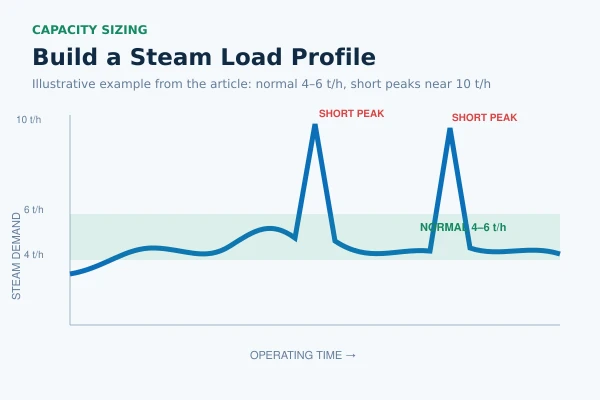
This does not automatically mean that maximum capacity should be ignored. It means boiler selection must consider both the peak and the much more common part-load condition.
Why Boiler Oversizing Can Be Expensive
An oversized boiler can create several problems.
If the burner cannot modulate down to match lower steam demand, the boiler may repeatedly start and stop. Frequent cycling can increase avoidable losses, create pressure fluctuations and add operating wear.
Oversizing can also mean:
- unnecessary initial investment;
- larger auxiliary equipment;
- additional installation space;
- excessive standby losses;
- and poorer utilization of the installed system.
Why Undersizing Is Also a Risk
A boiler that is too small may:
- fail to maintain required steam pressure;
- limit production capacity;
- operate continuously near maximum firing;
- struggle with short high-load periods;
- and leave little reserve for future production changes.
The goal is therefore not to minimize or maximize capacity. It is to match boiler capacity and configuration to a documented load profile.
For variable-load plants, buyers should also evaluate burner turndown, boiler sequencing and whether multiple smaller boilers would provide better flexibility than one large unit.
3. What Steam Pressure Does Your Process Require?
Capacity answers the question “How much steam?”
Pressure answers another question:
At what condition must that steam reach the process?
Boiler pressure should not be selected simply because a higher-pressure model appears more capable.
The required pressure should come from the process.
Boiler Pressure vs. Process Pressure
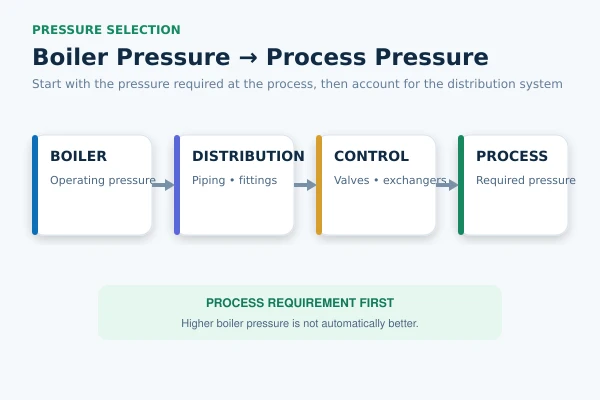
The boiler’s operating pressure and the pressure available at the steam-consuming equipment are not always identical.
Pressure can be lost through:
- steam piping;
- الصمامات;
- التركيبات;
- مبادلات حرارية;
- صمامات التحكم;
- مسافة التوزيع;
- and changing steam flow.
A buyer should therefore identify the pressure required at the actual process and allow the system designer to evaluate reasonable distribution losses and control requirements.
Unnecessarily high boiler pressure can increase equipment requirements and may create operating conditions that the process does not need.
Saturated Steam vs. Superheated Steam
Most process-heating applications use saturated steam, while some specialized industrial and power applications may require superheated steam.
| عامل |
Saturated Steam |
Superheated Steam |
| Temperature |
Related to saturation pressure |
Above saturation temperature |
| Common role |
تسخين العملية |
Specialized processes/power |
| Heat-transfer behavior |
Strong for many heating duties |
Application-dependent |
| System complexity |
Generally simpler |
أعلى عموما |
| Selection basis |
Process requirement |
Specific engineering requirement |
A supplier should therefore know capacity, pressure and steam-temperature requirements before recommending a boiler configuration.
4. Which Fuel Should You Choose for an Industrial Steam Boiler?
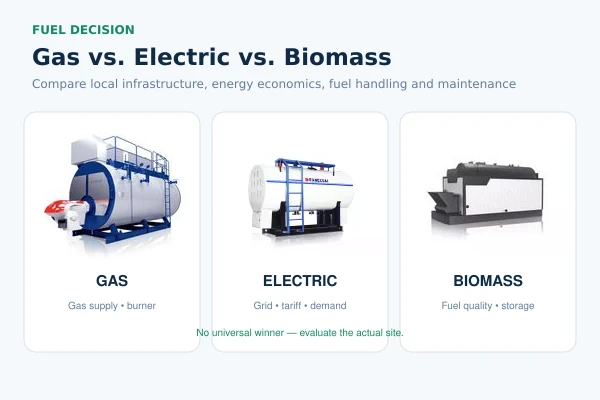
There is no universally best industrial boiler fuel.
Fuel selection is increasingly a site-specific economic and engineering decision.
Buyers should compare:
- local fuel price;
- long-term supply reliability;
- storage requirements;
- infrastructure;
- burner/fuel-system complexity;
- متطلبات الانبعاثات;
- صيانة;
- الأتمتة;
- and expected operating hours.
Gas-Fired Steam Boilers
غلايات بخارية تعمل بالغاز remain widely applicable where natural gas or another suitable gaseous fuel is reliably available.
Potential advantages include:
- mature burner technology;
- relatively simple fuel handling;
- strong load response;
- high automation potential;
- compact fuel infrastructure;
- and compatibility with heat-recovery equipment.
But buyers should still investigate gas-price exposure, supply pressure, local emissions requirements and the long-term availability of the fuel.
Oil and Diesel-Fired Boilers
Liquid-fuel systems may be useful where gas infrastructure is unavailable or where a site requires an independent or backup fuel supply.
The procurement scope may need to include:
- fuel tanks;
- pumping;
- الترشيح;
- fuel heating where applicable;
- burner configuration;
- spill-control measures;
- and local environmental requirements.
A lower boiler purchase price should not be considered separately from the cost of the complete fuel system.
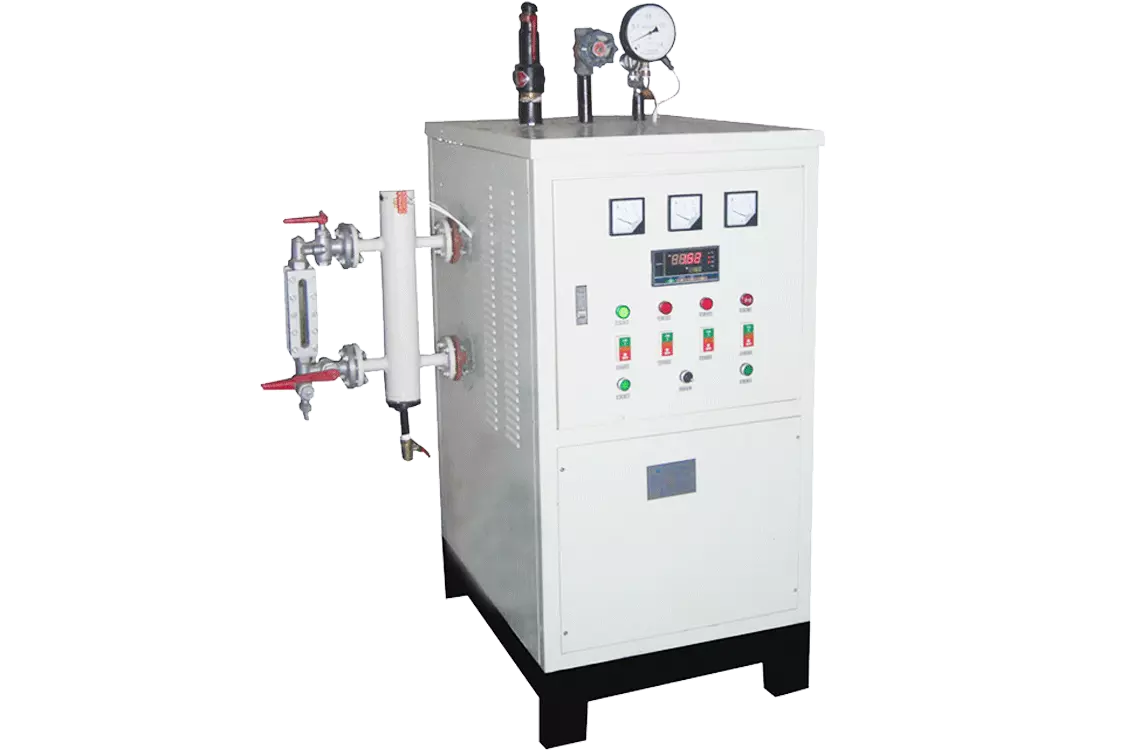
غلايات البخار الكهربائية
غلايات البخار الكهربائية eliminate combustion at the point of use and can provide precise load control.
لكن, the boiler itself is only part of the decision.
Buyers should check:
- available electrical capacity;
- قدرة المحول;
- plant maximum demand;
- connection voltage;
- grid-upgrade requirements;
- electricity tariff;
- demand charges;
- and expected operating schedule.
The International Energy Agency notes that electric boilers are commercially available for industrial heat and steam, while electricity-to-gas price ratios and grid connection constraints can materially affect deployment.
This is why an electric boiler should be evaluated as part of the plant’s electrical system rather than as an isolated piece of equipment.
غلايات بخار الكتلة الحيوية
غلايات بخارية تعمل بالكتلة الحيوية may be economically attractive where a consistent, suitable and competitively priced biomass fuel is locally available.
But “الكتلة الحيوية” is not a complete fuel specification.
Buyers should provide data for:
- moisture;
- calorific value;
- ash content;
- particle size;
- bulk density;
- contaminants;
- and seasonal variation.
The project may also require:
- fuel storage;
- conveying;
- feeding;
- التعامل مع الرماد;
- dust collection;
- and additional maintenance.
A cheap biomass fuel can become expensive if inconsistent quality reduces useful steam output or causes operating problems.
Dual-Fuel and Multi-Fuel Boilers
Fuel flexibility may be valuable where fuel prices fluctuate or where uninterrupted steam production is critical.
لكن, flexibility also adds complexity.
Compare:
- burner capability;
- تخزين;
- switching procedure;
- efficiency on each fuel;
- emissions on each fuel;
- control logic;
- والصيانة.
Fuel flexibility is valuable when it solves a real supply or operating risk—not simply because “more fuels” sounds better on a specification sheet.
5. Gas vs. Electric vs. مراجل الكتلة الحيوية: Which Is Better?
The answer depends on the site.
| عامل |
غلاية غاز |
غلاية كهربائية |
غلاية الكتلة الحيوية |
| Energy infrastructure |
Gas supply |
Electrical capacity |
Biomass supply/storage |
| On-site combustion |
نعم |
لا |
نعم |
| Fuel handling |
Relatively simple |
Very simple |
أكثر تعقيدًا |
| Automation potential |
عالي |
Very high |
عالي |
| تعقيد الصيانة |
معتدل |
أقل عموما |
أعلى عموما |
| Local emissions equipment |
Market-dependent |
No combustion system |
Often more extensive |
| Energy-price exposure |
Gas market |
Electricity market |
Biomass supply chain |
| Best fit |
Broad industrial use |
Favorable electrical economics |
Reliable biomass availability |
Instead of asking which fuel is universally cheapest, calculate the expected cost of useful steam under the plant’s actual conditions.
That requires actual energy prices, ساعات العمل, steam demand and realistic system efficiency.
6. Fire-Tube vs. Water-Tube Boiler: Which Design Should You Choose?
Boiler construction is another important purchasing decision.
Neither design is automatically superior.
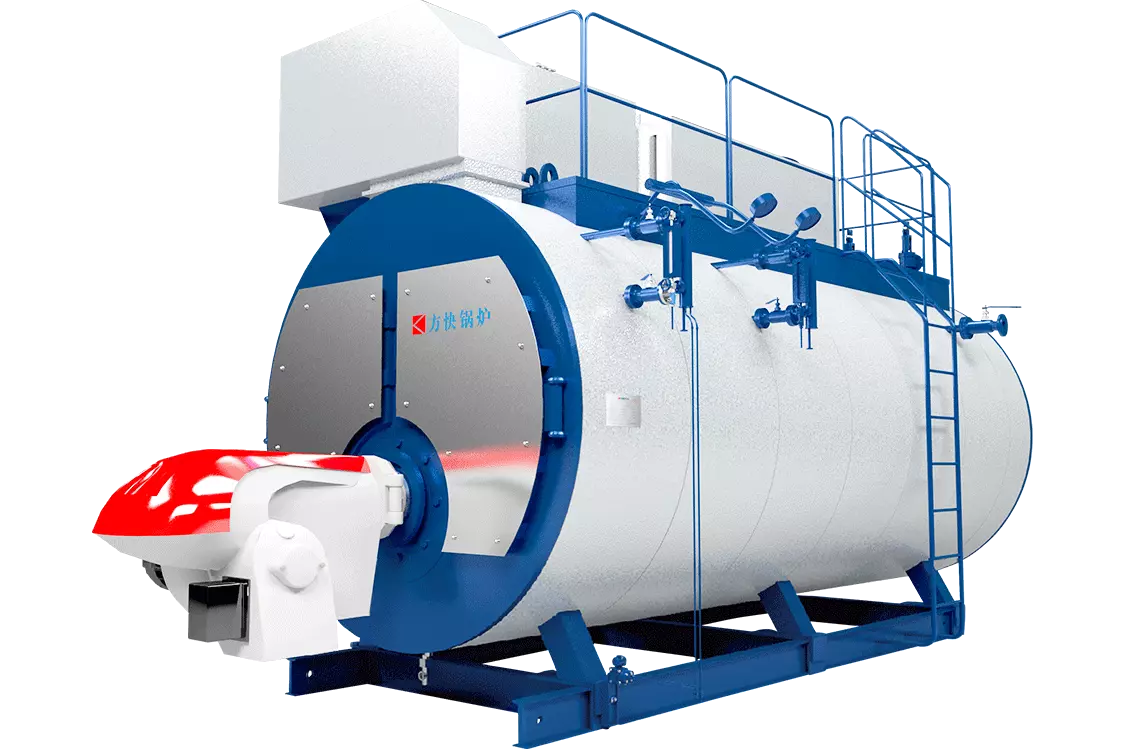
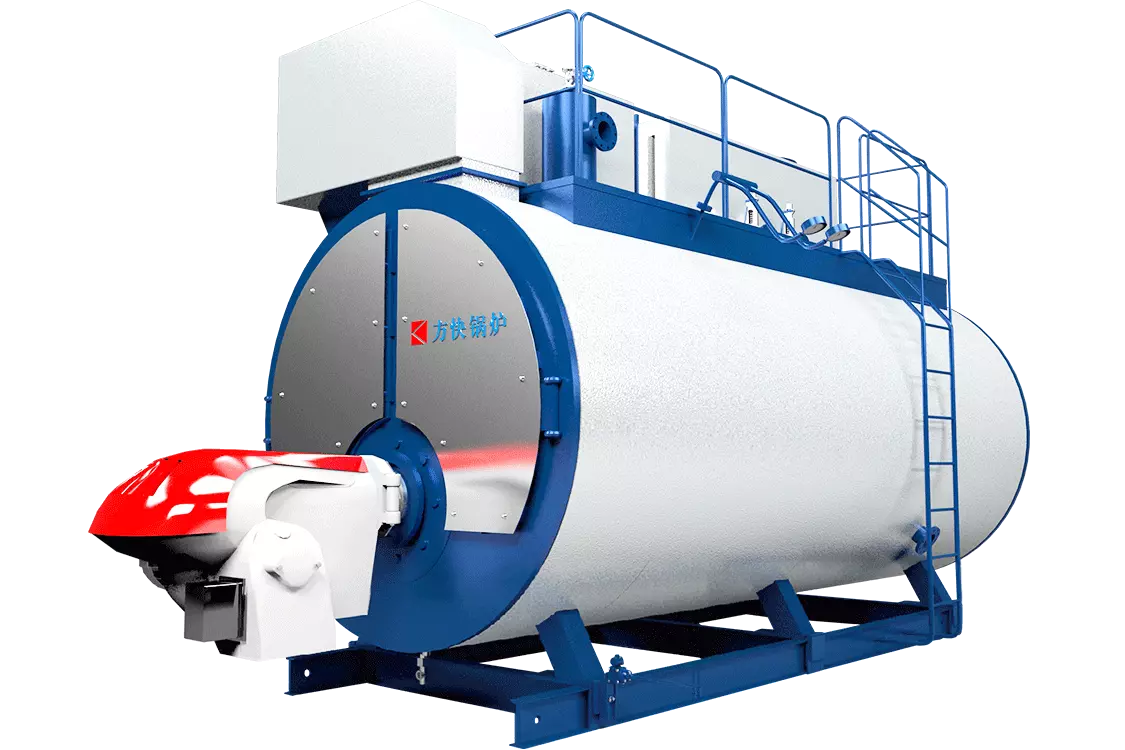
غلايات أنابيب النار
في غلاية أنبوب النار, hot combustion gases pass through tubes surrounded by water.
اعتمادا على المشروع, fire-tube designs can offer relatively straightforward operation and a compact solution for many industrial steam applications.
غلايات أنابيب المياه
في غلاية أنبوب مائي, water/steam flows through tubes heated externally by combustion gases.
Water-tube systems are frequently considered for applications involving higher capacities, pressures or demanding operating conditions, but the correct selection remains project-specific.
A detailed fire-tube vs. water-tube boiler comparison should consider:
| Selection Factor |
Questions to Ask |
| سعة |
What is minimum, normal and peak demand? |
| ضغط |
What process pressure is required? |
| Load changes |
How quickly does steam demand vary? |
| فضاء |
What boiler-room dimensions are available? |
| نوعية المياه |
What treatment system is available? |
| صيانة |
What service capability exists locally? |
| تثبيت |
Are there transport or site restrictions? |
| Expansion |
Is future steam-demand growth expected? |
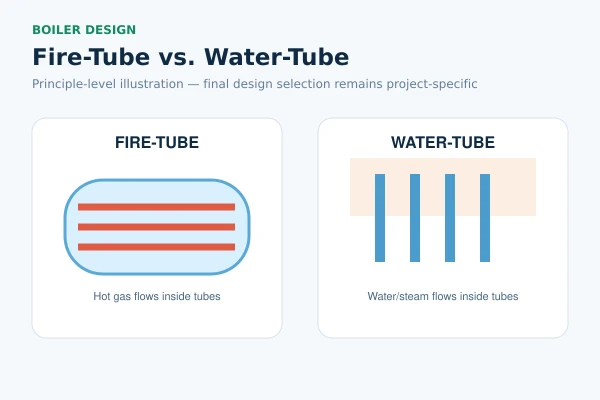
Boiler type should follow the process requirement, وليس العكس.
7. كيف ينبغي مقارنة كفاءة غلايات البخار الصناعية؟?
“كفاءة المرجل: 95%.”
في حد ذاته, هذا الرقم يخبر المشتري بالقليل بشكل مدهش.
يجب أن يوضح رقم الكفاءة ذو المعنى الظروف التي تم حسابه أو اختباره بموجبها.
بسأل:
- الوقود الذي تم استخدامه?
- هل كان الحساب يعتمد على LHV أو HHV?
- ما هو الحمل المفترض للغلاية?
- كم كانت درجة حرارة مياه التغذية?
- كم كانت درجة حرارة المكدس?
- ما هي حالة الهواء الزائد أو O₂ التي تم استخدامها?
- وكان المقتصد المدرجة?
- تم تضمين الكهرباء المساعدة?
- هل تم قياس القيمة أو حسابها?
الكفاءة المقدرة مقابل. كفاءة التشغيل الحقيقية
تعمل الغلاية داخل نظام بخاري.
يمكن أن يتأثر استهلاك الوقود السنوي الحقيقي:
- تعديل الموقد;
- الهواء الزائد;
- ركوب الدراجات القصيرة;
- التحجيم أو التلوث;
- درجة حرارة مياه التغذية;
- عودة المكثفات;
- انفجار;
- عازلة;
- تسرب البخار;
- أداء الاقتصاد;
- وإعدادات المشغل.
ال نحن. Department of Energy’s steam-system resources identify system-level improvement opportunities including combustion optimization, عودة المكثفات, blowdown control, efficient burners and waste-heat recovery.
This is an important procurement lesson.
The highest quoted efficiency is not automatically the lowest annual fuel cost.
Heat-Recovery Technologies Worth Evaluating
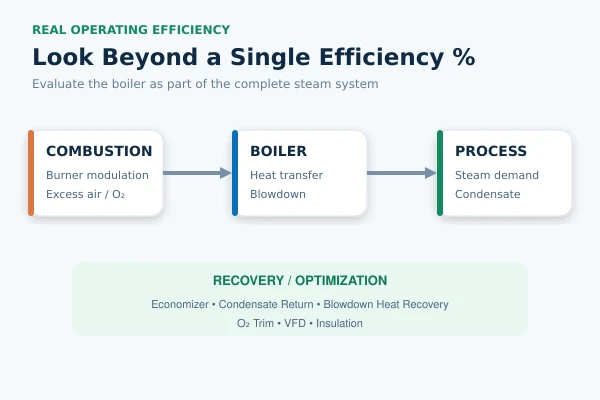
اعتمادا على المشروع, options may include:
- feedwater economizers;
- condensing economizers where technically suitable;
- احتراق الهواء التسخين;
- blowdown heat recovery;
- condensate recovery;
- automatic blowdown control;
- O₂ trim;
- variable-frequency drives;
- and improved insulation.
Each option should be evaluated against actual operating conditions.
8. Why Feedwater Quality Matters Before You Buy a Boiler
Feedwater is not a secondary issue.
Water conditions influence boiler reliability, كفاءة, maintenance and service life.
Depending on the system, engineers may need to evaluate:
- صلابة;
- dissolved solids;
- الأكسجين المذاب;
- القلوية;
- الرقم الهيدروجيني;
- السيليكا;
- ماء المكياج;
- جودة المكثفات;
- and treatment chemicals.
Poor water management can contribute to scale, تآكل, carryover and unnecessary blowdown.
Scale on heat-transfer surfaces can reduce effective heat transfer, while corrosion can create serious reliability problems.
The complete project may therefore require:
- pretreatment;
- تليين;
- التناضح العكسي عند الاقتضاء;
- الجرعات الكيميائية;
- نزع الهواء;
- feedwater storage;
- condensate recovery;
- and blowdown control.
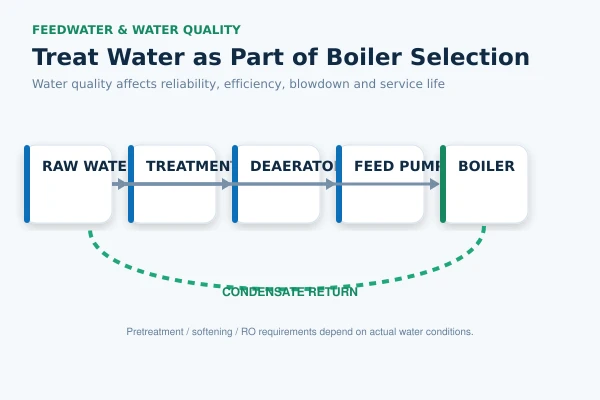
A boiler manufacturer should receive basic feedwater information before final equipment selection rather than discovering severe water-quality problems during commissioning.
9. What Auxiliary Equipment Does an Industrial Steam Boiler Need?
A quotation for “one boiler” does not necessarily include a complete steam plant.
تعد هذه إحدى أسهل الطرق لظهور عرضي أسعار للموردين متشابهين بينما يغطيان في الواقع نطاقات مختلفة جدًا.
اعتمادا على المشروع, قد تشمل المعدات المساعدة:
- الموقد;
- مضخات مياه التغذية;
- خزان مياه التغذية;
- مزيل الهواء;
- معدات معالجة المياه;
- المقتصد;
- سخان الهواء;
- مدخنة;
- نظام الوقود;
- قطار الغاز;
- معدات تغذية الكتلة الحيوية;
- التعامل مع الرماد;
- معدات التفجير;
- نظام المكثفات;
- خزانة التحكم;
- معدات التحكم في الانبعاثات;
- الصمامات والأجهزة.
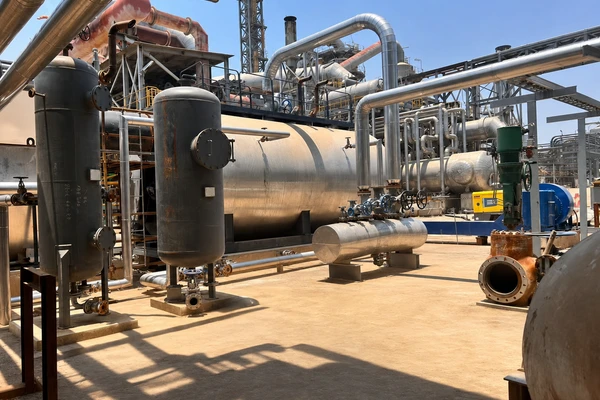
يجب على المشترين طلب قائمة واضحة من الادراج والاستثناءات.
إذا كان المورد أ يشمل المرجل, الموقد, المقتصد, المضخات وأدوات التحكم بينما يقتبس المورد ب فقط وعاء الضغط والموقد الأساسي, أسعارها غير قابلة للمقارنة مباشرة.
10. ما هي أتمتة الغلايات التي يجب أن تحددها؟ 2026?
لا يتم تشغيل الغلاية التي يتم التحكم فيها بواسطة PLC تلقائيًا “غلاية ذكية.”
يجب أن يكون سؤال الشراء:
ماذا يقيس نظام التحكم, سِجِلّ, التواصل والتحسين?
على الأقل, قد تحتاج أتمتة الغلايات الصناعية إلى التحكم أو المراقبة:
- عملية الموقد;
- ضغط البخار;
- مستوى المياه;
- مياه التغذية;
- تشابكات السلامة;
- ظروف التنبيه.
قد تراقب الأنظمة الأكثر تقدمًا:
- تدفق البخار;
- تدفق الوقود;
- تدفق مياه التغذية;
- درجة حرارة مياه التغذية;
- درجة حرارة المكدس;
- كومة O₂;
- معدل حرق الموقد;
- انفجار;
- ساعات العمل;
- تاريخ التنبيه;
- واستهلاك الطاقة.
قد يمتد التكامل إلى:
أجهزة الاستشعار → PLC → HMI → SCADA → تخزين البيانات → المراقبة عن بعد
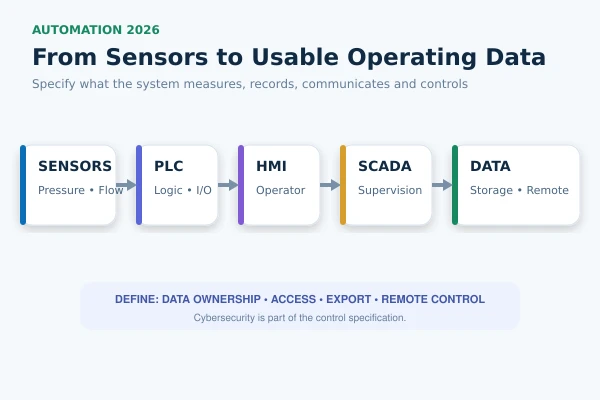
قبل أن يأمر المراقبة عن بعد, تحديد أيضا:
- الذي يملك بيانات التشغيل;
- من يستطيع الوصول إليه;
- كم من الوقت يتم الاحتفاظ بالبيانات;
- ما إذا كان يمكن تصديرها;
- من يمكنه تغيير إعدادات PLC;
- وما إذا كان من الممكن تعطيل الوصول عن بعد بواسطة المصنع.
للأنظمة الصناعية المتصلة, يجب أن يكون الأمن السيبراني جزءًا من مواصفات التحكم. نيست SP 800-82 القس. 3 يوفر التوجيه لأمن التكنولوجيا التشغيلية, بما في ذلك بيئات التحكم الصناعية.
11. الانبعاثات وإصدار الشهادات: Check the Installation Market First
There is no single global emissions limit that applies to every industrial steam boiler.
Requirements may vary by:
- دولة;
- state/province;
- الولاية القضائية المحلية;
- قدرة المرجل;
- وقود;
- عملية;
- ساعات العمل;
- and environmental permit.
على سبيل المثال, ال نحن. EPA’s industrial, commercial and institutional boiler rules illustrate how boiler requirements can depend on facility and fuel category.
For an export project, buyers should identify the applicable emissions requirement before final burner and emissions-control selection.
Potential regulated emissions can include:
- أكاسيد النيتروجين;
- CO;
- الجسيمات;
- SOx;
- and other market-specific pollutants.
The required solution may involve low-NOx burners, flue-gas recirculation, combustion controls, dust collection or other technologies depending on fuel and local requirements.
Certification Requirements
Certification also depends on destination and project scope.
Examples can include applicable requirements under the ASME Boiler and Pressure Vessel Code أو, for relevant EU pressure equipment, ال Pressure Equipment Directive.
Do not simply ask a supplier:
“Do you have CE/ASME?”
Instead ask:
- Which equipment is covered?
- Which manufacturer is named?
- What is the certificate scope?
- Does it apply to the exact equipment being quoted?
- What project documentation will be supplied?
Certification should be verified before production.
12. How Much Does an Industrial Steam Boiler Cost?
There is no reliable universal price for an industrial steam boiler.
Price depends on much more than nominal capacity.
Major cost drivers include:
- قدرة البخار;
- ضغط التصميم;
- درجة حرارة البخار;
- boiler construction;
- وقود;
- الموقد;
- مواد;
- الأتمتة;
- استعادة الحرارة;
- معالجة المياه;
- emissions equipment;
- certification;
- auxiliary systems;
- transport;
- تثبيت;
- and commissioning.
This creates three different numbers:
Boiler Purchase Price ≠ Installed Project Cost ≠ Lifecycle Cost
يمكن أن يصبح عرض أسعار المعدات المنخفض مكلفًا عند استبعاد الأنظمة المهمة.
بدلا من السؤال فقط:
“كم سعر غلاية بخارية 10 طن?”
بسأل:
“ما هو مدرج في كامل 10 نظام بخار t/h للضغط المحدد, وقود, مياه التغذية, متطلبات الانبعاثات وملف التشغيل?”
ينتج عن هذا السؤال اقتباس أكثر فائدة.
13. كيف يمكنك حساب التكلفة الإجمالية لملكية الغلايات الصناعية?
التكلفة الإجمالية للملكية تأخذ في الاعتبار تكلفة المرجل طوال فترة التقييم - وليس فقط تكلفة الشراء.
النموذج العملي هو:
التكلفة الإجمالية للملكية للغلاية = المعدات + وقود + كهرباء + ماء + المواد الكيميائية + صيانة + قطع غيار + الامتثال للانبعاثات + تثبيت + التوقف - توفير الطاقة القابلة للاسترداد
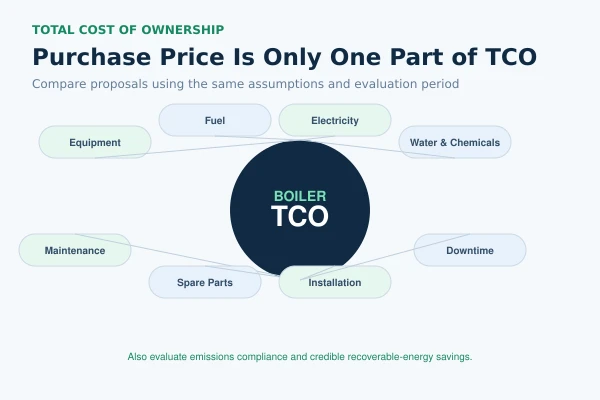
خمس-, عشرة- أو يمكن استخدام النموذج طويل الأمد اعتمادًا على عملية الاستثمار في الشركة.
تكلفة المعدات
Include the boiler and all equipment necessary to achieve the defined scope.
تكلفة الوقود
For many steam plants, fuel becomes one of the largest lifecycle expenses.
Annual fuel calculations should use realistic steam demand and operating hours rather than assuming continuous operation at nameplate capacity.
Important inputs include:
- annual operating hours;
- steam load profile;
- درجة حرارة مياه التغذية;
- fuel heating value;
- boiler efficiency basis;
- عودة المكثفات;
- and local fuel price.
كهرباء
Include electrical consumption from:
- المشجعين;
- مضخات;
- الضوابط;
- التعامل مع الوقود;
- معالجة المياه;
- emissions equipment;
- and related auxiliaries.
For electric boilers, electricity becomes the primary energy input and tariff structure becomes particularly important.
Water and Chemicals
يعتبر:
- ماء المكياج;
- feedwater treatment;
- chemical consumption;
- condensate recovery;
- and blowdown.
Maintenance and Spare Parts
Estimate:
- burner service;
- tube cleaning;
- refractory maintenance where applicable;
- sensors;
- الصمامات;
- مضخات;
- water-treatment consumables;
- and critical spare parts.
Downtime
Downtime is often underestimated.
In some manufacturing facilities, an hour without process steam can cost far more than a small difference in quoted boiler efficiency.
Critical processes should therefore evaluate:
- redundancy;
- backup capacity;
- spare-parts availability;
- service response;
- and maintenance planning.
14. A Practical 10-Year Boiler TCO Comparison Worksheet
When comparing industrial steam boiler suppliers, most buyers make a critical mistake: they compare only the quotation price instead of comparing the full lifecycle cost under identical operating assumptions.
To make a fair decision, all suppliers must be evaluated using the same technical and economic baseline:
- identical steam demand profile
- identical operating hours
- identical fuel price assumptions
- identical feedwater conditions
- identical efficiency basis (LHV or HHV)
- identical maintenance strategy
Without this normalization, the comparison becomes meaningless.
مثال: 10-Year TCO Comparison (10 t/h Gas Boiler Case)
Assumptions for this example:
- Steam demand: 10 ذ (average 6.5 ذ)
- ساعات العمل: 6,000 h/year
- وقود: غاز طبيعي
- Gas price: 0.35 USD/Nm³
- كفاءة المرجل: 90% (Supplier A), 92% (Supplier B), 94% (Supplier C)
- Project life: 10 سنين
10-Year TCO Comparison Table (Example Filled)
| TCO Item |
Supplier A (Basic System) |
Supplier B (Optimized System) |
Supplier C (High-Efficiency System) |
| Equipment cost |
$180,000 |
$210,000 |
$260,000 |
| Auxiliaries (مضخة, صهريج, الضوابط) |
$45,000 |
$60,000 |
$85,000 |
| تثبيت & التكليف |
$50,000 |
$55,000 |
$70,000 |
| Subtotal CAPEX |
$275,000 |
$325,000 |
$415,000 |
| تكلفة الوقود السنوية |
$310,000 |
$295,000 |
$275,000 |
| 10-year fuel cost |
$3,100,000 |
$2,950,000 |
$2,750,000 |
| Annual electricity |
$18,000 |
$16,000 |
$15,000 |
| 10-year electricity |
$180,000 |
$160,000 |
$150,000 |
| ماء & المواد الكيميائية |
$25,000 |
$22,000 |
$20,000 |
| 10-year water/chemicals |
$250,000 |
$220,000 |
$200,000 |
| الصيانة السنوية |
$20,000 |
$18,000 |
$16,000 |
| 10-year maintenance |
$200,000 |
$180,000 |
$160,000 |
| Spare parts (10-سنة) |
$60,000 |
$55,000 |
$50,000 |
| Emissions compliance cost |
$30,000 |
$25,000 |
$20,000 |
| Estimated downtime cost |
$120,000 |
$80,000 |
$50,000 |
| Heat recovery benefit |
-$50,000 |
-$90,000 |
-$130,000 |
| 10-year total TCO |
$4,165,000 |
$3,925,000 |
$3,665,000 |
Key Insight from the Comparison
Although Supplier C has the highest initial investment, it delivers the lowest total lifecycle cost due to:
- higher efficiency (lower fuel consumption)
- better heat recovery integration
- lower downtime risk
- improved automation stability
في أثناء, يبدو المورد "أ" جذابًا في مرحلة الشراء ولكنه يصبح الخيار الأغلى انتهى 10 سنين بسبب عدم كفاءة الوقود.
الاستنتاج الهندسي
قرار التكلفة الإجمالية للملكية الصحيح ليس كذلك:
"أي غلاية أرخص؟?"
إنها:
"أي غلاية تنتج البخار بأقل تكلفة للطن على مدار عمرها التشغيلي الحقيقي?"
في معظم الحالات الصناعية, تمثل تكلفة الوقود 70-85% من إجمالي تكلفة دورة الحياة, مما يعني أن فرق الكفاءة بنسبة 2-3% يمكن أن يفوق فرق سعر المعدات بأكمله في غضون بضع سنوات.
15. كيف ينبغي للمشترين مقارنة عروض أسعار الغلايات البخارية الصناعية؟?
غالبًا ما تكون عروض أسعار الغلايات الصناعية مضللة بسبب اختلاف الموردين:
- تشمل نطاقات المعدات المختلفة
- تحمل ظروف التشغيل المختلفة
- استخدام تعريفات مختلفة للكفاءة
- استبعاد الأنظمة المساعدة الحرجة
- أو تحويل المسؤولية إلى المشتري
لذلك, the first step is not price comparison — it is scope normalization.
خطوة 1: Normalize Technical Assumptions
Before comparing prices, force all suppliers to use the same baseline:
- سعة البخار: identical (على سبيل المثال, 10 ذ)
- ضغط: identical (على سبيل المثال, 10 حاجِز / 16 حاجِز)
- وقود: same specification and price basis
- ساعات العمل: same annual runtime
- درجة حرارة مياه التغذية: same assumption
- Condensate return: same percentage
- Efficiency basis: LHV or HHV clearly defined
If suppliers refuse to align assumptions, their quotations are not comparable.
خطوة 2: Compare “System Scope”, Not Just Boiler
A real industrial steam system includes more than the pressure vessel.
A proper comparison must include:
- boiler body
- burner system
- feedwater system
- معالجة المياه
- المقتصد (إن أمكن)
- نظام التحكم (PLC/HMI)
- safety valves and instrumentation
- نظام الوقود (قطار الغاز / oil system / biomass feeding)
- chimney and flue system
- installation and commissioning scope
خطوة 3: Real Engineering Comparison Table
| Item |
Supplier A |
Supplier B |
Supplier C |
| Boiler type |
Fire-tube |
Fire-tube |
Water-tube |
| Rated efficiency |
90% |
92% |
94% |
| Part-load efficiency |
Not specified |
معتدل |
High stability |
| Burner turndown ratio |
1:3 |
1:5 |
1:8 |
| وشملت المقتصد |
لا |
نعم |
نعم (نوع عالي الكفاءة) |
| نظام استعادة المكثفات |
خياري |
متضمنة |
متضمنة + الأمثل |
| نظام التحكم |
PLC الأساسي |
PLC + واجهة المستخدم البشرية |
PLC + SCADA + remote monitoring |
| نظام الانبعاثات |
الموقد القياسي |
موقد منخفض أكاسيد النيتروجين |
أكاسيد النيتروجين منخفضة للغاية + FGR |
| معالجة المياه |
غير متضمنة |
متضمنة |
نظام متكامل تماما |
| نطاق التثبيت |
المعدات فقط |
التثبيت الجزئي |
تسليم المفتاح الكامل |
| التكليف |
غير متضمنة |
متضمنة |
ضمان الأداء الكامل |
| ضمان |
12 شهور |
18 شهور |
24 شهور + ضمان الأداء |
| Spare parts |
محدود |
طقم قياسي |
مجموعة حرجة كاملة لمدة عامين |
| التوثيق |
الدليل الأساسي |
الحزمة الفنية الكاملة |
ممتلىء + نموذج التوأم الرقمي |
خطوة 4: تحديد فجوات التكلفة المخفية
العديد من عروض الأسعار المنخفضة السعر تستبعد الأنظمة المهمة مثل:
- نظام معالجة المياه
- نظام عودة المكثفات
- blowdown heat recovery
- عمالة التثبيت
- تكامل التحكم
- معدات الامتثال للانبعاثات
غالبًا ما تحول هذه الاستثناءات ما بين 20 إلى 40٪ من إجمالي تكلفة المشروع إلى المشتري.
خطوة 5: قاعدة القرار النهائي
بعد التطبيع, وينبغي أن يتبع القرار هذا المنطق:
- هل يلبي النظام متطلبات العملية؟?
- هل يقلل من تكلفة دورة الحياة؟ (التكلفة الإجمالية للملكية)?
- هل يقلل من المخاطر التشغيلية (downtime, instability)?
- Does it comply with emissions and certification rules?
- Is supplier support reliable for 10+ سنين?
Only when all five answers are positive should price become the deciding factor.
Final Engineering Insight
A professional boiler procurement decision is not a price comparison exercise.
It is a system engineering optimization problem involving:
- thermodynamics (كفاءة)
- process engineering (steam demand)
- economics (fuel cost over time)
- reliability engineering (downtime risk)
- compliance engineering (الانبعاثات + certification)
If you want, I can next upgrade this article further into a “lead-generation version” (SEO + CTA + product positioning for MakeBoiler) or convert it into a landing page structure for Google Ads traffic.
16. What Should Be Included in an Industrial Boiler Quotation?
A professional industrial steam boiler quotation should clearly define the technical and commercial scope.
اعتمادا على المشروع, request:
Boiler Data
- نموذج;
- سعة;
- operating/design pressure;
- درجة حرارة البخار;
- وقود;
- efficiency and calculation/test basis.
Major Equipment
- سخان مياه;
- الموقد;
- المقتصد;
- مضخات مياه التغذية;
- deaerator/feedwater system;
- معالجة المياه;
- نظام الوقود;
- الضوابط;
- emissions equipment.
التوثيق
- ورقة البيانات الفنية;
- رسم الترتيب العام;
- مخطط تدفق العملية;
- ص&ID where required;
- electrical drawings;
- control description;
- الشهادات المعمول بها;
- دليل التشغيل;
- دليل الصيانة;
- spare-parts list;
- factory test records.
Commercial Scope
- سعر;
- delivery time;
- packing;
- transportation responsibility;
- مسؤولية التثبيت;
- التكليف;
- تمرين;
- ضمان;
- after-sales support;
- exclusions.
A clear quotation reduces misunderstandings later in the project.
17. How Do You Evaluate an Industrial Steam Boiler Manufacturer?
Price alone is not enough to evaluate a boiler supplier.
An industrial boiler is a pressure system expected to operate for many years, often inside a production process where steam availability is critical.
Evaluate the supplier in several areas.
Engineering Capability
Can the supplier explain why a particular capacity, ضغط, burner and auxiliary configuration has been selected?
Manufacturing Capability
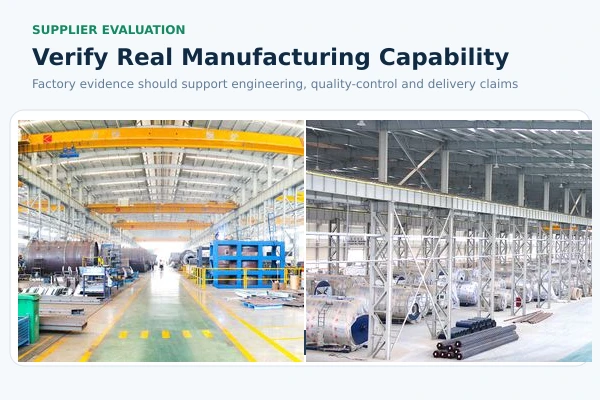
Ask about:
- manufacturing process;
- welding;
- material traceability;
- تقتيش;
- pressure testing;
- factory acceptance testing;
- and quality-control documentation.
Performance Evidence
For statements such as:
“كفاءة عالية”
ask for:
Calculation/test basis + وقود + حمولة + درجة حرارة مياه التغذية.
ل:
“أكاسيد النيتروجين منخفضة”
ask for:
قيمة مضمونة + وقود + حمولة + reference conditions + test method.
ل:
“Smart boiler”
ask for:
PLC architecture + قائمة الإدخال/الإخراج + monitored parameters + communication functions.
International Project Capability
لمشاريع التصدير, also evaluate:
- packaging;
- shipping experience;
- documentation;
- installation coordination;
- remote technical support;
- spare-parts delivery;
- language capability;
- and commissioning responsibility.
A good supplier should be able to explain what it will deliver, what the buyer must provide and where each party’s responsibility begins and ends.
18. Industrial Steam Boiler Buying Red Flags
يجب على فريق المشتريات إجراء مزيد من التحقيق عندما يرى أيًا مما يلي.
1. الكفاءة دون شروط الاختبار
النسبة المئوية وحدها لا تكفي.
2. يعتمد الحجم على السعة القصوى فقط
يجب على المورد أن يسأل عن الحمل الطبيعي والحد الأدنى.
3. لا توجد مناقشة حول تحميل الملف الشخصي
يؤثر الطلب المتغير على تشغيل الموقد والغلاية.
4. الانبعاثات مضمونة دون شروط مرجعية
اطلب الوقود, حمولة, الأكسجين المرجعي وأساس الاختبار.
5. المعدات المساعدة الهامة مفقودة
قد يعكس السعر المنخفض نطاقًا غير مكتمل.
6. نطاق الشهادة غير واضح
التحقق من الشركة المصنعة, المعدات وقابلية التطبيق.
7. لا يسأل المورد أبدًا عن مياه التغذية
تؤثر ظروف المياه على تشغيل الغلاية وحياتها.
8. مسؤولية التثبيت غير محددة
تحتاج المشاريع الدولية إلى حدود واجهة واضحة.
9. لا توجد خطة لقطع الغيار
Critical spares should be identified before shipment.
10. The Price Is Extremely Low but Exclusions Are Vague
قارن النطاق قبل مقارنة السعر.
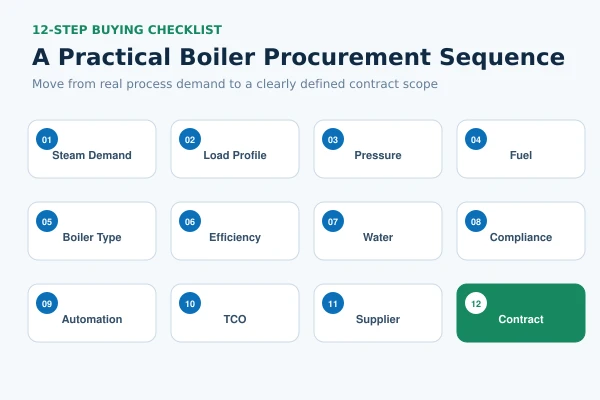
19. 12-Step Industrial Steam Boiler Buying Checklist for 2026
Use this process before placing an order.
خطوة 1: Define Steam Demand
Determine capacity, ضغط, temperature and steam quality.
خطوة 2: Build a Load Profile
Identify minimum, normal and peak demand.
خطوة 3: Define Required Pressure
Include process requirements and distribution considerations.
خطوة 4: Evaluate Fuel Options
Compare price, infrastructure, supply reliability and storage.
خطوة 5: Select the Appropriate Boiler Design
Evaluate fire-tube, water-tube or another configuration against actual requirements.
خطوة 6: Compare Real Efficiency
Use consistent test/calculation assumptions and examine part-load operation.
خطوة 7: Confirm Feedwater Conditions
Define treatment, نزع الهواء, condensate return and blowdown requirements.
خطوة 8: Verify Emissions and Certification
استخدام المتطلبات المطبقة على سوق التثبيت.
خطوة 9: تعريف الأتمتة
تحديد القياسات, تكامل PLC/HMI/SCADA, أجهزة الإنذار والوصول عن بعد.
خطوة 10: حساب التكلفة الإجمالية للملكية
قارن تكاليف تشغيل دورة الحياة، وليس سعر الشراء فقط.
خطوة 11: تقييم المورد
مراجعة الهندسة, تصنيع, اختبار, التوثيق والخدمة.
خطوة 12: تأكيد نطاق العقد
تحديد الادراج بوضوح, exclusions, تثبيت, التكليف, تمرين, قطع الغيار والضمان.
باختصار:
الطلب على البخار ← ملف تعريف التحميل ← الضغط ← الوقود ← نوع الغلاية ← الكفاءة ← الماء ← الامتثال ← الأتمتة ← التكلفة الإجمالية للملكية ← المورد ← العقد
20. ما هي المعلومات التي يجب عليك إرسالها إلى الشركة المصنعة للغلايات؟?
للحصول على عرض أسعار هندسي مفيد, prepare the following information.
بيانات RFQ الأساسية للغلاية
- سعة البخار المطلوبة
- الحد الأدنى من الطلب على البخار
- الطلب العادي على البخار
- ذروة الطلب على البخار
- ضغط العمل
- درجة حرارة البخار المطلوبة
- نوع الوقود ومواصفاته
- ساعات العمل يوميا
- أيام التشغيل في السنة
- درجة حرارة مياه التغذية
- نوعية مياه التغذية
- Expected condensate return
- Industry/application
- بلد التثبيت
- متطلبات الانبعاثات المحلية
- الشهادة المطلوبة
- Site altitude where relevant
- الكهرباء متوفرة
- Space/transport restrictions
- تاريخ التسليم المطلوب
Providing these parameters allows the engineering team to evaluate an actual boiler system instead of producing a generic price quotation.
Frequently Asked Questions About Buying an Industrial Steam Boiler
What size industrial steam boiler do I need?
The correct size depends on minimum, normal and peak steam demand rather than maximum production capacity alone. Buyers should build a steam-load profile that also considers daily operating hours, batch loads, seasonal changes and future production requirements.
How do I calculate industrial steam boiler capacity?
Start by determining steam consumption from all relevant process equipment and identifying which loads operate simultaneously. Separate normal demand from short peak loads and include reasonable system requirements. Final sizing should be verified through an engineering heat and mass balance rather than relying only on a simple rule of thumb.
What pressure should an industrial steam boiler operate at?
The boiler should supply sufficient pressure for the process after accounting for steam-distribution and control requirements. الضغط العالي ليس أفضل تلقائيًا. Define the pressure required at the process first, then select an appropriate boiler operating and design pressure.
Is a gas or electric steam boiler better?
Neither is universally better. Electric boilers eliminate point-of-use combustion and offer precise control, but electricity prices, يمكن أن تؤثر سعة الشبكة ورسوم الطلب على تكلفة التشغيل. قد توفر غلايات الغاز اقتصاديات مواتية حيث يتوفر الغاز بسهولة. قارن بين استخدام أسعار الطاقة المحلية الفعلية والطلب على البخار.
هل غلاية الكتلة الحيوية أرخص من غلاية الغاز?
ويمكن أن يكون في مواقع ذات كتلة حيوية موثوقة ومنخفضة التكلفة, لكن سعر الوقود وحده لا يكفي. رطوبة الكتلة الحيوية, calorific value, رماد, تخزين, feeding, ويجب أيضًا تضمين التحكم في الغبار وصيانته في المقارنة الاقتصادية.
ما هو الفرق بين غلايات أنابيب النار وغلايات أنابيب المياه؟?
تقوم غلايات أنابيب النار بتمرير الغازات الساخنة عبر أنابيب محاطة بالمياه, بينما تعمل غلايات أنابيب المياه على توزيع الماء/البخار عبر أنابيب يتم تسخينها خارجيًا. التصميم المناسب يعتمد على القدرة, ضغط, استجابة الحمل, فضاء, ظروف المياه ومتطلبات العملية.
كيف ينبغي مقارنة كفاءة الغلايات الصناعية؟?
Compare suppliers using the same fuel basis, حمولة المرجل, feedwater temperature and test/calculation method. قم أيضًا بتقييم ترتيب الموقد, درجة حرارة المكدس, الهواء الزائد, تكوين المقتصد, condensate recovery and blowdown because these influence real operating cost.
What auxiliary equipment does an industrial steam boiler need?
اعتمادا على المشروع, auxiliary systems may include burners, مضخات, معالجة المياه, أجهزة نزع الهواء, الاقتصاديين, مَداخِن, أنظمة الوقود, condensate systems, blowdown systems, controls and emissions equipment. Always confirm quotation inclusions and exclusions.
How much does an industrial steam boiler cost?
There is no reliable universal price. Cost varies with capacity, ضغط, وقود, تصميم المرجل, الموقد, الضوابط, استعادة الحرارة, معالجة المياه, certification, emissions equipment and auxiliary-system scope. Installed project cost should be evaluated separately from boiler purchase price.
How do I calculate boiler total cost of ownership?
Add equipment, وقود, كهرباء, ماء, المواد الكيميائية, صيانة, قطع غيار, تثبيت, emissions compliance and expected downtime over the selected evaluation period. Subtract credible recovered-energy savings where appropriate. Compare all proposals using the same assumptions.
What information does a manufacturer need to quote a boiler?
على الأقل, provide capacity, تحميل الملف الشخصي, ضغط العمل, درجة حرارة البخار, وقود, ساعات العمل, ظروف مياه التغذية, عودة المكثفات, application, بلد التثبيت, emissions requirements and certification requirements.
How should I compare industrial boiler manufacturers?
Compare engineering capability, manufacturing quality, نطاق الشهادة, documented efficiency and emissions performance, factory testing, الأتمتة, project experience, documentation, commissioning support, spare-parts availability and after-sales service—not only price.
خاتمة: Buy the Boiler That Fits the Process
The best industrial steam boiler in 2026 is not automatically the one with the highest capacity, highest quoted efficiency or lowest purchase price.
A successful boiler project begins with the production process.
بسأل:
- How much steam is really required?
- كيف يتغير الطلب خلال النهار?
- What pressure must reach the process?
- ما هي أنواع الوقود المتوفرة محليا?
- What does each fuel actually cost?
- What is the feedwater quality?
- ما هي قواعد الانبعاثات المطبقة?
- What automation is needed?
- What equipment is included?
- Who will install and commission the system?
- What happens if the boiler stops?
- What will the system cost over ten years?
The strongest purchasing strategy is therefore:
Define capacity → build the load profile → define pressure → compare fuels → select the boiler type → evaluate real efficiency → confirm water and compliance requirements → define automation → calculate TCO → verify supplier evidence → confirm the complete project scope.
If you are preparing an industrial steam boiler project, start with five parameters:
سعة البخار + ضغط العمل + وقود + ساعات العمل + بلد التثبيت
With those inputs—and preferably a real steam-load profile—a boiler manufacturer can move beyond a generic quotation and begin engineering a system that matches the actual process.
Need help choosing the right industrial steam boiler? Send your capacity, ضغط, fuel and installation country to us on WhatsApp for a project-specific boiler recommendation and quotation. Get a Boiler Quote on WhatsApp → +86-132-1322-2805。
المراجع الرسمية




الخامسiew مراجعات عملائنا
"خدمة العملاء في Fangkuai من الدرجة الأولى. لقد ساعدوني في اختيار الغلاية المثالية لاحتياجاتي وقدموا دعمًا كبيرًا طوال العملية. كانت عملية التثبيت أيضًا سلسة للغاية وتجاوزت الغلاية توقعاتي. إنه سهل الاستخدام والصيانة, وكفاءة الطاقة رائعة. أوصي بشدة بمنتجات Fangkuai لأي شخص يحتاج إلى حلول تدفئة موثوقة وفعالة."
خوان
المكسيك"أنا معجب جدًا بجودة غلاية الماء الساخن من Fangkuai. لقد تم بناؤه ليدوم وتجاوز توقعاتي. كانت عملية التثبيت سلسة للغاية وكانت خدمة العملاء ممتازة. غلاية الماء الساخن سهلة التشغيل والصيانة, وكفاءة الطاقة رائعة. أوصي بشدة بغلايات الماء الساخن من Fangkuai."
جاك
أستراليا"مولد البخار من Fangkuai مثالي لأعمالي الصغيرة. إنه سهل الاستخدام للغاية ويتطلب الحد الأدنى من الصيانة. كما أنها موفرة للطاقة بشكل كبير, مما ساعدني على توفير المال على فواتير الطاقة الخاصة بي. خدمة العملاء في Fangkuai ممتازة أيضًا. إنهم متجاوبون للغاية ومستعدون دائمًا للمساعدة. أوصي بشدة بمولدات البخار من Fangkuai."
أحمد
مصر"مولد البخار من Fangkuai مثالي لأعمالي الصغيرة. إنه سهل الاستخدام للغاية ويتطلب الحد الأدنى من الصيانة. كما أنها موفرة للطاقة بشكل كبير, مما ساعدني على توفير المال على فواتير الطاقة الخاصة بي. خدمة العملاء في Fangkuai ممتازة أيضًا. إنهم متجاوبون للغاية ومستعدون دائمًا للمساعدة. أوصي بشدة بمولدات البخار من Fangkuai."
أحمد
مصر"جعلت المعدات المساعدة لـ Fangkuai نظام الغلايات الخاص بي أفضل. جودة المعدات استثنائية والأسعار معقولة جدًا. ساعدت المعدات في تحسين كفاءة وأداء نظام الغلايات الخاص بي, مما أدى إلى توفير كبير في التكاليف. أوصي بشدة بمعدات Fangkuai المساعدة لأي شخص يحتاج إلى ملحقات غلاية عالية الجودة."
ماريك
المملكة المتحدة"خدمة العملاء في Fangkuai من الدرجة الأولى. لقد ساعدوني في اختيار الغلاية المثالية لاحتياجاتي وقدموا دعمًا كبيرًا طوال العملية. كانت عملية التثبيت أيضًا سلسة للغاية وتجاوزت الغلاية توقعاتي. إنه سهل الاستخدام والصيانة, وكفاءة الطاقة رائعة. أوصي بشدة بمنتجات Fangkuai لأي شخص يحتاج إلى حلول تدفئة موثوقة وفعالة."
خوان
المكسيك"غلاية الماء الساخن من Fangkuai مذهلة. يسخن بسرعة وكفاءة, ويبقى الماء ساخنًا لفترة طويلة. لم نواجه أي مشاكل معه أبدًا وقد حقق تحسنًا كبيرًا في عملياتنا اليومية. كانت عملية التثبيت سلسة للغاية وكانت خدمة العملاء ممتازة. أوصي بشدة بغلايات الماء الساخن من Fangkuai."
ساره
كندا"مولد البخار من Fangkuai مثالي لأعمالي الصغيرة. إنه سهل الاستخدام للغاية ويتطلب الحد الأدنى من الصيانة. كما أنها موفرة للطاقة بشكل كبير, مما ساعدني على توفير المال على فواتير الطاقة الخاصة بي. خدمة العملاء في Fangkuai ممتازة أيضًا. إنهم متجاوبون للغاية ومستعدون دائمًا للمساعدة. أوصي بشدة بمولدات البخار من Fangkuai."
أحمد
مصر"الغلاية البخارية من Fangkuai مثالية لأعمال معالجة الطعام الخاصة بي. إنه يلبي جميع متطلباتنا وهو موثوق للغاية. جودة المواد وبناء المرجل استثنائية. كما أنها سهلة التشغيل والصيانة, مما ساعدنا على توفير الوقت والمال على الصيانة. أوصي بشدة بالغلايات البخارية من Fangkuai لأي شخص يحتاج إلى حلول تدفئة موثوقة."
جسون
البرازيل