
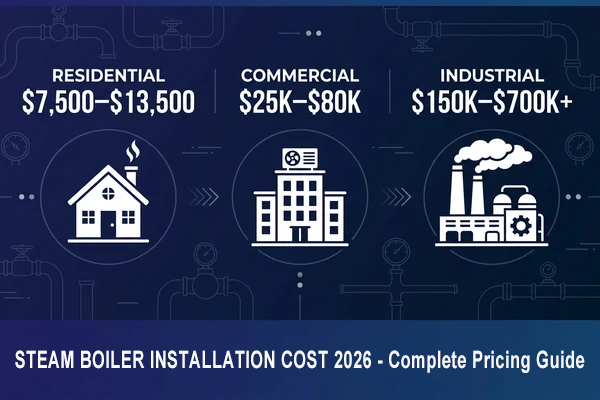
Resumo do custo de instalação por segmento
| Segmento | Custo do equipamento | Custo da mão -de -obra | Faixa total de instalação |
|---|---|---|---|
| residencial (≤ 200 MBH) | $3,000 – $9,000 | $2,500 – $5,000 | $7,500 – $13,500 |
| Comercial Leve (150–300 HP) | $15,000 – $50,000 | $8,000 – $20,000 | $25,000 – $80,000 |
| Industrial (500–2.000 PV) | $80,000 – $400,000 | $40,000 – $120,000 | $150,000 – $700,000 |
| Grande Indústria (2,000+ HP) | $200,000 – $800,000 | $100,000 – $300,000 | $700,000 – $1,500,000+ |
Seção 1: Custo de instalação de caldeira a vapor por segmento
1.1 Custo de instalação de caldeira a vapor residencial
Sistemas de vapor residenciais, embora menos comum que hidrônico (água quente) laços, continuam sendo um produto básico em casas históricas no Nordeste e Centro-Oeste dos EUA. O custo total típico de instalação varia entre $7,500 e $13,500, equipamento de cobertura, mão de obra local, e tubulação essencial próxima à caldeira.
- Nível de orçamento ($7,500 – $9,500): Aplica-se a substituições diretas e iguais, onde os coletores de fornecimento e retorno existentes estão em perfeitas condições, e sem materiais perigosos (amianto) estão presentes.
- Nível intermediário ($9,500 – $11,500): Envolve remediação parcial da tubulação próxima à caldeira, instalando atualizado, caminhos de ventilação compatíveis com o código, e taxas de autorização residencial padrão.
- Nível de alta qualidade ($11,500 – $13,500): Necessário quando uma substituição completa do sistema de tubulação próximo à caldeira não for negociável. Isto inclui frequentemente a redução do amianto e complexos de navegação, caminhos de ventilação de vários andares.
O principal fator de custo em projetos residenciais é a qualidade do tubulação próxima à caldeira. Porque o vapor se expande rapidamente, tamanhos de tubos incorretos, soltar cabeçalhos, ou escolhas erradas de tom podem causar golpe de aríete grave, ciclo curto sistêmico, e falha prematura da caldeira.
Quanto custa substituir uma caldeira a vapor residencial?
Em 2026, o custo médio nacional para substituir uma caldeira a vapor residencial é $10,500. Esta meta de referência inclui uma unidade padrão de caldeira a vapor de baixa pressão e eficiência média, remoção mecânica completa da embarcação antiga, licenças de conformidade com código padrão, e atualizações essenciais na tubulação imediata próxima à caldeira para garantir o fornecimento de vapor seco.
1.2 Custo de instalação comercial leve
Operações comerciais leves – incluindo complexos de apartamentos multifamiliares, escolas primárias, e locais de fabricação boutique - contam com caldeiras que vão desde 150 para 300 Potência da caldeira (HP). Os custos totais instalados variam de $25,000 para $80,000.
- Alocação de Equipamentos: $15,000 para $50,000 para o conjunto do casco da caldeira e do queimador.
- Mão de obra de instalação: $8,000 para $20,000 para aparelhamento, colocação, e conexões de tubos.
- Licenças & Conformidade: $1,500 para $6,000 dependendo dos códigos ambientais e de segurança municipais locais.
- Preparação do Local: $3,000 para $12,000 para ajustes na linha de combustível e pequenas alterações estruturais.
1.3 Custo de instalação de caldeira a vapor industrial
Custo Total Instalado Industrial (TIC) exige um enorme compromisso de capital, geralmente correndo de $150,000 para cima de $1,500,000+.
- Sistemas de médio porte (500–2.000 PV): Os custos médios do projeto caem suavemente entre $300,000 e $700,000.
- Grande, Sistemas de alta pressão: Instalações complexas que exigem altas pressões severas (>150 PSIG) juntamente com configurações auxiliares abrangentes que variam de $700,000 para $1,500,000+.
Os principais subcustos industriais incluem montagem mecânica especializada e tubulação estrutural ($20,000–US$ 30.000), integração elétrica multitensão ($15,000–US$ 25.000), isolamento térmico ($4,000–US$ 6.000), e protocolos de comissionamento rigorosos ($5,000–$ 10.000).
Estudo de caso: 10-Projeto de caldeira a vapor ton/hora (Instalação de processamento de alimentos)
- Equipamento Primário: $180,000
- Sistemas Auxiliares (Queimador, Economizador, Água de alimentação): $65,000
- Instalação Mecânica & Tubulação de campo: $85,000
- Conformidade, Inspeções & Comissionamento: $32,000
- TIC final total: $362,000
Seção 2: Detalhamento total dos custos de instalação – linha por linha
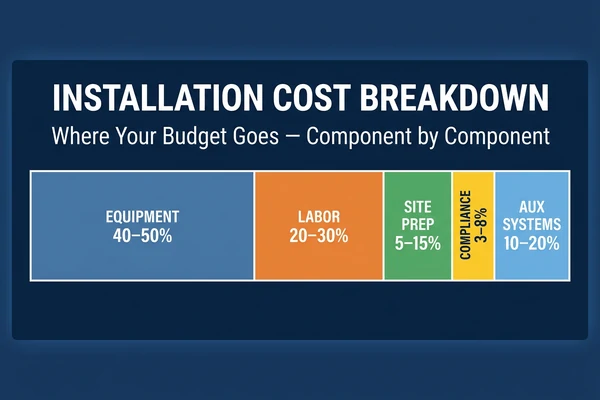
Para evitar desvios orçamentais inesperados, os gerentes de projeto devem rastrear as oito categorias de custos distintas que constituem um projeto de instalação de caldeira a pleno vapor.
2.1 Custo do equipamento (40% – 50% de TIC)
Isto representa o preço de compra de hardware dos principais sistemas mecânicos:
- O vaso de pressão primário (tubo de fogo, tubo de água, ou de alta capacidade caldeira elétrica).
- O conjunto do queimador (frequentemente adquirido separadamente do casco da caldeira para atender aos critérios exatos de baixas emissões de NOx).
- Um integrado economizador ou unidade de recuperação de calor, que reduz as despesas de combustível a longo prazo em 5% para 15% através da recuperação de calor dos gases de combustão.
- Infraestrutura de água de alimentação: o tanque desaerador, bombas de alimentação multiestágio de alta pressão, e sistema de retorno de condensado.
- O painel de controle mestre, utilizando automação PLC avançada ou sistema de gerenciamento predial contínuo (BMS) interfaces.
- [Link Interno: Veja nosso Preço da caldeira a vapor industrial Comparação de preços de equipamentos por capacidade exata da HP.]
2.2 Custo da mão -de -obra (20% – 30% de TIC)
O trabalho de campo envolve comerciantes altamente qualificados que trabalham sob tolerâncias mecânicas precisas:
- Montagem Mecânica & Aparelhamento: $15,000 para $45,000 em pegadas industriais.
- Fabricação de tubulação próxima à caldeira: $8,000 para $30,000 para soldagem e rosqueamento de aço carbono de alto calibre.
- Isolamento Térmico: $4,000 para $6,000 para isolar as principais redes de vapor e o corpo principal da caldeira.
- Fiação Elétrica & Instrumentação: $10,000 para $25,000 para roteamento de energia em campo.
- Programação de controles: $5,000 para $15,000 para testes de sequência e ajuste de loop.
- Referências trabalhistas: Comando padrão de mecânica de HVAC/caldeira de US$ 65 a US$ 120/h, enquanto os jornaleiros sindicalizados em jurisdições complexas custam em média US$ 95 a US$ 160/hora.
2.3 Preparação do Local (5% – 15% de TIC)
Antes da chegada do novo equipamento, o espaço físico deve atender a rígidas diretrizes espaciais e civis:
- Reforço Estrutural: $5,000 para $25,000 para plataformas de concreto capazes de suportar alto peso operacional.
- Extensão da Linha de Gás Natural: $1,200 para $8,000 para fornecer volume e pressão adequados.
- Atualizações de infraestrutura elétrica: $3,000 para $12,000 (como implementar alimentação trifásica de 480V).
- Modificações de encanamento: $2,000 para $8,000 para linhas de abastecimento de água e drenagem de purga em alta temperatura.
- Conduto de exaustão & Instalação de pilha: $3,000 para $15,000 para um layout adequado da culatra.
- Redução de amianto: $1,500 para $8,000 em porões de instalações residenciais ou industriais mais antigas.
2.4 Permissões e Conformidade (3% – 8% de TIC)
Negligenciar a supervisão regulatória interromperá as operações e causará o risco de graves violações do código:
- Edifício Local & Licenças Mecânicas: $150 para $3,000, dimensionado pela capacidade total de BTU.
- ASME Seção I “S” Verificação de carimbo: $1,200 para $5,000 para validação do Inspetor Autorizado.
- Teste de emissões de pilha EPA: $650 para $3,500 para verificar a conformidade estrita com as métricas locais de qualidade do ar.
- NFPA 85 Revisão de conformidade: $2,000 para $8,000 para segurança de queimadores industriais e proteção contra chamas.
- Certificado de Inspeção Estadual: $300 para $1,500 para o registo operacional inicial obrigatório.
Quais licenças são necessárias para instalação de caldeira a vapor?
- Licença Mecânica/Construção Local: Concede autoridade municipal para alterar espaços utilitários e estruturais.
- Relatório de dados do fabricante ASME: Certifica a integridade estrutural e de soldagem do vaso de pressão.
- Qualidade do Ar/Licença de Operação EPA: Obrigatório para queimadores de combustíveis fósseis de alto consumo para garantir que os limites de emissões sejam mantidos.
- Conselho Nacional/Registro Estadual: Insere o vaso de pressão no banco de dados de inspeção de segurança obrigatória do estado.
2.5 Sistemas Auxiliares (10% – 20% de TIC)
Uma caldeira não pode funcionar eficazmente isoladamente; requer uma rede robusta de equipamentos de suporte:
- Receptores de Condensado: $3,000 para $12,000 para coleta eficiente de água.
- Skids de dosagem química: $1,500 para $6,000 para evitar incrustações internas e corrosão causada por oxigênio.
- Válvulas de alívio de segurança & Reguladores: $800 para $3,000.
- Medição de fluxo de vapor: $2,000 para $8,000 para rastreamento em tempo real da eficiência térmica.
- Vasos de purga: $3,000 para $10,000 para resfriar com segurança a água lavada antes da descarga.
2.6 Teste, Comissionamento & Comece (2% – 5% de TIC)
- Teste Hidrostático: Verifica a contenção da tubulação sem vazamentos em pressões elevadas (normalmente coberto pelos custos de inspeção inicial).
- Afinação do Queimador & Análise de Combustão: $800 para $3,500 para otimizar as relações combustível-ar.
- Verificação do Loop de Controle: $2,000 para $5,000 para testar todos os intertravamentos de segurança automáticos.
- Protocolos de treinamento de operadores: $1,500 para $4,000 para integração da equipe de operações liderada por OEM.
- Teste de aceitação de desempenho: $2,000 para $6,000 para confirmar as métricas de saída de vapor da placa de identificação.
2.7 Frete e Rigging (1% – 3% de TIC)
- Frete Pesado Industrial: $3,000 para $15,000 dependendo da distância e dos regulamentos de carga ampla.
- Equipes de guindastes e rigging especializadas: $2,000 para $10,000 para manobras estruturais complexas.
- Fabricação de skid modular personalizado: $5,000 para $20,000 para pré-embalados, colocação de campo drop-in.
2.8 Contingência do Projeto (10% Recomendado)
Um apartamento 10% linha de contingência deve ser sempre mantido. Os fatores comuns de despesas não mapeadas incluem linhas de condensado corroídas no subsolo, rede de gás municipal subdimensionada, e degradação oculta do concreto estrutural.
Seção 3: Fatores-chave que determinam seu custo de instalação
3.1 Capacidade da caldeira e classificação de pressão
À medida que a capacidade aumenta, a escala necessária de componentes auxiliares e infraestrutura de tubulação cresce proporcionalmente. Sistemas de vapor de alta pressão projetados para operação acima 15 O PSIG deverá cumprir rigorosamente Código ASME para caldeiras e vasos de pressão (Seção I). Este teste rigoroso, soldagem, e o paradigma da certificação acrescenta uma imediata 15% para 25% prêmio em comparação com soluções de baixa pressão.
Regra prática: Orçamento 1.5 × para 2.0 × o custo do equipamento para instalação se a pressão exceder 15 PSIG.
3.2 Impacto do tipo de combustível no custo de instalação
| Tipo de combustível | Instalar Premium | Principal fator de custo |
|---|---|---|
| Gás natural | Linha de base | Extensão da linha de gás + regulador. Caminho de instalação mais econômico. |
| Propano | +5% – 10% | Colocação de pátio de tanques externo dedicado ($1,500–$ 4.000) + controles de modulação de pressão. |
| Óleo para aquecimento / #2 | +8% – 15% | Tanques de armazenamento duplos + bombas de óleo dedicadas e circuitos de contenção ambiental. |
| Biomassa / Combustível sólido | +25% – 50% | Silos de armazenamento automatizados, alimentações de transportadores mecânicos complexos, e sistemas de manuseio de cinzas. |
| Elétrico | -10% – 15% | Sem gases de combustão, ventilação zero, e pegada estrutural simplificada - mas apresenta altos custos contínuos de serviços públicos. |
3.3 Nova instalação vs.. Retrofit versus. Substituição
- Nova Construção (Campo verde): Altos custos de inicialização, como todos os trabalhos estruturais de apoio, principais circuitos de distribuição, e pontos de atendimento de utilidades devem ser construídos do zero.
- Reforma (Sala da caldeira existente): 20% para 40% mais econômico do que configurações greenfield, aproveitando redes de distribuição pré-existentes, pontos de ventilação, e estruturas fundamentais.
- Substituição igual por igual: O caminho mais baixo de despesas de capital, normalmente em execução 30% para 50% de uma instalação totalmente nova, desde que os coletores e elementos de tubulação circundantes permaneçam estruturalmente sólidos.
3.4 Localização e mercado de trabalho local
A dinâmica laboral pode alterar drasticamente as projeções financeiras. Projetos com equipes mecânicas sindicalizadas em ambientes metropolitanos (por exemplo, Nordeste dos EUA ou Califórnia) incorrer em um $20 para $40 prêmio por hora sobre rural, regiões de loja aberta. Além disso, a conformidade com regulamentações ambientais locais – como os padrões Ultra-Low NOx da Califórnia ou a Lei Local 97 de Nova York – acrescenta custos significativos de engenharia e supervisão de conformidade.
Seção 4: Cronograma de instalação da caldeira a vapor de 6 fases
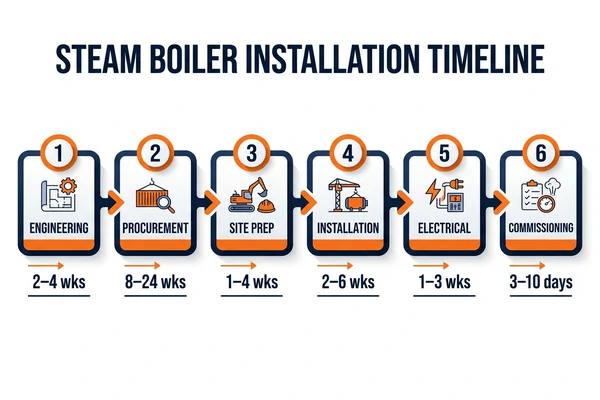
Um cronograma de projeto bem planejado limita o tempo de inatividade operacional e ajuda a coordenar tarefas comerciais sequenciais.
- Fase 1: Pesquisa do local & Engenharia (2–4 semanas)
Verificação de carga mecânica, P&Elaboração de identificação, dimensionamento final do navio, e engenharia espacial. Alocação estimada: $3,000 – $12,000. - Fase 2: Aquisições & Prazo de entrega da fábrica (8–24 semanas)
A janela central onde o vaso de pressão é construído e testado. Embora as substituições residenciais padrão exijam apenas 2 a 4 semanas, equipamentos industriais requerem rotineiramente de 12 a 24 semanas. Isto marca o primeiro marco de pagamento de capital. - Fase 3: Obras Civis & Preparação do Local (1–4 semanas)
Derramando almofadas de concreto de alta resistência, atualizando a rede elétrica de entrada, e instalação de estruturas pesadas de culatra. Alocação estimada: $5,000 – $25,000. - Fase 4: Montagem Mecânica & Aparelhamento (2–6 semanas)
Colocando o vaso primário, soldagem dos principais coletores de vapor próximos à caldeira, e completando ligações do sistema auxiliar. Isto representa o pico da janela de despesas trabalhistas. - Fase 5: Elétrica & Integração de controles (1–3 semanas)
Roteamento de energia de campo, fiação do instrumento, Configuração do link BMS, e implementação de intertravamentos de segurança contra chamas. Alocação estimada: $10,000 – $25,000. - Fase 6: Comissionamento, Teste & Entregar (3–10 dias)
Conduzindo o teste hidrostático oficial, executando análise de combustão, realizando treinamento de segurança da equipe, e garantir a aprovação final dos inspetores. Alocação estimada: $3,000 – $12,000.
Seção 5: Como minimizar o custo de instalação da caldeira a vapor
5.1 Escreva um escopo de trabalho definitivamente documentado
Não aborde fornecedores mecânicos com parâmetros vagos. Indique explicitamente o HP operacional necessário, configurações de combustível, Pressão máxima de trabalho permitida (MAWP), limites máximos de emissões, e selos ASME exigidos. Definir se os cabeçalhos serão reutilizados ou totalmente fabricados novamente garante balanceamento de lances igual a igual e elimina pedidos de alteração no meio do projeto.
5.2 Execute a regra dos três lances
Adquira um mínimo de três lances detalhados: um de uma equipe de campo autorizada pelo OEM, um de um especialista regional independente estabelecido, e um de uma grande empresa contratante mecânica. Exija rastreamento de custos linha por linha, em vez de cotações agregadas de montante fixo. Qualquer lance que acerte 20% abaixo da mediana deveria ser examinado, já que normalmente omite a permissão necessária, comissionamento, ou detalhes da tubulação.
5.3 Aproveite o tempo estratégico de compras
Planejar a aquisição de equipamentos para o quarto trimestre (Outubro-dezembro). Os fabricantes de caldeiras industriais oferecem frequentemente promoções de volume de final de ano, reduzindo custos com equipamentos 8% para 15%. Crucialmente, evite esperar por uma falha inesperada do sistema; instalações de emergência acarretam taxas de mão de obra premium e taxas de frete acelerado que podem aumentar os custos 20% para 35%.
5.4 Agrupe a instalação com um contrato de manutenção preventiva
A negociação de um contrato de manutenção preventiva de 3 anos durante a fase inicial de instalação pode garantir um $2,000 para $6,000 redução em taxas de serviço contínuas. Essa abordagem garante o envio prioritário em campo e preserva sua garantia estrutural estendida do OEM.
5.5 Maximize o potencial de reutilização de componentes
Se a tubulação próxima à caldeira existente estiver sob 10 anos, configurado corretamente, e livre de escalonamento interno, mantê-lo pode salvar $4,000 para $15,000 em custos de fabricação. De forma similar, as pilhas de culatras de exaustão existentes podem ser retidas se a produção de BTU da sua nova caldeira estiver dentro 20% dos parâmetros do equipamento anterior.
Seção 6: Compradores de custos ocultos frequentemente perdem
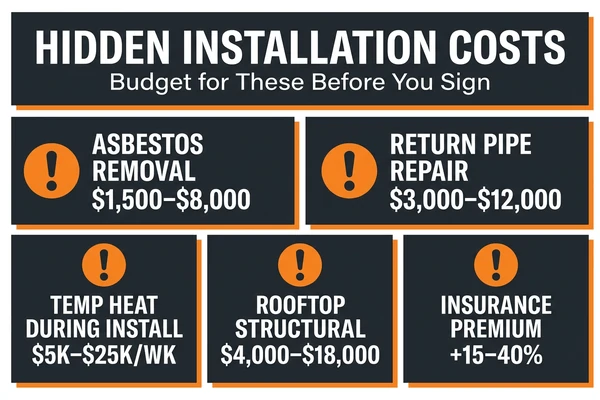
6.1 Redução de amianto
Salas de caldeiras construídas antes de 1980 geralmente apresentam isolamento de amianto de alta densidade em torno de linhas antigas. As leis estaduais e federais exigem contenção completa e remoção certificada antes do início de qualquer trabalho de substituição, adicionando $1,500 para $8,000 para o orçamento do projeto.
6.2 Correção de tubulação de retorno
Corroído, dimensionado, ou linhas de retorno de condensado mal inclinadas são o principal problema oculto em redes de vapor mais antigas. A correção de problemas de layout estrutural down-line pode custar entre $3,000 e $12,000, mas a falha em abordá-los causará um mau desempenho de aquecimento e uma vida útil mais curta do equipamento.
6.3 Vapor temporário / Redundância de Produção
Para hospitais, processadores de alimentos, e operações químicas, pausar a produção durante uma substituição não é uma opção. Alugar um sistema de vapor temporário montado em reboque custa $5,000 para $25,000 por semana. Planejar sua instalação para coincidir com as paradas anuais da planta pode minimizar ou eliminar essa despesa.
6.4 Engenharia Estrutural Especializada
O posicionamento de equipamentos em espaços apertados requer uma engenharia cuidadosa. As colocações em telhados precisam de uma revisão estrutural certificada e acesso de guindaste, custo $4,000 para $18,000. Instalações em porões apertados que exigem aparelhamento estrutural através de aberturas de fundação podem adicionar $3,000 para $10,000.
6.5 Impacto do prêmio de seguro de longo prazo
Não atender aos padrões de segurança como a NFPA 85 ou NFPA 99 pode levar a um 15% para 40% aumentar em prêmios de seguro de instalações. Garantir que sua instalação seja totalmente compatível desde o primeiro dia protege suas instalações e mantém os custos de seguro previsíveis.
Seção 7: FAQ - Perguntas frequentes
1º trimestre: Quanto custa instalação de caldeira a vapor em 2026?
Os custos de instalação de caldeira a vapor variam de $7,500 para $13,500 para sistemas residenciais, enquanto os sistemas industriais variam de $150,000 para superar $700,000+. A média nacional de substituição residencial é de $10,500, inclusive de equipamentos, trabalho, atualizações de tubulação próxima à caldeira, e licenças padrão.
2º trimestre: O que está incluído no custo de instalação da caldeira a vapor?
Uma instalação completa inclui o equipamento principal (carcaça e queimador da caldeira), fabricação de tubulação próxima à caldeira, mão de obra especializada, preparação do local (desabafar, utilitários), licenças regulatórias, configurações auxiliares (água de alimentação, condensado), e comissionamento final. Citações apenas nessa lista “equipamento + trabalho” muitas vezes sinto falta 30% para 50% do custo real do projeto.
3º trimestre: Quanto tempo leva a instalação da caldeira a vapor?
As instalações residenciais levam 2 para 5 dias se a tubulação for reutilizada, e 1 para 2 semanas para uma revisão completa do cabeçalho. Projetos industriais exigem 3 para 8 meses total, impulsionado por prazos de entrega de equipamentos de 8 para 24 semanas. Para minimizar o tempo de inatividade, encomende o seu equipamento antes de iniciar a preparação do local.
4º trimestre: Preciso de licença para instalar uma caldeira a vapor?
Sim, uma licença mecânica é exigida em quase todas as jurisdições, custo $150 para $3,000 com base na capacidade de BTU. Os sistemas industriais também exigem inspeções ASME, Testes de pilha EPA, e registro estadual de caldeira. Operar sem essas licenças pode anular apólices de seguro de propriedade.
Q5: Como posso reduzir o custo de instalação de caldeira a vapor?
Você pode reduzir custos reutilizando a tubulação existente próxima à caldeira, se ela estiver em boas condições, encomenda de equipamentos no quarto trimestre para garantir descontos por volume de fábrica, e obter três lances detalhados para evitar o aumento do escopo. Adicionalmente, agendar trabalhos durante paradas planejadas da planta evita a necessidade de aluguel temporário de caldeiras.
Q6: Qual é a parte mais cara da instalação de uma caldeira a vapor?
Para projetos residenciais, retrabalhar a tubulação próxima à caldeira costuma ser o maior custo inesperado ($3,000–$ 15.000). Para projetos industriais, aquisição de equipamentos é o maior item de linha (40% para 50% de TIC), seguido de trabalho mecânico (20% para 30% de TIC).
Conclusão & Próximas etapas
Gerenciar a instalação de uma caldeira a vapor requer o equilíbrio de vários itens de linha interconectados, em vez de rastrear uma única despesa fixa. O mais bem sucedido, projetos dentro do orçamento são aqueles que respondem por todas as oito categorias de custos bem antes da primeira cotação ser assinada.
Para manter seu projeto no caminho certo, defina claramente seu escopo operacional, garanta três lances detalhados, manter um 10% contingência financeira, e escolha um contratante com base em credenciais e referências verificadas.
Esteja você substituindo uma unidade desatualizada ou configurando uma nova instalação, Investir na caldeira a vapor certa pode fornecer benefícios de longo prazo. Se você não tem certeza de qual sistema é adequado para suas necessidades, É melhor consultar um engenheiro de aquecimento qualificado ou especialista em caldeiras, Whatsapp +86 132-1322-2805.


Vveja as avaliações do nosso cliente
"Os geradores de vapor de Fangkuai são excelentes. Eles são muito fáceis de usar e requerem manutenção mínima. O atendimento ao cliente da Fangkuai também é excepcional. Eles são muito receptivos e sempre dispostos a ajudar. A eficiência energética dos geradores de vapor também é notável, que me ajudou a economizar dinheiro em minhas contas de energia. Eu recomendo os geradores de vapor da Fangkuai."
maria
Espanha"Há anos que usamos a caldeira de óleo térmico Fangkuai para nossa fábrica de produtos químicos e ela nunca nos decepcionou. A caldeira é muito durável e pode suportar condições adversas. Também é muito fácil de operar e manter, o que nos ajudou a economizar tempo e dinheiro em manutenção. As caldeiras de óleo térmico da Fangkuai são excelentes e eu as recomendo para qualquer pessoa que precise de soluções de aquecimento confiáveis."
Chang
China"O equipamento auxiliar de Fangkuai tornou meu sistema de caldeira ainda melhor. A qualidade do equipamento é excepcional e os preços são muito razoáveis. O equipamento ajudou a melhorar a eficiência e o desempenho do meu sistema de caldeira, o que levou a uma economia significativa de custos. Eu recomendo o equipamento auxiliar da Fangkuai para qualquer pessoa que precise de acessórios de caldeira de alta qualidade."
Maryk
Reino Unido"O atendimento ao cliente da Fangkuai é excelente. Eles me ajudaram a escolher a caldeira perfeita para minhas necessidades e forneceram um ótimo suporte durante todo o processo. O processo de instalação também foi muito tranquilo e a caldeira superou minhas expectativas. É muito fácil de usar e manter, e a eficiência energética é notável. Eu recomendo os produtos da Fangkuai para qualquer pessoa que precise de soluções de aquecimento confiáveis e eficientes."
Juan
México"A caldeira a vapor da Fangkuai é perfeita para o meu negócio de processamento de alimentos. Atende a todos os nossos requisitos e é muito confiável. A qualidade dos materiais e a construção da caldeira são excepcionais. Também é muito fácil de operar e manter, o que nos ajudou a economizar tempo e dinheiro em manutenção. Eu recomendo as caldeiras a vapor da Fangkuai para qualquer pessoa que precise de soluções de aquecimento confiáveis."
json
Brasil"Os geradores de vapor de Fangkuai são excelentes. Eles são muito fáceis de usar e requerem manutenção mínima. O atendimento ao cliente da Fangkuai também é excepcional. Eles são muito receptivos e sempre dispostos a ajudar. A eficiência energética dos geradores de vapor também é notável, que me ajudou a economizar dinheiro em minhas contas de energia. Eu recomendo os geradores de vapor da Fangkuai."
maria
Espanha"A caldeira de óleo térmico da Fangkuai é muito fácil de operar e manter. Isso nos ajudou a economizar tempo e dinheiro em manutenção, o que levou a uma economia significativa de custos. A qualidade dos materiais e a construção da caldeira são excepcionais. Também é muito eficiente energeticamente, que nos ajudou a economizar dinheiro em nossas contas de energia. Eu recomendo a caldeira de óleo térmico da Fangkuai ."
Allen
Brasil"Há anos que usamos a caldeira de óleo térmico Fangkuai para nossa fábrica de produtos químicos e ela nunca nos decepcionou. A caldeira é muito durável e pode suportar condições adversas. Também é muito fácil de operar e manter, o que nos ajudou a economizar tempo e dinheiro em manutenção. As caldeiras de óleo térmico da Fangkuai são excelentes e eu as recomendo para qualquer pessoa que precise de soluções de aquecimento confiáveis."
Chang
China"O atendimento ao cliente da Fangkuai é excelente. Eles me ajudaram a escolher a caldeira perfeita para minhas necessidades e forneceram um ótimo suporte durante todo o processo. O processo de instalação também foi muito tranquilo e a caldeira superou minhas expectativas. É muito fácil de usar e manter, e a eficiência energética é notável. Eu recomendo os produtos da Fangkuai para qualquer pessoa que precise de soluções de aquecimento confiáveis e eficientes."
Juan
México