
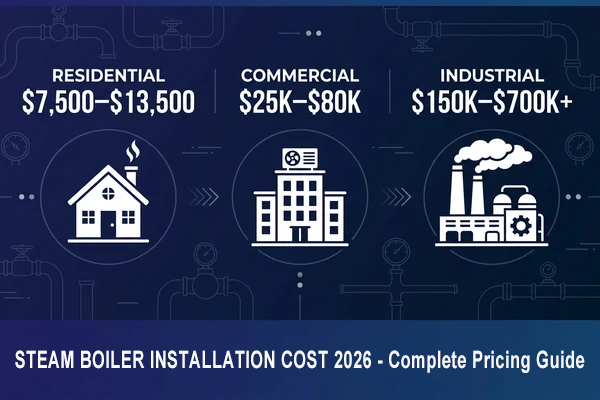
Installation Cost by Segment at a Glance
| Segment | Equipment Cost | Labor Cost | Total Installation Range |
|---|---|---|---|
| Residential (≤ 200 MBH) | $3,000 – $9,000 | $2,500 – $5,000 | $7,500 – $13,500 |
| Light Commercial (150–300 HP) | $15,000 – $50,000 | $8,000 – $20,000 | $25,000 – $80,000 |
| Industrial (500–2,000 HP) | $80,000 – $400,000 | $40,000 – $120,000 | $150,000 – $700,000 |
| Large Industrial (2,000+ HP) | $200,000 – $800,000 | $100,000 – $300,000 | $700,000 – $1,500,000+ |
Section 1: Steam Boiler Installation Cost by Segment
1.1 Residential Steam Boiler Installation Cost
Residential steam systems, while less common than hydronic (hot water) loops, remain a staple in historic homes across the Northeast and Midwest US. The typical total installation cost ranges between $7,500 and $13,500, covering equipment, local labor, and essential near-boiler piping.
- Budget Tier ($7,500 – $9,500): Applies to straight like-for-like drop-in replacements where the existing supply and return headers are in pristine condition, and no hazardous materials (asbestos) are present.
- Mid-Range Tier ($9,500 – $11,500): Involves partial remediation of the near-boiler piping, installing updated, code-compliant venting paths, and standard residential permitting fees.
- High-End Tier ($11,500 – $13,500): Required when a full replacement of the near-boiler piping system is non-negotiable. This frequently includes asbestos abatement and navigating complex, multi-story venting pathways.
The ultimate cost driver in residential projects is the quality of the near-boiler piping. Because steam expands rapidly, incorrect pipe sizes, drop headers, or poor pitch choices can cause severe water hammer, systemic short-cycling, and premature boiler failure.
How much does it cost to replace a residential steam boiler?
In 2026, the national average cost to replace a residential steam boiler is $10,500. This target baseline includes a standard mid-efficiency low-pressure steam boiler unit, full mechanical removal of the old vessel, standard code compliance permits, and essential updates to the immediate near-boiler header piping to ensure dry steam delivery.
1.2 Light Commercial Installation Cost
Light commercial operations—including multi-family apartment complexes, primary schools, and boutique manufacturing sites—rely on boilers ranging from 150 to 300 Boiler Horsepower (HP). Total installed costs fluctuate from $25,000 to $80,000.
- Equipment Allocation: $15,000 to $50,000 for the bare boiler shell and burner assembly.
- Installation Labor: $8,000 to $20,000 for rigging, placement, and pipe tie-ins.
- Permits & Compliance: $1,500 to $6,000 depending on local municipal environmental and safety codes.
- Site Preparation: $3,000 to $12,000 for fuel line adjustments and minor structural alterations.
1.3 Industrial Steam Boiler Installation Cost
Industrial Total Installed Cost (TIC) demands a massive capital commitment, generally running from $150,000 to upwards of $1,500,000+.
- Mid-Size Systems (500–2,000 HP): Average project costs land smoothly between $300,000 and $700,000.
- Large, High-Pressure Systems: Complex facilities demanding severe high pressures (>150 PSIG) alongside comprehensive auxiliary setups scale from $700,000 to $1,500,000+.
Key industrial sub-costs include specialized mechanical assembly and structural piping ($20,000–$30,000), multi-voltage electrical integration ($15,000–$25,000), thermal insulation ($4,000–$6,000), and rigorous commissioning protocols ($5,000–$10,000).
Case Study: 10-Ton/Hr Steam Boiler Project (Food Processing Facility)
- Primary Equipment: $180,000
- Auxiliary Systems (Burner, Economizer, Feedwater): $65,000
- Mechanical Installation & Field Piping: $85,000
- Compliance, Inspections & Commissioning: $32,000
- Total Final TIC: $362,000
Section 2: Full Installation Cost Breakdown — Line by Line
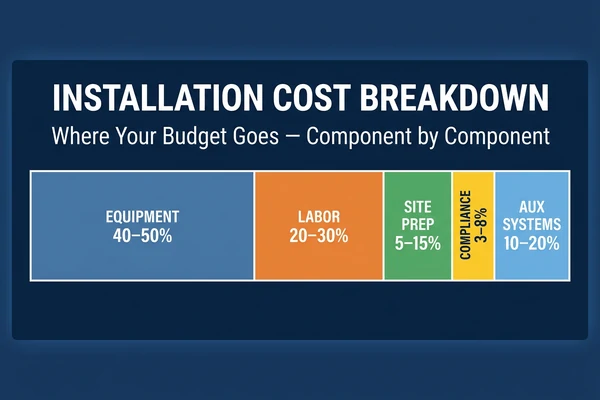
To prevent unexpected budget deviations, project managers must track the eight distinct cost categories that constitute a full steam boiler installation project.
2.1 Equipment Cost (40% – 50% of TIC)
This represents the hardware purchase price of the main mechanical systems:
- The primary pressure vessel (fire-tube, water-tube, or high-capacity electric boiler).
- The burner assembly (frequently sourced separately from the boiler shell to meet exact low-NOx emissions criteria).
- An integrated economizer or heat recovery unit, which cuts long-term fuel expenditure by 5% to 15% via flue-gas heat recapture.
- Feedwater infrastructure: the deaerator tank, high-pressure multi-stage feed pumps, and condensate return system.
- The master control panel, utilizing advanced PLC automation or seamless Building Management System (BMS) interfaces.
- [Internal Link: See our Industrial Steam Boiler Price Comparison for equipment pricing by exact HP capacity.]
2.2 Labor Cost (20% – 30% of TIC)
Field labor involves highly skilled tradespeople working under precise mechanical tolerances:
- Mechanical Assembly & Rigging: $15,000 to $45,000 on industrial footprints.
- Near-Boiler Piping Fabrication: $8,000 to $30,000 for heavy-gauge carbon steel welding and threading.
- Thermal Insulation: $4,000 to $6,000 to insulate major steam mains and the main boiler body.
- Electrical Wiring & Instrumentation: $10,000 to $25,000 for field power routing.
- Controls Programming: $5,000 to $15,000 for sequence testing and loop tuning.
- Labor Benchmarks: Standard HVAC/boiler mechanics command $65–$120/hr, while unionized journeymen in complex jurisdictions average $95–$160/hr.
2.3 Site Preparation (5% – 15% of TIC)
Before the new equipment arrives, the physical space must meet strict spatial and civil guidelines:
- Structural Reinforcement: $5,000 to $25,000 for concrete pads capable of carrying high operational weight.
- Natural Gas Line Extension: $1,200 to $8,000 to supply adequate volume and pressure.
- Electrical Infrastructure Upgrades: $3,000 to $12,000 (such as implementing 480V 3-phase power).
- Plumbing Modifications: $2,000 to $8,000 for supply water lines and high-temperature blowdown drainage.
- Exhaust Flue & Stack Installation: $3,000 to $15,000 for proper breeching layout.
- Asbestos Abatement: $1,500 to $8,000 in older residential or industrial facility basements.
2.4 Permits and Compliance (3% – 8% of TIC)
Neglecting regulatory oversight will halt operations and risk major code violations:
- Local Building & Mechanical Permits: $150 to $3,000, scaled by total BTU capacity.
- ASME Section I “S” Stamp Verification: $1,200 to $5,000 for Authorized Inspector validation.
- EPA Stack Emissions Testing: $650 to $3,500 to verify strict compliance with local air quality metrics.
- NFPA 85 Compliance Review: $2,000 to $8,000 for industrial burner safety and flame safeguards.
- State Inspection Certificate: $300 to $1,500 for the initial mandatory operational log.
What permits are required for steam boiler installation?
- Local Mechanical/Building Permit: Grants municipal authority to alter utility and structural spaces.
- ASME Manufacturer’s Data Report: Certifies the structural and welding integrity of the pressure vessel.
- Air Quality/EPA Operating Permit: Mandatory for high-input fossil fuel burners to ensure emissions limits are maintained.
- National Board/State Registration: Enters the pressure vessel into the state mandatory safety inspection database.
2.5 Auxiliary Systems (10% – 20% of TIC)
A boiler cannot run effectively in isolation; it requires a robust network of supportive equipment:
- Condensate Receivers: $3,000 to $12,000 for efficient water collection.
- Chemical Dosing Skids: $1,500 to $6,000 to prevent internal scaling and oxygen-driven pitting.
- Safety Relief Valves & Regulators: $800 to $3,000.
- Steam Flow Metering: $2,000 to $8,000 for real-time tracking of thermal efficiency.
- Blowdown Vessels: $3,000 to $10,000 to safely cool down flushed water before discharge.
2.6 Testing, Commissioning & Startup (2% – 5% of TIC)
- Hydrostatic Testing: Verifies leak-free piping containment at elevated pressures (typically covered by initial inspection costs).
- Burner Tuning & Combustion Analysis: $800 to $3,500 to optimize fuel-to-air ratios.
- Controls Loop Verification: $2,000 to $5,000 to test all automatic safety interlocks.
- Operator Training Protocols: $1,500 to $4,000 for OEM-led onboarding of operations staff.
- Performance Acceptance Testing: $2,000 to $6,000 to confirm nameplate steam output metrics.
2.7 Freight and Rigging (1% – 3% of TIC)
- Industrial Heavy Freight: $3,000 to $15,000 depending on distance and wide-load regulations.
- Crane and Specialized Rigging Crews: $2,000 to $10,000 for complex structural maneuvers.
- Custom Modular Skid Fabrication: $5,000 to $20,000 for pre-packaged, drop-in field placement.
2.8 Project Contingency (10% Recommended)
A flat 10% contingency line should always be maintained. Common drivers of unmapped expenditures include corroded sub-floor condensate lines, undersized municipal gas mains, and hidden structural concrete degradation.
Section 3: Key Factors That Determine Your Installation Cost
3.1 Boiler Capacity and Pressure Rating
As capacity increases, the required scale of auxiliary components and piping infrastructure grows proportionally. High-pressure steam systems designed for operation above 15 PSIG must strictly comply with ASME Boiler and Pressure Vessel Code (Section I). This rigorous testing, welding, and certification paradigm adds an immediate 15% to 25% premium compared to low-pressure solutions.
Rule of Thumb: Budget 1.5 × to 2.0 × the equipment cost for installation if pressure exceeds 15 PSIG.
3.2 Fuel Type Impact on Installation Cost
| Fuel Type | Install Premium | Key Cost Driver |
|---|---|---|
| Natural Gas | Baseline | Gas line extension + regulator. Most cost-effective installation pathway. |
| Propane | +5% – 10% | Dedicated external tank yard placement ($1,500–$4,000) + pressure modulation controls. |
| Heating Oil / #2 | +8% – 15% | Dual-contained storage tanks + dedicated oil pumps and environmental containment loops. |
| Biomass / Solid Fuel | +25% – 50% | Automated storage silos, complex mechanical conveyor feeds, and ash handling systems. |
| Electric | -10% – 15% | No flue gases, zero venting, and simplified structural footprint—but features high ongoing utility costs. |
3.3 New Installation vs. Retrofit vs. Replacement
- New Construction (Greenfield): High initialization costs, as all supporting structural work, main distribution loops, and utility service points must be built from scratch.
- Retrofit (Existing Boiler Room): 20% to 40% more cost-effective than greenfield setups, leveraging pre-existing distribution networks, venting points, and foundational structures.
- Like-for-Like Replacement: The lowest capital expenditure pathway, typically running 30% to 50% of a brand-new installation, provided the surrounding headers and piping elements remain structurally sound.
3.4 Location and Local Labor Market
Labor dynamics can dramatically alter financial projections. Projects staffed with unionized mechanical crews in metropolitan environments (e.g., the Northeast US or California) incur a $20 to $40 per hour premium over rural, open-shop regions. Furthermore, compliance with localized environmental regulations—such as California’s Ultra-Low NOx standards or New York’s Local Law 97—adds significant engineering and compliance oversight costs.
Section 4: The 6-Phase Steam Boiler Installation Timeline
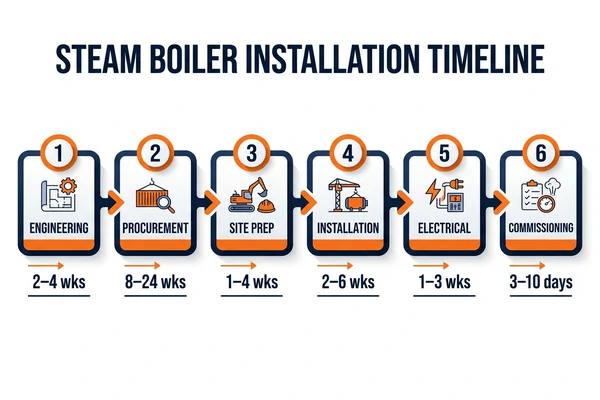
A well-planned project timeline limits operational downtime and helps coordinate sequential trade tasks.
- Phase 1: Site Survey & Engineering (2–4 Weeks)
Mechanical load verification, P&ID drafting, final vessel sizing, and spatial engineering. Estimated Allocation: $3,000 – $12,000. - Phase 2: Procurement & Factory Lead Time (8–24 Weeks)
The core window where the pressure vessel is built and tested. While standard residential replacements require just 2–4 weeks, industrial equipment routinely requires 12–24 weeks. This marks the primary capital payment milestone. - Phase 3: Civil Works & Site Preparation (1–4 Weeks)
Pouring high-strength concrete pads, updating incoming utility mains, and installing heavy breeching structures. Estimated Allocation: $5,000 – $25,000. - Phase 4: Mechanical Assembly & Rigging (2–6 Weeks)
Placing the primary vessel, welding main near-boiler steam headers, and completing auxiliary system tie-ins. This represents the peak labor expenditure window. - Phase 5: Electrical & Controls Integration (1–3 Weeks)
Field power routing, instrument wiring, BMS link configuration, and implementing flame safety interlocks. Estimated Allocation: $10,000 – $25,000. - Phase 6: Commissioning, Testing & Handover (3–10 Days)
Conducting the official hydrostatic test, executing combustion analysis, conducting staff safety training, and securing final inspector sign-offs. Estimated Allocation: $3,000 – $12,000.
Section 5: How to Minimize Steam Boiler Installation Cost
5.1 Write a Definitively Documented Scope of Work
Do not approach mechanical vendors with vague parameters. Explicitly state your required operational HP, fuel configurations, Maximum Allowable Working Pressure (MAWP), emissions ceilings, and required ASME stamps. Defining whether headers will be reused or completely fabricated anew ensures apples-to-apples bid balancing and eliminates mid-project change orders.
5.2 Execute the Three-Bid Rule
Acquire a minimum of three detailed bids: one from an OEM-authorized field team, one from an established independent regional specialist, and one from a major mechanical contracting firm. Demand line-by-line cost tracking rather than aggregate lump-sum quotes. Any bid that lands 20% below the median should be scrutinized, as it typically omits necessary permitting, commissioning, or piping details.
5.3 Leverage Strategic Procurement Timing
Plan equipment procurement for the fourth quarter (October–December). Industrial boiler manufacturers frequently offer year-end volume promotions, reducing equipment costs by 8% to 15%. Crucially, avoid waiting for an unexpected system failure; emergency installations carry premium labor rates and expedited freight fees that can drive up costs by 20% to 35%.
5.4 Bundle Installation with a Preventive Maintenance Agreement
Negotiating a 3-year preventive maintenance contract during the initial installation phase can secure an immediate $2,000 to $6,000 reduction in ongoing service rates. This approach guarantees priority field dispatch and preserves your extended OEM structural warranty.
5.5 Maximize Component Reuse Potential
If your existing near-boiler piping is under 10 years old, properly configured, and free of internal scaling, keeping it can save $4,000 to $15,000 in fabrication costs. Similarly, existing exhaust breeching stacks can be retained if your new boiler’s BTU output falls within 20% of the previous equipment’s parameters.
Section 6: Hidden Costs Buyers Frequently Miss
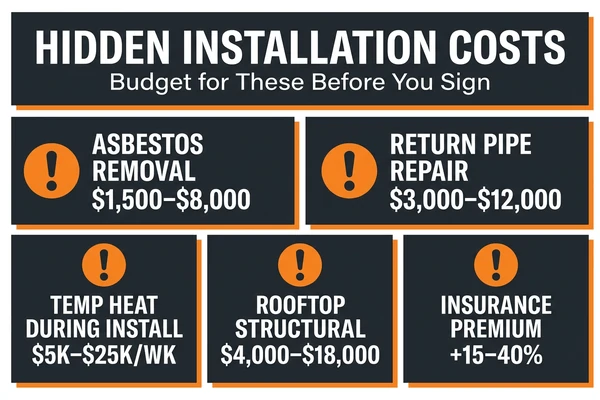
6.1 Asbestos Abatement
Boiler rooms built prior to 1980 often feature high-density asbestos insulation around old lines. State and federal laws mandate complete containment and certified removal before any replacement work begins, adding $1,500 to $8,000 to the project budget.
6.2 Return Piping Remediation
Corroded, scaled, or poorly pitched condensate return lines are the top hidden issue in older steam networks. Correcting structural layout problems down-line can cost between $3,000 and $12,000, but failure to address them will cause poor heating performance and shortened equipment lifespans.
6.3 Temporary Steam / Production Redundancy
For hospitals, food processors, and chemical operations, pausing production during a replacement is not an option. Renting a trailer-mounted temporary steam system costs $5,000 to $25,000 per week. Planning your installation to coincide with annual plant shutdowns can minimize or eliminate this expense.
6.4 Specialized Structural Engineering
Positioning equipment in tight spaces requires careful engineering. Rooftop placements need a certified structural review and crane access, costing $4,000 to $18,000. Tight basement installations that require structural rigging through foundation openings can add $3,000 to $10,000.
6.5 Long-Term Insurance Premium Impact
Failing to meet safety standards like NFPA 85 or NFPA 99 can lead to a 15% to 40% increase in facility insurance premiums. Ensuring your installation is fully compliant from day one protects your facility and keeps insurance costs predictable.
Section 7: FAQ — Frequently Asked Questions
Q1: How much does steam boiler installation cost in 2026?
Steam boiler installation costs range from $7,500 to $13,500 for residential systems, while industrial systems range from $150,000 to over $700,000+. The national residential replacement average stands at $10,500, inclusive of equipment, labor, near-boiler piping updates, and standard permits.
Q2: What is included in steam boiler installation cost?
A complete installation includes the core equipment (boiler shell and burner), near-boiler piping fabrication, specialized labor, site preparation (venting, utilities), regulatory permits, auxiliary setups (feedwater, condensate), and final commissioning. Quotes that list only “equipment + labor” often miss 30% to 50% of the project’s true cost.
Q3: How long does steam boiler installation take?
Residential installations take 2 to 5 days if piping is reused, and 1 to 2 weeks for a full header overhaul. Industrial projects require 3 to 8 months total, driven by equipment lead times of 8 to 24 weeks. To minimize downtime, order your equipment before starting site preparation.
Q4: Do I need a permit to install a steam boiler?
Yes, a mechanical permit is required in nearly all jurisdictions, costing $150 to $3,000 based on BTU capacity. Industrial systems also require ASME inspections, EPA stack tests, and state boiler registration. Operating without these permits can void property insurance policies.
Q5: How can I reduce steam boiler installation cost?
You can reduce costs by reusing existing near-boiler piping if it is in good condition, ordering equipment in Q4 to secure factory volume discounts, and getting three itemized bids to prevent scope creeping. Additionally, scheduling work during planned plant shutdowns avoids the need for temporary boiler rentals.
Q6: What is the most expensive part of installing a steam boiler?
For residential projects, reworking the near-boiler piping is often the largest unexpected cost ($3,000–$15,000). For industrial projects, equipment procurement is the largest single line item (40% to 50% of TIC), followed by mechanical labor (20% to 30% of TIC).
Conclusion & Next Steps
Managing a steam boiler installation requires balancing multiple interconnected line items rather than tracking a single flat expense. The most successful, on-budget projects are those that account for all eight cost categories well before the first quote is signed.
To keep your project on track, clearly define your operational scope, secure three itemized bids, maintain a 10% financial contingency, and choose a contractor based on verified credentials and references.
Whether you’re replacing an outdated unit or setting up a new facility, investing in the right steam boiler can provide long-term benefits. If you are unsure which system is right for your needs, it is best to consult a qualified heating engineer or boiler expert, WhatsApp +86 132-1322-2805.


View Reviews of our Customer
"I purchased a Fangkuai steam boiler for my factory and it has been working flawlessly for months now. The quality of the materials and the construction of the boiler are impressive. It is also very energy efficient, which has helped us save money on our energy bills. I highly recommend Fangkuai's products to anyone in need of reliable and efficient heating solutions."
John
USA"The steam boiler from Fangkuai is perfect for my food processing business. It meets all of our requirements and is very reliable. The quality of the materials and the construction of the boiler are exceptional. It is also very easy to operate and maintain, which has helped us save time and money on maintenance. I highly recommend Fangkuai's steam boilers to anyone in need of reliable heating solutions."
Json
Brazil"The customer service at Fangkuai is top-notch. They helped me choose the perfect boiler for my needs and provided great support throughout the process. The installation process was also very smooth and the boiler has exceeded my expectations. It is very easy to use and maintain, and the energy efficiency is remarkable. I highly recommend Fangkuai's products to anyone in need of reliable and efficient heating solutions."
Juan
Mexico"Fangkuai's steam generators are excellent. They are very easy to use and require minimal maintenance. The customer service at Fangkuai is also exceptional. They are very responsive and always willing to help. The energy efficiency of the steam generators is also remarkable, which has helped me save money on my energy bills. I highly recommend Fangkuai's steam generators."
Maria
Spain"The steam generator from Fangkuai is perfect for my small business. It is very easy to use and requires minimal maintenance. It is also very energy efficient, which has helped me save money on my energy bills. The customer service at Fangkuai is also excellent. They are very responsive and always willing to help. I highly recommend Fangkuai's steam generators."
Ahmed
Egypt"I purchased a Fangkuai steam boiler for my factory and it has been working flawlessly for months now. The quality of the materials and the construction of the boiler are impressive. It is also very energy efficient, which has helped us save money on our energy bills. I highly recommend Fangkuai's products to anyone in need of reliable and efficient heating solutions."
John
USA"The steam generator from Fangkuai is perfect for my small business. It is very easy to use and requires minimal maintenance. It is also very energy efficient, which has helped me save money on my energy bills. The customer service at Fangkuai is also excellent. They are very responsive and always willing to help. I highly recommend Fangkuai's steam generators."
Ahmed
Egypt"The customer service at Fangkuai is top-notch. They helped me choose the perfect boiler for my needs and provided great support throughout the process. The installation process was also very smooth and the boiler has exceeded my expectations. It is very easy to use and maintain, and the energy efficiency is remarkable. I highly recommend Fangkuai's products to anyone in need of reliable and efficient heating solutions."
Juan
Mexico"I purchased a Fangkuai steam boiler for my factory and it has been working flawlessly for months now. The quality of the materials and the construction of the boiler are impressive. It is also very energy efficient, which has helped us save money on our energy bills. I highly recommend Fangkuai's products to anyone in need of reliable and efficient heating solutions."
John
USA